In Conversation with Mona Taha
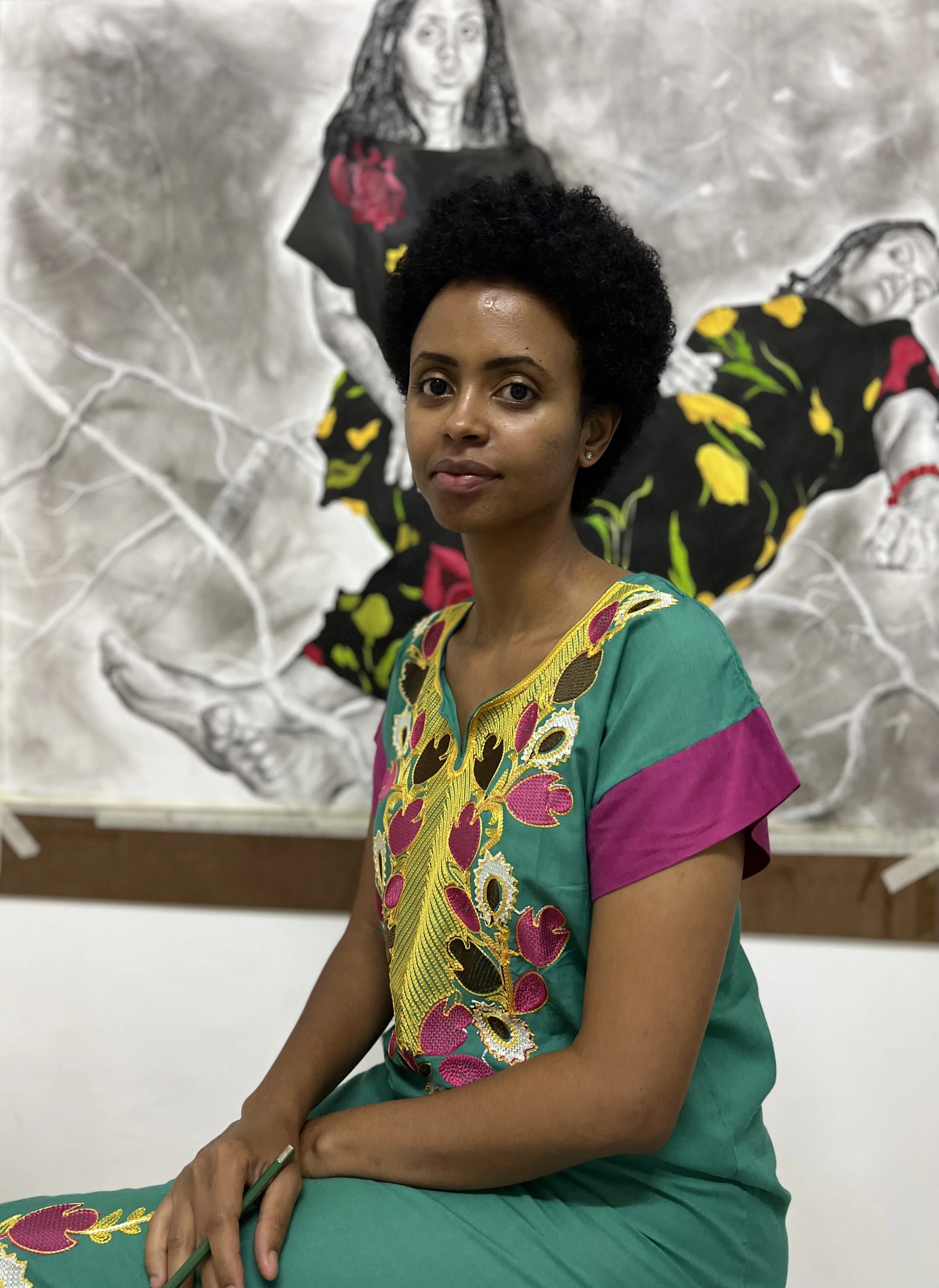
Courtesy of Mona Taha and Afriart Gallery
Mona Taha b. 1988 in Uganda Nationality: Ugandan Current Residence: Kampala, Uganda. Mona Taha’s practice moves fluidly between drawing and painting, and across different media such as charcoal, ink, gouache, watercolor, and collage, among others. Her work is both figurative and atmospheric, balancing a distinctive sensuality with a raw, unguarded honesty. Process and material are central to her work. She often works intuitively, letting fluid mediums spread, stain, and settle unpredictably while building compositions through layering, interruption, and response. Collage, often composed of offcuts and remnants from earlier works, plays a central role in her recent practice. It introduces fragments that simultaneously conceal and disclose, suggesting incompletion and rupture as generative forces. Rooted in autobiography, her work explores identity, femininity, self-discovery, and transformation.
For Taha, making art is a therapeutic process that allows space for reflection, confrontation, and growth. While earlier works often centered on portraiture and the body as sites of inquiry, her recent paintings expand this exploration outward. Figures appear embedded within their environments, dissolving into and emerging from landscapes that act not as backdrop but as presence and structure.
Taha’s work continues to evolve as an intimate yet expansive exploration of selfhood. It opens toward broader ideas of connection, resilience, and renewal. Through this, she encourages deeper self-awareness and a reclamation of identity, especially for women navigating the tension between societal expectations and inner truth. She has shown her work in Surfaces (Afriart Gallery, 2019), Where the Wild Things are (Afriart Gallery, 2022), Echo (Jenkins Johnson Projects NYC, 2022), Shapes of Water (Afriart Gallery, 2023), and Eastern Voices: Contemporary Art from East Africa (Addis Fine Art, London, 2023). Besides, she has participated in Art Basel Miami Beach, Liste Art Fair Basel, Art Paris, 1-54 Contemporary African Art Fair New York and London, Art X Lagos, Abu Dhabi Art, and FNB Joburg.
I had the pleasure of asking Mona about her newest exhibition, the advantages and disadvantages of being a self-taught artist, and so much more.
UZOMAH: Would you consider being anything other than an artist? Do you see being an artist as a calling?
MONA: I don’t know if I’d consider anything else but an artist; it’s a language that comes easily to me and gives back to me; however, there are things I’d like to do that I find interesting, maybe those I’d consider as passion projects. I do think of art as a vessel to communicate, and I suppose that would make it a calling, but it’s not like you just wake up and you’re an artist; it takes a lot of work to help this seed that was planted grow and thrive. A lot of renewing your vows.

Mona Taha, Resting Place, 2026, Ink, watercolor, acrylic on paper collage, 74.5x58cm, ©Mona Taha, Courtesy of Afriart Gallery and the Artist.
U: If possible, can you describe the purpose of art and what it means to you and society?
M: It started off being something that was therapeutic to me, to refemotionst emotions, but I’ve generally always been enthusiastic about art, both technically and conceptually. It served as a window into people’s lives and experiences. Art serves different purposes; it’s a reflection, but also an escape from the mundane, it’s a voice for the parts of us we seek to understand.
As a self-taught artist, I work in a wide range of media, including charcoal, ink, and collage. How did you begin your career as an artist? Can you recall the moment you wanted to be an artist?
I think every kid wants to be some kind of artist. I’d like to think I consciously thought about it when I took art classes in high school, but unfortunately, I had no role models to look up to to provide guidance on how to get there. It wasn’t generally a career that was encouraged. So I meandered for years before I could finally find my way to it.
U: What are some advantages of being a self-taught artist? Are there any disadvantages?
M: Well, I’ve had these conversations with artists who were taught in art institutions at the university level, and they always seemed to suggest that being self-taught gave you the advantage of a more unique take on technique, by preserving instinct. However, if I could go back, I’d have loved to have been surrounded by an art community much earlier, different mediums, and live models. I still sought knowledge on drawing from online art spaces, so no one is entirely self-taught, perhaps maybe it gave me the time to develop at my own pace.
U: How can more African visual artists like you gain more attention in the contemporary art world?
M: I..., in particular, was helped by an artist development program called Surfaces, run by Afriart gallery, which introduces artists with potential to the idea of conceptual art and helps them understand their chosen mediums. I think programs like these assist artists by opening them up to the world of art, galleries, and networks. Artist-run incubator spaces, as well, are vital as they place an emphasis on the artist’s process rather than being result-oriented. The artists have access to studio space, networks, and information to guide their practices. We have to think local so as to develop an artist ecosystem that supports each other.

Mona Taha, Rahma ( Mercy_ also Womb), 2025, Mixed media and cutouts on paper, 69.5x47cm, ©Mona Taha, Courtesy of Afriart Gallery and the Artist.
U: With such a high-tension climate politically in the world today, how can your art be a means of change in how people see a woman from a Muslim background, and who is a daughter and mother?
M: My hope is that the art provides the viewer with an opportunity to see us as humans first, with aspirations, dreams, but also capture our womanhood, our sensuality, and resilience while navigating different roles, which are shared experiences across borders. With that, there is a shift in the idea of a Muslim woman depicted in the narrow political or religious archetypes often found in mainstream media.
U: What is a day in the studio like for you? Do you have a set routine?
M: I work daylight hours so I can have enough time when my boys get back from school. I prepare myself mentally, directing my focus in the space I’m in, trying to get a feel of the work, and then I’m lucky if I find a great podcast that can push me through. I think it’s easy if you enjoy the work you do, it keeps you curious and challenges you.
U: Can an artist separate itself from politics, or is it something that gives art a dual existence, both as a societal expression and a personal one of the artist who makes said art?
M: I don’t think art can exist in a vacuum; it’s often a reflection of the artist’s observed experience. For me, it was always defined by personal experiences. Even when the themes seem to have nothing to do with politics, perhaps it is that the art seeks respite on an unconscious level, or withdrawal from corrupted systems, or that the work reflects an existing class system, which is a socioeconomic aspect.

Mona Taha, Barakah (Abundance_ Bounty), 2025, Ink, watercolor, and acrylic on paper collage, 72x56cm, ©Mona Taha, Courtesy of Afriart Gallery and the Artist.
U: If you could go back in time and trade places with any artist, who would you pick and why?
M: I think I was always drawn to Georgia O'Keeffe, to have become such an icon during a time when women were not widely recognized as professional artists. Not only that, but to not abide by what was regarded as popular art at that time, but to set her own trail and create what she personally was drawn to, the richness of the color and the abstraction of form, from her environment. I think a part of me also romanticizes the idea of leaving all the ‘noise’ behind and moving away to some place where I can give myself totally to observing the landscape and nature, as she did.
U: Your art draws on inspiration and a stunning approach to fluidity that tells not just a story but also mirrors themes universal to all women, appealing even to men seeking to understand more about the female journey. Can you discuss how you applied some of your core themes as an artist in your recent exhibition, A Walk in Makindye, at Afriart Gallery?
M: The art was born out of my own introspection, which happens during quiet walks I take in the neighborhood, which allowed me to pause and reflect on my own inner landscape, hence becoming one with nature all around. These walks renewed my spirit amidst everything going on around, in the news, and in life, which I like to present through the exploration of color and the fluidity of the mediums that bring a soft quality to the pieces. The unpredictability of the washes and the use of fragments suggests the existence of the ambiguity of life itself, past experiences that shaped us, and the different parts of identity within us. The walk itself shows a commitment to oneself through resilience, acceptance, and hope, believing that beauty still exists around us.
U: What is next for you after the exhibition?
M: I continue on the journey to explore, be curious, and open-minded in my practice.
For more information about Mona’s work, please follow her on Instagram here. The magazine did a feature on her exhibition, which can be found here. Along with an interview with the curator Daudi Karungi, available here.