Mona Taha: A Walk in Makindye

Mona Taha, Barakah (Abundance_ Bounty), 2025, Ink, watercolor, and acrylic on paper collage, 72x56cm, ©Mona Taha, Courtesy of Afriart Gallery and the Artist.
Afriart Gallery is pleased to present A Walk in Makindye, a new body of work by Mona Taha. This new body of work emerges from repeated walks through Makindye, the Kampala neighborhood where she moves between home and studio along quiet roads lined with trees, undergrowth, birds, and small animals. In these daily passages through a green and lived-in part of the city, observation becomes ritual. Walking becomes a way of looking, and looking becomes a way of returning to the self.
This body of work also emerges from a period of pause within the artist’s practice. After several years of consistent production and public presentation, Taha stepped away from exhibiting for over a year, turning instead toward research, reflection, and a more private process of self-inquiry. During this time, she revisited materials, experimented with new combinations of mediums, and allowed herself to work without the immediate pressures of exhibition or outcome. The paintings presented here are the result of that interval of quiet exploration works that grow out of a renewed attentiveness to process, to observation, and to the subtle ways in which inner experience finds form in the natural world around her.


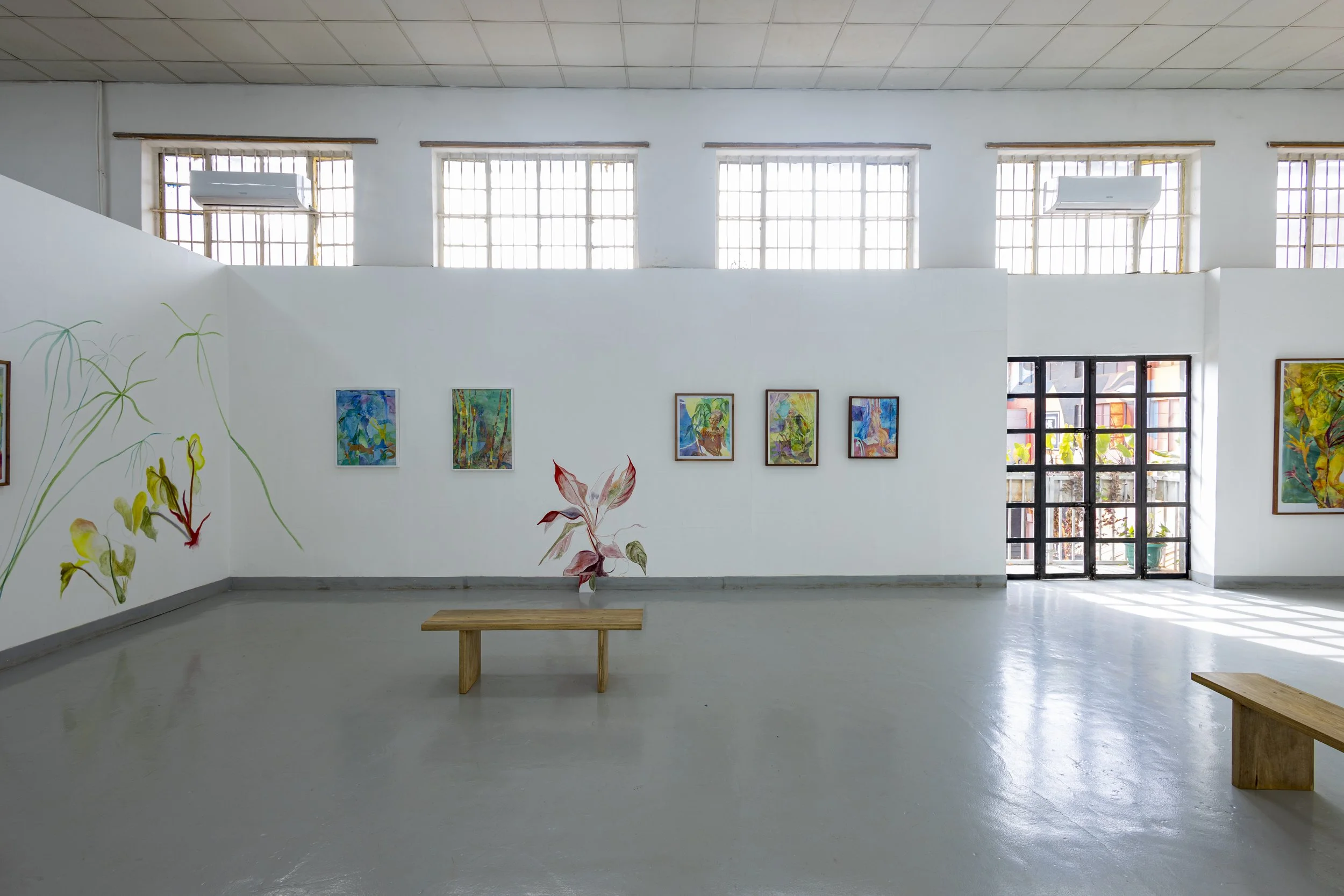


INSTALLATION VIEW: A Walk in Makindye, Mona Taha, Courtesy of Afriart Gallery 2026, Photo by James Wasswa
Alongside her visual practice, Taha maintains a close relationship with poetry, both reading and writing it regularly. The reflective tone in her paintings often echoes the structure of a poem built through fragments, pauses, and subtle shifts in atmosphere rather than direct narrative. Much like poetry, her compositions allow meaning to unfold gradually through layers of color and gesture, creating a contemplative space that invites viewers to slow down and reflect.
Yet these works are not simple celebrations of landscape. They do not present nature as scenery, nor as escape in any naïve sense. Instead, Taha approaches nature as a space of reorientation: a place where the self can soften, unravel, and be reassembled. In a time marked by speed, overload, uncertainty, and emotional fatigue, this gesture becomes especially resonant. These paintings do not deny the chaos of contemporary life; they propose another rhythm within it.

Mona Taha, Rahma ( Mercy_ also Womb), 2025, Mixed media and cutouts on paper, 69.5x47cm, ©Mona Taha, Courtesy of Afriart Gallery and the Artist.
Working with watercolor, ink, coffee, tea, and collage, Taha builds images through accumulation, staining, interruption, and response. Her process allows fluid materials to spread, pool, fade, and settle with a degree of unpredictability. Rather than imposing total control, she collaborates with the medium, letting it generate its own atmosphere and logic. This openness is central to the work: form is not fixed from the beginning, but discovered through process.
The collage elements intensify this language. Often made from fragments, offcuts, and remnants of earli er works, they introduce a visual structure of rupture and return. These strips do not merely decorate the image; they act like interruptions, membranes, or thresholds across the picture plane. They obscure and reveal. They divide and connect. Through them, fragments that once seemed discarded are brought back into relation, suggesting that brokenness, excess, and incompletion can themselves become generative.

INSTALLATION VIEW: A Walk in Makindye, Mona Taha, Courtesy of Afriart Gallery 2026, Photo by James Wasswa
This is especially significant in the treatment of the figure. Taha’s subjects do not dominate the landscape; they seem to emerge through it and with it. Their bodies share the tonal atmosphere of the surrounding space, at times nearly dissolving into washes of greens, blues, and earthen color. The human form becomes porous, held within an ecology rather than standing apart from it. In these works, nature is not the background. It is a structure, a presence, and a companion.

Mona Taha, Resting Place, 2026, Ink, watercolor, acrylic on paper collage, 74.5x58cm, ©Mona Taha, Courtesy of Afriart Gallery and the Artist.
If Taha’s earlier practice often centered the self through portraiture and interior searching, this body of work marks a subtle but important shift. A self-taught artist with a background in economics, Taha initially turned to drawing as a way of navigating questions of identity and personal experience. Many of her early works took the form of self-portraits, using the human face and body as sites through which to explore emotion, vulnerability, and transformation. These portraits often reflected moments of introspection, grappling with personal change, the complexities of motherhood, and the evolving understanding of self within the rhythms of everyday life.
While the inquiry into selfhood remains central to her practice, it is no longer held solely within the face or body. In this new body of work, that exploration expands outward into the surrounding environment into light, vegetation, atmosphere, and the organic rhythms of the natural world. The figure is no longer isolated as the primary subject but becomes part of a wider ecology of forms and sensations. What emerges is a visual language of abundance, but not excess; of beauty, but not decoration; of softness, but not passivity, suggesting a practice that continues to grow from personal reflection while opening itself to a broader sense of connection and renewal.

INSTALLATION VIEW: A Walk in Makindye, Mona Taha, Courtesy of Afriart Gallery 2026, Photo by James Wasswa
Looking at these new works, I felt that they resonate with a longer art historical lineage in which artists have approached nature as a symbolic language for inner life. In the late nineteenth century, figures associated with Symbolism, such as Odilon Redon and Gustav Klimt, turned to atmosphere, landscape, and the human figure to evoke psychological and spiritual states rather than simply depict the visible world. This sensibility continued across the twentieth and twenty-first centuries through artists who explored the relationship between the body, the environment, and the unseen dimensions of experience from the metaphysical investigations of Hilma af Klint and the intimate landscapes of Georgia O’Keeffe to the layered and fragmented figuration of Wangechi Mutu. Within this broader lineage, Taha’s work contributes a contemporary voice in which nature, material process, and the human figure become intertwined sites of reflection and renewal.
In the context of today’s world with its wars, digital saturation, private anxieties, and collective disorientation, these works feel quietly urgent. They return us to the possibility that restoration may begin in attention: in walking, in pausing, in re-entering the more-than-human world with humility. Taha’s paintings offer no grand solution. What they offer instead is something rarer: an image of coexistence, of slowness, and of the self not as sealed or isolated, but as something capable of being remade through contact, care, and presence.
Taha treats nature not as a place one visits, but as a condition through which one becomes visible again. In this sense, the works invite us quietly and without insistence to take a walk of our own.
For more information about this exhibition, please visit the gallery’s site here. The gallery can also be found on Instagram and Artsy. The magazine did an interview with the artist Mona Tahaa, which can be found here. Along with an interview with the curator Daudi Karungi, available here.