In Discussion with Daudi Karungi
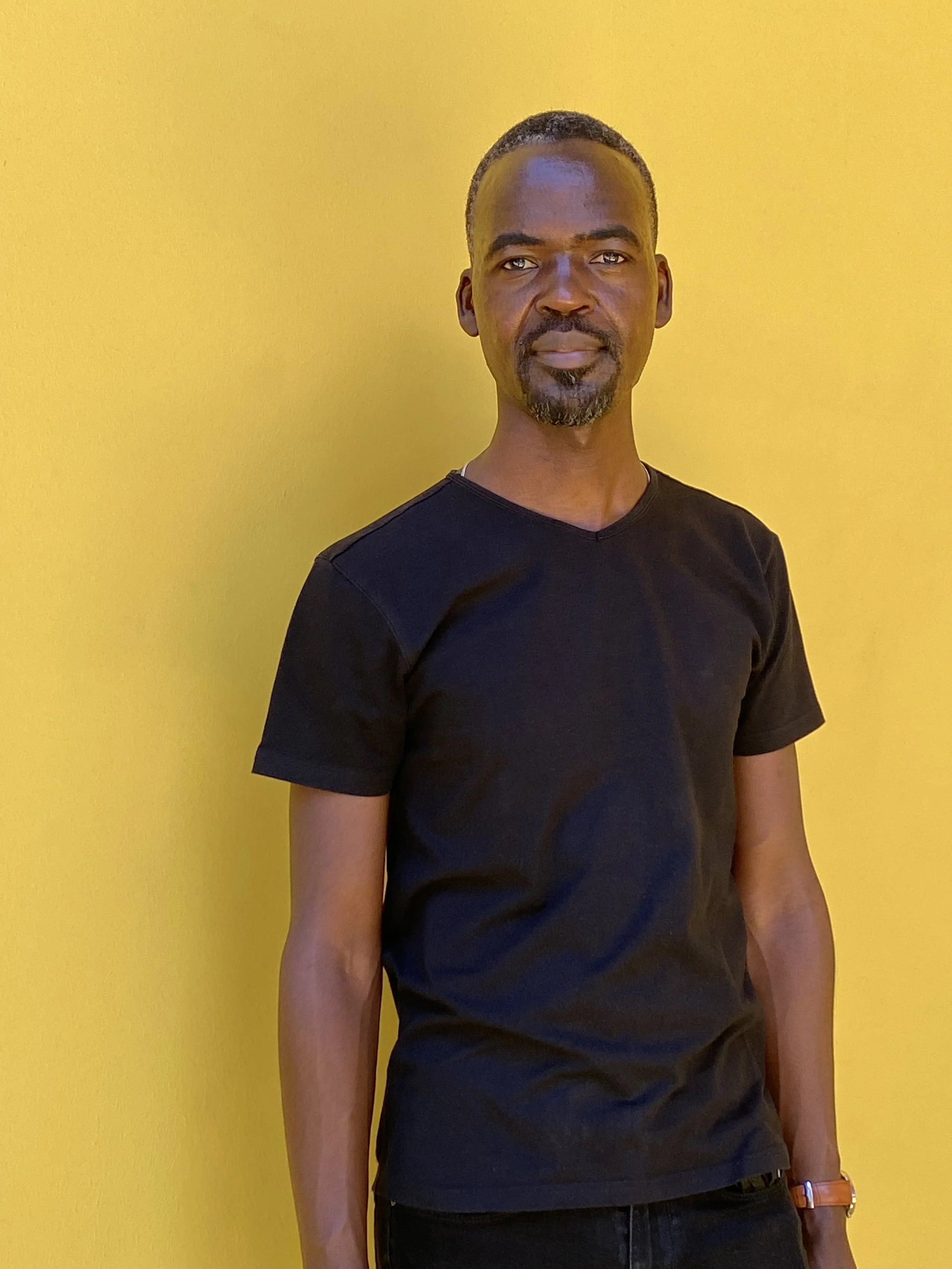
Photo Credit: Charlene Komuntale
Daudi Karungi (b. 1979, Kampala, Uganda) is a catalyst for contemporary African art, widely recognized for his visionary leadership and commitment to building sustainable cultural infrastructures across the continent. He is the founder and director of Afriart Gallery (est. 2002), a leading contemporary art gallery based in Kampala that represents some of Africa’s most influential artists and regularly participates in major international art fairs, including Art Basel Miami Beach, Art X Lagos, and LISTE.
Karungi’s work spans beyond commercial representation. He is the founder of the Silhouette Art Foundation, a Kampala-based non-profit dedicated to collecting, archiving, and sharing knowledge through publishing, think tanks, mobility support, and research-based programming. Silhouette’s work focuses on unlearning inherited narratives, encouraging critical thought, and shaping sustainable, self-defined futures for African art.
Earlier in his career, Karungi co-founded the Kampala Arts Trust (KART) and launched the Kampala Art Biennale, both of which contributed significantly to Uganda’s emerging contemporary art scene by fostering critical dialogue and international exchange.
A former practicing artist (2002–2016) with a background from the Margaret Trowel School of Industrial and Fine Arts at Makerere University, Karungi brings both creative and curatorial depth to his work. He is a founding board member of the Contemporary Art Society of Uganda (CASU) and a regular contributor to global conversations on African art ecosystems. His work has been featured in The New York Times, The Art Newspaper, and at forums such as Talking Galleries (New York Edition).
I had the pleasure of asking Daudi how he determines when a show has been successfully curated, what his favorite aspect of producing his and Mona’s current exhibition, and so much more.
UZOMAH: What inspires you most about curating, and what do you see as its most important task?
DAUDI: For me, curating begins in close proximity to the artist and the work. It emerges through sustained engagement, studio visits, conversations over time, and careful witnessing of how ideas take material form. Inspiration does not come from an abstract concept, but from observing how an artist thinks through making.
The task of curating, then, is not simply to present work but to translate it by creating the conditions in which an artist’s ideas can be encountered with clarity and depth. It is a process of mediation between artist and audience, as well as of positioning the work within a broader field of meaning, so that it resonates beyond its immediate context.
U: In your experience, how does a curator collaborate with an artist to build a solid show?
D: Collaboration requires proximity, but more importantly, trust. A strong exhibition emerges when the artist feels that the curator understands not only the work, but the thinking and sensibility behind it.
This kind of trust is built over time through dialogue, through looking, and through a shared commitment to the integrity of the work. The curator’s role is not to impose structure, but to sharpen and extend what is already present, allowing the exhibition to articulate the work in its most precise and compelling form.
U: How do you determine when a show has been successfully curated?
D: A successful exhibition is not only resolved visually, but it is also resolved conceptually and experientially. It is when the artist, the curator, and the audience arrive at a shared sense that the work has been translated with clarity and intention.
You feel it in the coherence of the space, in the way the works speak to each other, and in the way audiences are able to enter the work, whether intellectually, emotionally, or intuitively. Success is when the exhibition produces a meaningful encounter, one that lingers beyond the space itself.
U: How was your experience working with Mona for the most recent exhibition?
D: Mona developed this body of work over the course of a year, and through regular studio visits, I witnessed a significant shift in her practice. There was a deepening, both materially and conceptually, in how she approached collage, her use of ink, and the layering of imagery.
What was particularly striking was how the work began to operate on a more internal, almost spiritual level. The exhibition was not initially conceived as such, but as the body of work developed, it became clear that it carried its own internal logic and coherence. Curating the show was, in many ways, about recognizing that moment and creating the space for it to be fully realized.
U: Can you share your curatorial philosophy? How do you implement it with each artist and space?
D: My curatorial approach is grounded in attentiveness to the artist, to the work, and to the context in which it will be encountered. I begin by asking what the work requires, rather than applying a fixed framework.
Each project demands its own methodology. Some works require restraint; others require a more active structuring of space and narrative. Implementation becomes a process of careful calibration, selection, and spatial relationships so that the exhibition does not overwhelm the work, but allows it to unfold with clarity. At its core, my philosophy is about enabling the work to speak fully, while situating it within a broader conversation that extends its reach.
U: How do you balance what the artist wants with the gallery’s goals when planning a show?
D: Ideally, there is no tension to resolve because the relationship begins with alignment. A gallery chooses to work with an artist because it believes in the work, and the artist engages the gallery because they trust its ability to support and position that work.
From there, it becomes a process of negotiation and clarity to ensure that both artistic integrity and the broader ambitions of the gallery are held in balance. When that alignment is present from the beginning, the exhibition becomes a shared project rather than a compromise.
U: How did you and Mona ensure your goals aligned for a show you both enjoyed?
D: Mona was interested in presenting this body of work, particularly to a Ugandan audience, and I had spent enough time with the work to understand its internal logic and significance. Our alignment came from a shared commitment to presenting the work with care and sincerity, allowing it to be encountered on its own terms while also shaping the conditions for that encounter. Once that mutual understanding was established, the process unfolded with a sense of ease and clarity.
U: What was your favorite aspect of producing this exhibition?
D: The installation was the most compelling part of the process. Having encountered the works primarily in the studio, unframed and in isolation, there was an element of uncertainty in how they would translate into the gallery space.
That moment of transition when the works are framed, placed, and begin to relate to one another spatially, is where the exhibition truly comes into being. Inviting Mona to extend the work onto the walls through mural-like interventions further activated the space, creating a continuity between the works and their environment.
I value that moment of not fully knowing, and then gradually arriving at a resolution.
U: What’s next for you? Any projects you're excited about?
D: I am currently working on two exhibitions this year. Having taken some time away from curating, returning to it now feels particularly engaging.
There is a renewed interest on my part in how exhibitions can function not just as presentations but as spaces of thought, where artists, audiences, and ideas come into meaningful relation.
For more information about this exhibition, please visit the Gallery’s site here. The magazine also did an interview with Mona, which can be found here. The feature of the exhibition can be found here, in the magazine.