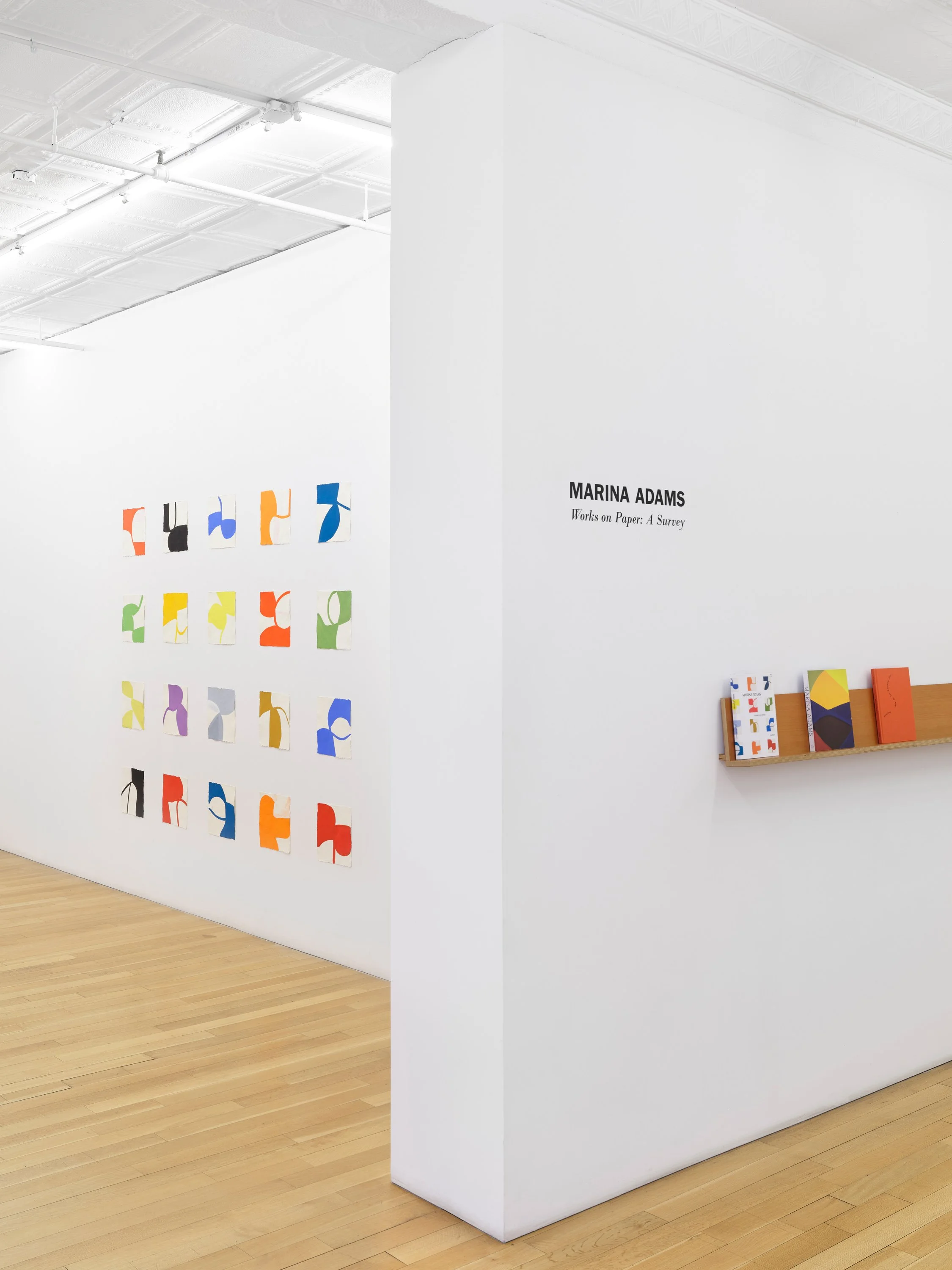
Marina Adams: Works on Paper: A Survey
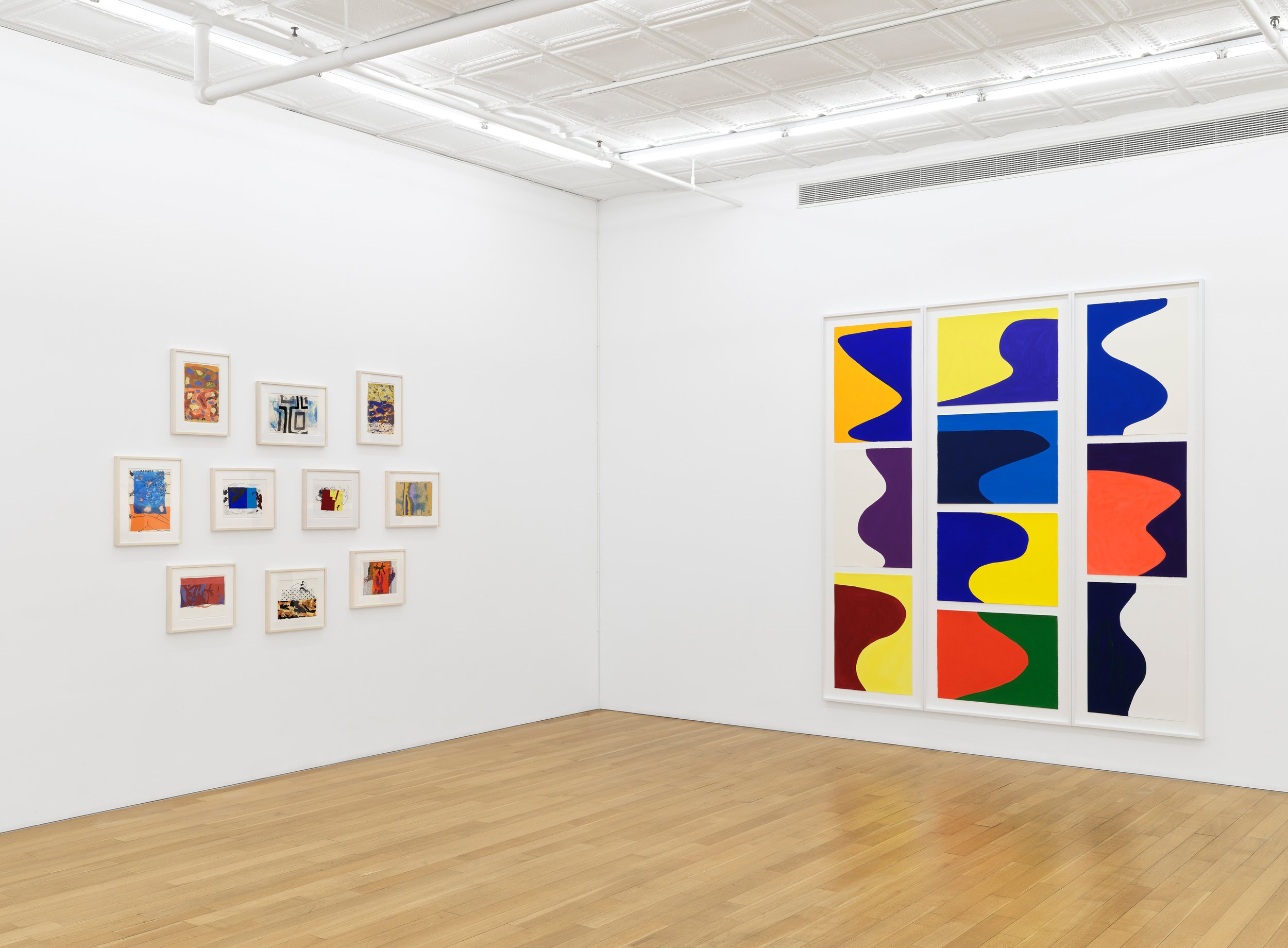
Installation view, Marina Adams: Works on Paper: A Survey, April 9, 2026 – May 29, 2026, Peter Blum Gallery, New York. Photo: Courtesy of the artist and Peter Blum Gallery
Marina Adams’s latest solo exhibition, “Works on Paper: A Survey” at Peter Blum Gallery in downtown New York, features over three decades of works on paper by the New York-based artist, yet resists the tidy logic of a retrospective. Rather than presenting a linear progression, the exhibition unfolds as something closer to a feedback loop, where forms, gestures, and decisions echo forward and backward across the artist’s career. What emerges is not a narrative of refinement, but one of continual return: a practice that seems to rediscover itself in real time.
Paper, here, is not secondary to painting but foundational to it. As Adams herself suggests, one work leads to another, and nowhere is that recursive energy more visible than in the sheer range of materials on view. What initially reads as a survey of works on paper quickly destabilizes into something more expansive: oil, acrylic, watercolor, gouache, crayon, and collage coexist without hierarchy, each medium treated as provisional, interchangeable, and alive. The result is a body of work that feels less medium-specific than process-driven—an evolving system in which material is simply another variable.
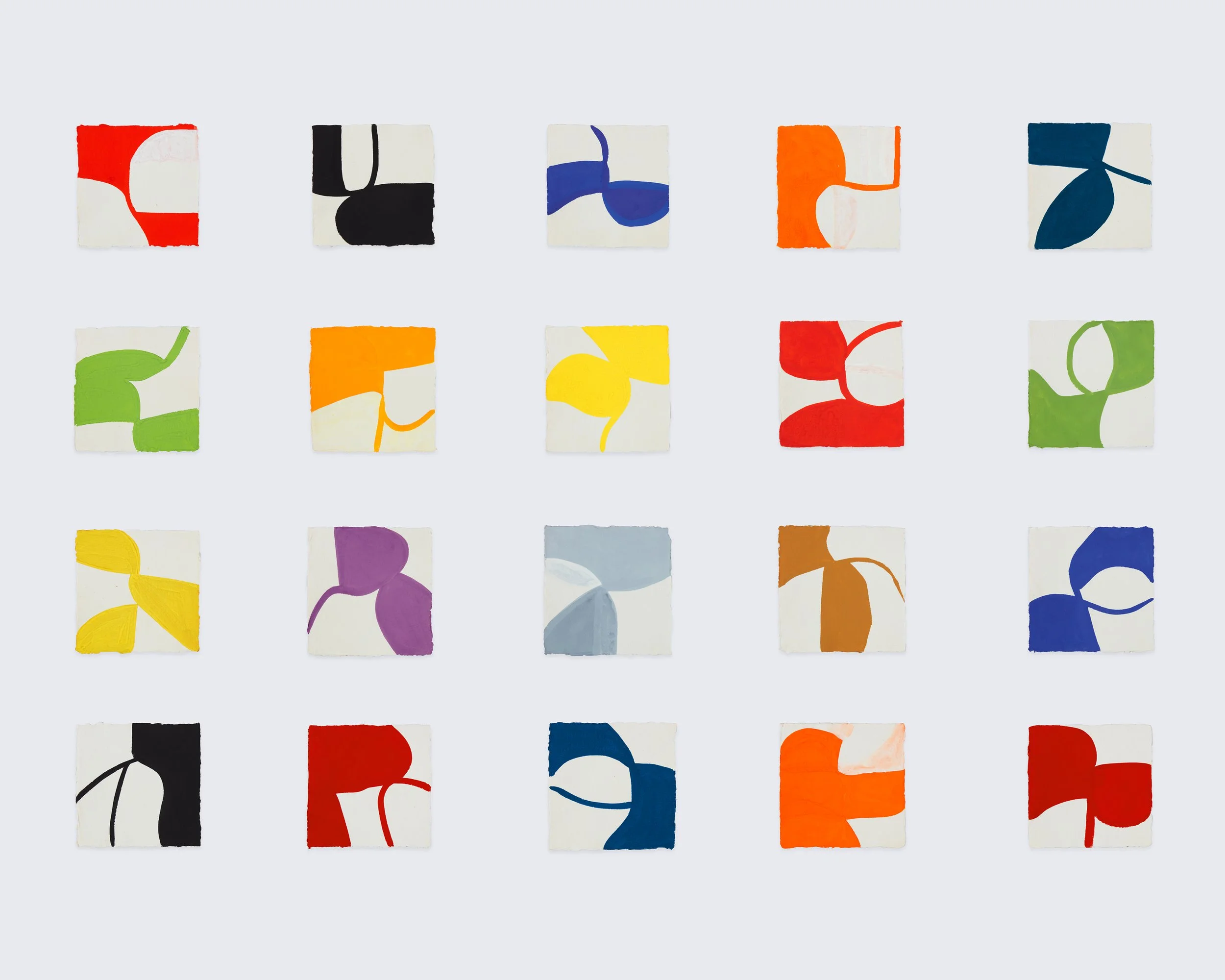
Marina Adams New Alphabet, 2010 Gouache on handmade Indian Khadi paper Overall (variable): 78 x 100 inches (198.1 x 254 cm) Twenty sheets: 12 x 12 inches (30.5 x 30.5 cm)
The exhibition opens with a grid of twenty small-scale gouaches titled “New Alphabet” (2010), where Adams reduces her visual language to a set of modular, almost calligraphic forms. Painted on handmade Indian Khadi paper, each square presents a variation on a curved gesture: loops, arcs, and cropped biomorphic shapes rendered in vivid bursts of orange, cobalt, lemon yellow, black, and green. Arranged together, the works function less as discrete compositions than as a syntax in formation, as though Adams is testing the emotional and spatial possibilities of a private language.
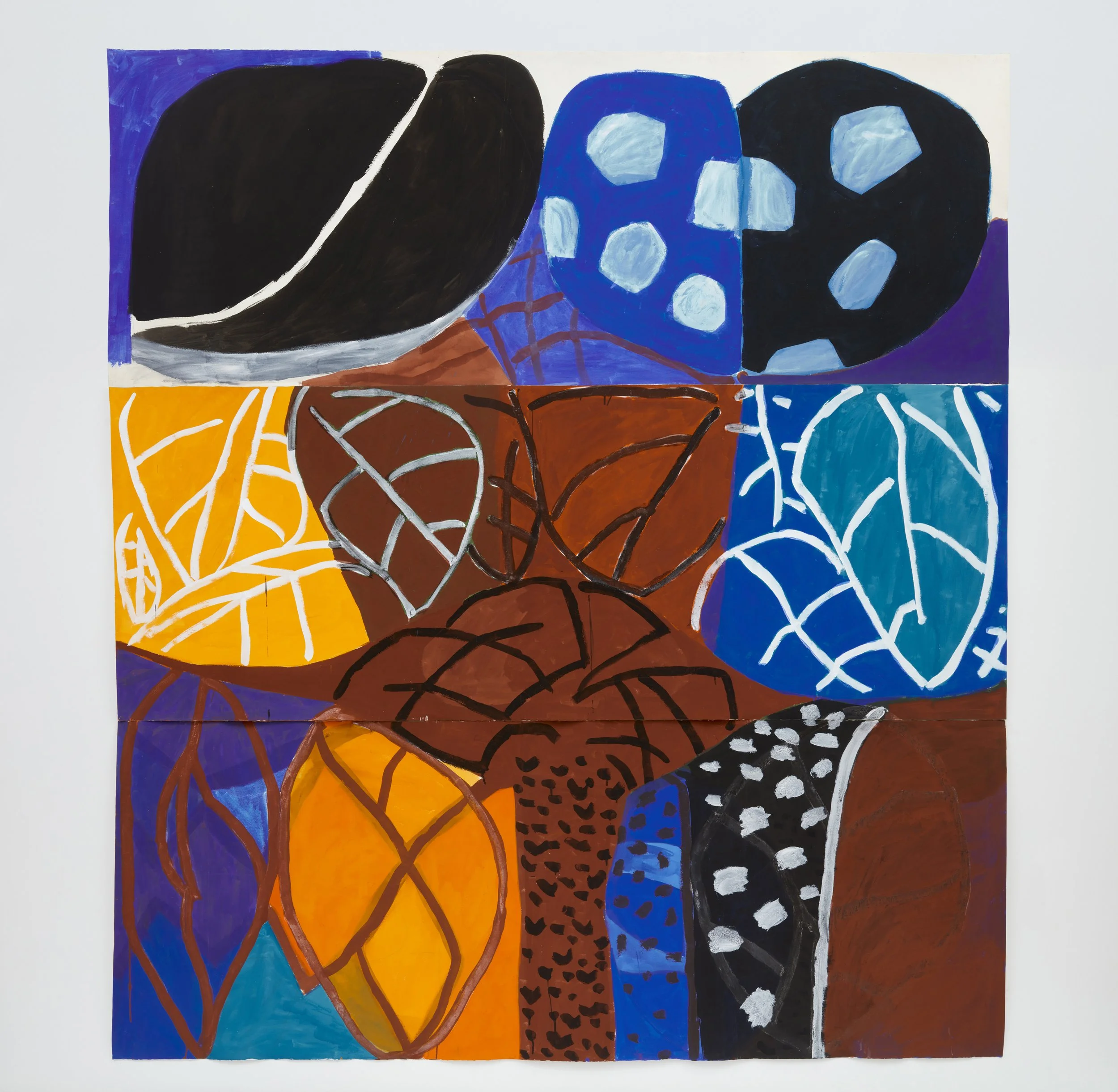
Marina Adams 1996_135x119, 1996 India ink, gouache, and enamel on paper Overall: 135 x 119 inches (342.9 x 302.3 cm) Three sheets: 45 x 119 inches (114.3 x 302.3 cm)
A standout, and perhaps the most unexpected work in the exhibition, is “1996_135x119” (1996), a monumental, three-part composition presented unframed and directly hinged to the wall. Its rawness feels radical. The seams between sheets remain visible, the surface uncontained, as if the work is still in the act of becoming. In hindsight, it reads as a kind of hinge within Adams’s broader practice, sort of a precursor to the fully realized abstractions for which she is best known, but also something more unruly.
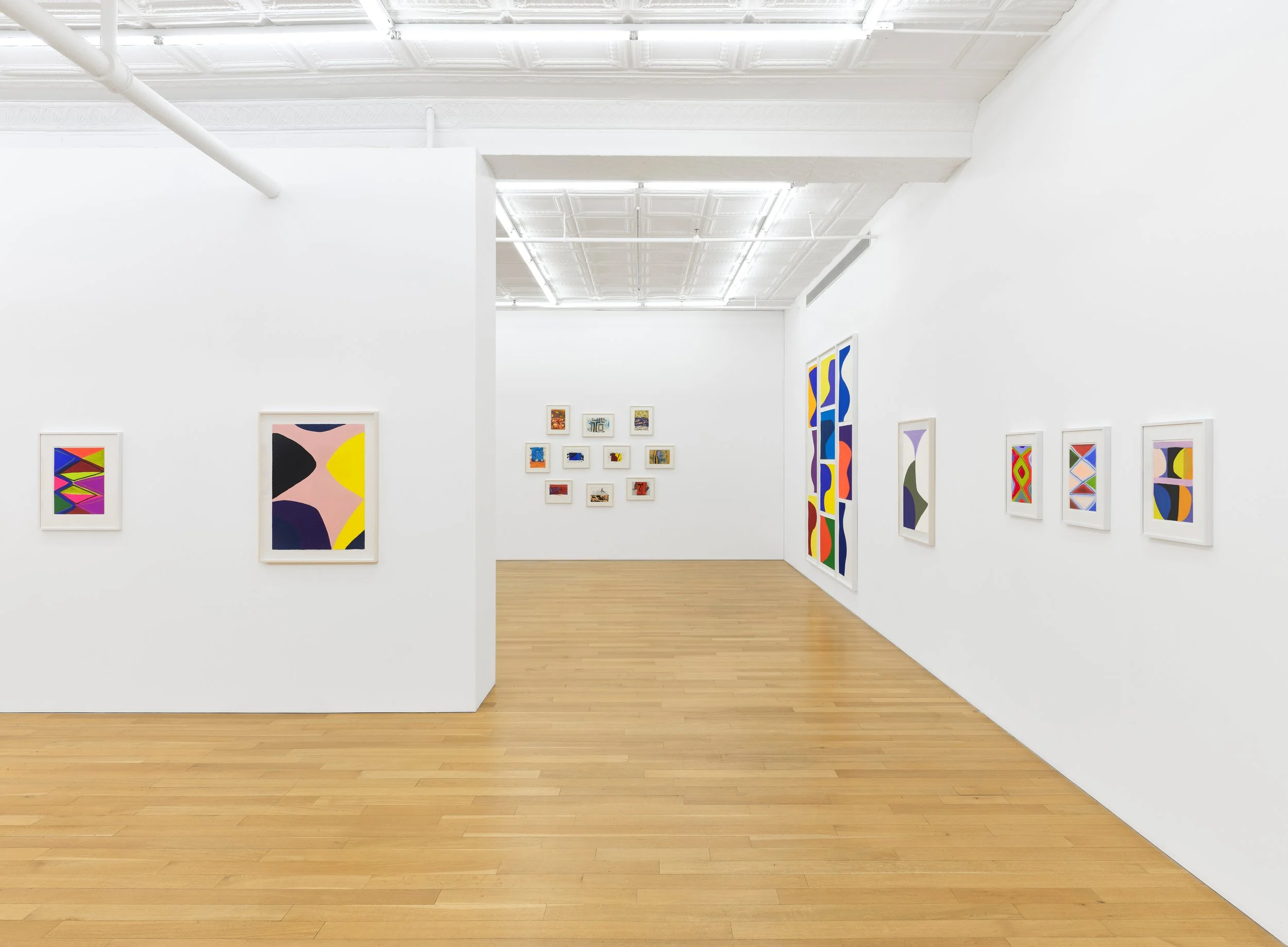
Installation view, Marina Adams: Works on Paper: A Survey, April 9, 2026 – May 29, 2026, Peter Blum Gallery, New York. Photo: Courtesy of the artist and Peter Blum Gallery
This sense of instability—mostly of forms on the verge of coalescing or dissolving—runs throughout the exhibition. Early works from the “Roma” series (1994) suggest organic structures distilled into essential contours, while later compositions push toward a more immersive chromatic architecture, where color carries both spatial and emotional weight. Across these shifts, Adams maintains a commitment to what might be called a “thinking-through-making,” where intuition outruns intention and the work itself dictates its next move.
What becomes increasingly clear is that Adams’s relationship to abstraction is not fixed but elastic. If there is a throughline, it is rhythm—not just in the visual cadence of line and color, but in the cyclical return of ideas. Shapes reappear decades later, transformed but recognizable; materials migrate across time, taking on new roles. The exhibition (and its accompanying publication) ultimately suggests that Adams’s practice is not driven by reinvention so much as by reactivation. Each work carries the residue of another, and together they form a dense, interwoven field of decisions, revisions, and rediscoveries.
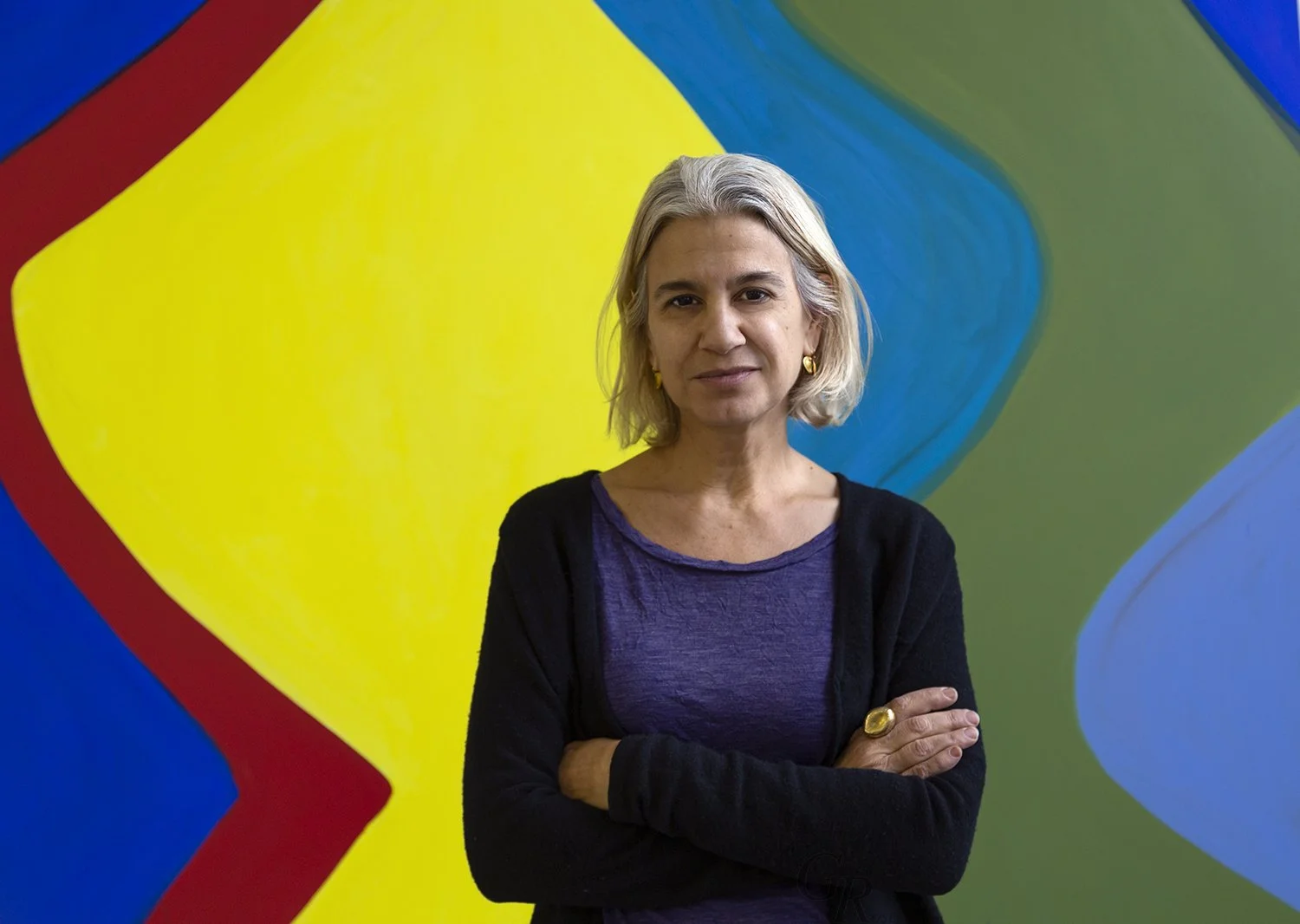
Photo by Grace Roselli
About the Artist
Marina Adams (b. 1960, Orange, NJ) is based in New York, NY, Bridgehampton, NY, and the hills outside of Parma, Italy. She earned degrees from Tyler School of Art at Temple University (Philadelphia) and Columbia University (New York). She is the recipient of the John Simon Guggenheim Memorial Fellowship (2016) and the Award of Merit Medal for Painting from the American Academy of Arts and Letters (2018). Her work is in the collections of the Museum of Modern Art (New York), Metropolitan Museum of Art (New York), Modern Art Museum of Fort Worth (Fort Worth, TX), Buffalo AKG Art Museum (Buffalo, NY), Longlati Foundation (Shanghai), Colby College Museum of Art (Waterville, ME), K11 Art Foundation (Hong Kong), and The Rennie Collection (Vancouver, Canada) among others.
The exhibition opened on April 9 and closed today, May 29, 2026. There was an Artist Reception: April 9, 6 – 8 pm, and an Artist Conversation + Book Launch: May 19, 6 – 8 pm. For more information about this exhibition and others at the Peter Blum Gallery, please visit their site here. The magazine also did a feature on the exhibition, which can be found here.