In Conversation with Murray Hochman
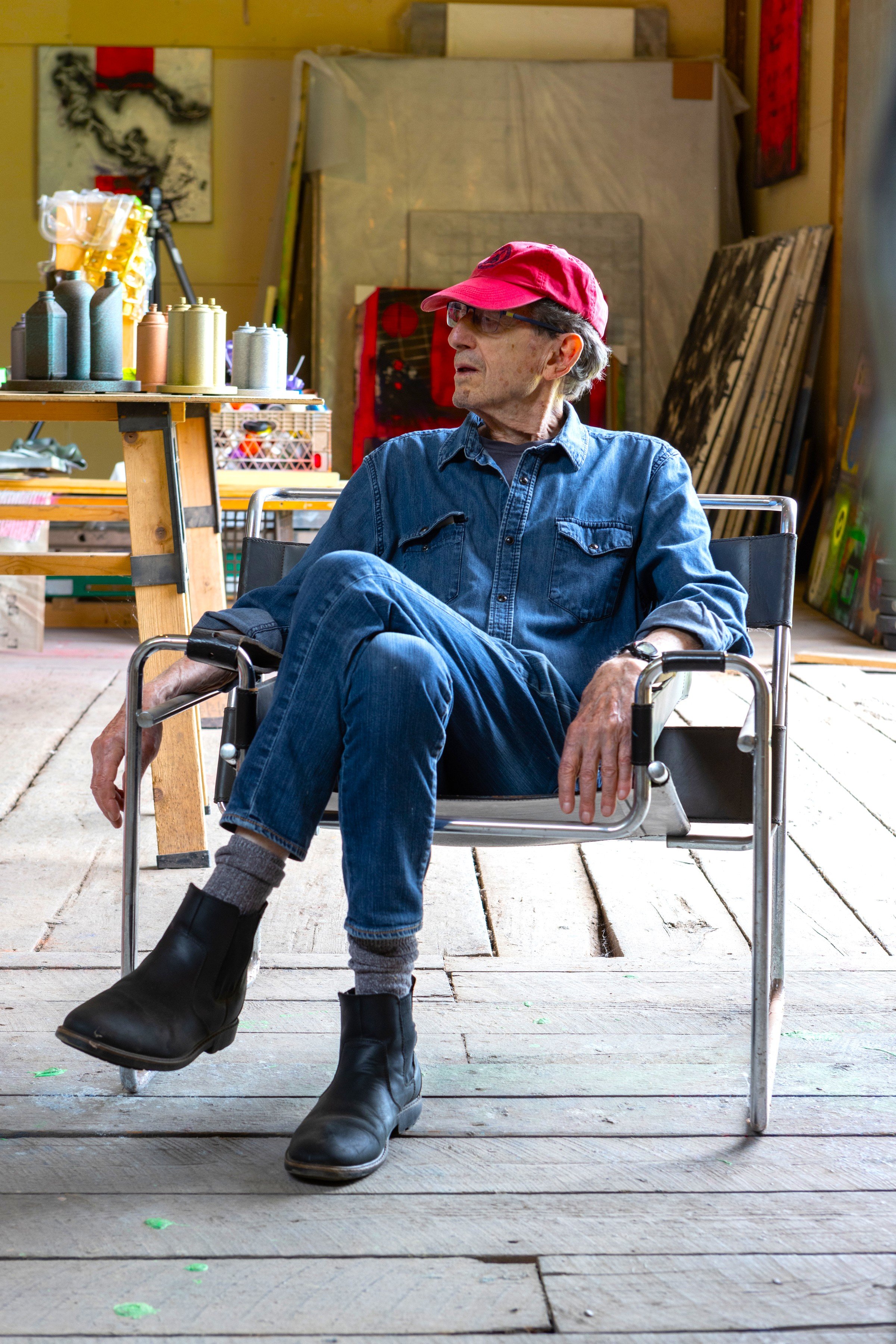
Murray Hochman in his studio, a converted barn in the Berkshire Hills of Massachusetts.
Murray Hochman (b. 1934) is a prolific NYC painter currently living in the Berkshires (MA). For more than 60 years, he has quietly pushed the boundaries of contemporary painting. Throughout that time, he exhibited his work regularly, but has distanced himself from the art establishment, letting his own processes, both internal and external, shape his work.
Growing up in New York City’s Lower East Side, Hochman immersed himself in the wealth of art and entertainment the city had to offer. As a young boy, on school days, he could often be found at local pool halls or Broadway shows, or roller-skating in the then-empty galleries of uptown museums. After graduating high school, in the aftermath of the Korean War, he was drafted and stationed in Kaiserslautern, Germany. His time there would become one of the most formative periods of his life. He traveled throughout Europe, was introduced to world literature through Ivy League army buddies, and had his first encounter with ceramics in an army base crafts class. Upon returning home, Hochman attended New York University through the GI Bill and graduated with a BA in art history. He went on to study ceramics, receiving an MFA from Alfred University. Afterwards, Hochman returned to New York City and quickly shifted to painting, but his preoccupation with surfaces and texture remains evident in his work.
From the vibrant NYC arts scene of the 1960s to the present, Hochman has painted consistently, guided by cultural trends, the demands of his materials and an abiding interest in experimentation. Visually, he took cues from the abstract expressionists and minimalists, and deeply admired the experimental sounds of minimalist composers such as Morton Feldman and La Monte Young. Although his works are often created in a minimal form, his sophisticated — sometimes whimsical — use of color and space create compositions in which time seems to dissolve.
An overarching influence on Hochman’s work has been his nearly lifelong practice of Zen Buddhism, with its emphasis on emptiness and the unification of opposing forces. It is a practice that lends his work a certain spontaneity and sense of the unexpected: letting his materials, chance and the moment guide his creative process. “The parameters of my work,” he says, “are both formal and expressionistic, veering between concept and impulse, and their fusion.” Peering into the visual expanse of his larger paintings, one often discerns an underpainting of formal geometric shapes. These are covered with layers of undulating chromatic paint, dissolved by solvents and then scraped off to reveal the complexity of what lies underneath.
A major aesthetic influence has been the Japanese concept of wabi-sabi, which exalts the unstudied — often overlooked — beauty of common objects: seeing perfection in the imperfect and the impermanent. Elements of wabi-sabi are visible in many of Hochman’s distressed surfaces, and in his re-use of materials such as empty paint cans, discarded plastic and metal shelving from local scrapyards. For several years in the 1990s he immersed himself in what he called Studies for Rust, using patina solutions popular with interior decorators to paint simple geometric forms. Over time, they transmuted into powdery rich-brown rust along with olive green and dusty blue metallic surfaces. This transformation was filtered through Hochman’s keen perception of surfaces and lifelong exploration of materials.
I had the pleasure and honor of asking Murray, as an artist, what he would like to be remembered as. Can one separate the art from the artist and the artist from the art, and so much more.
UZOMAH: Have you ever doubted pursuing a career as an artist? What motivated you to persist despite uncertainty?
MURRAY: As I’ve always said, you’ve got to do something, and for me it was art. I guess I’ve always taken things as they come, life as it presents itself. I’ve never really questioned that choice, and nothing has ever interested me as much as art.
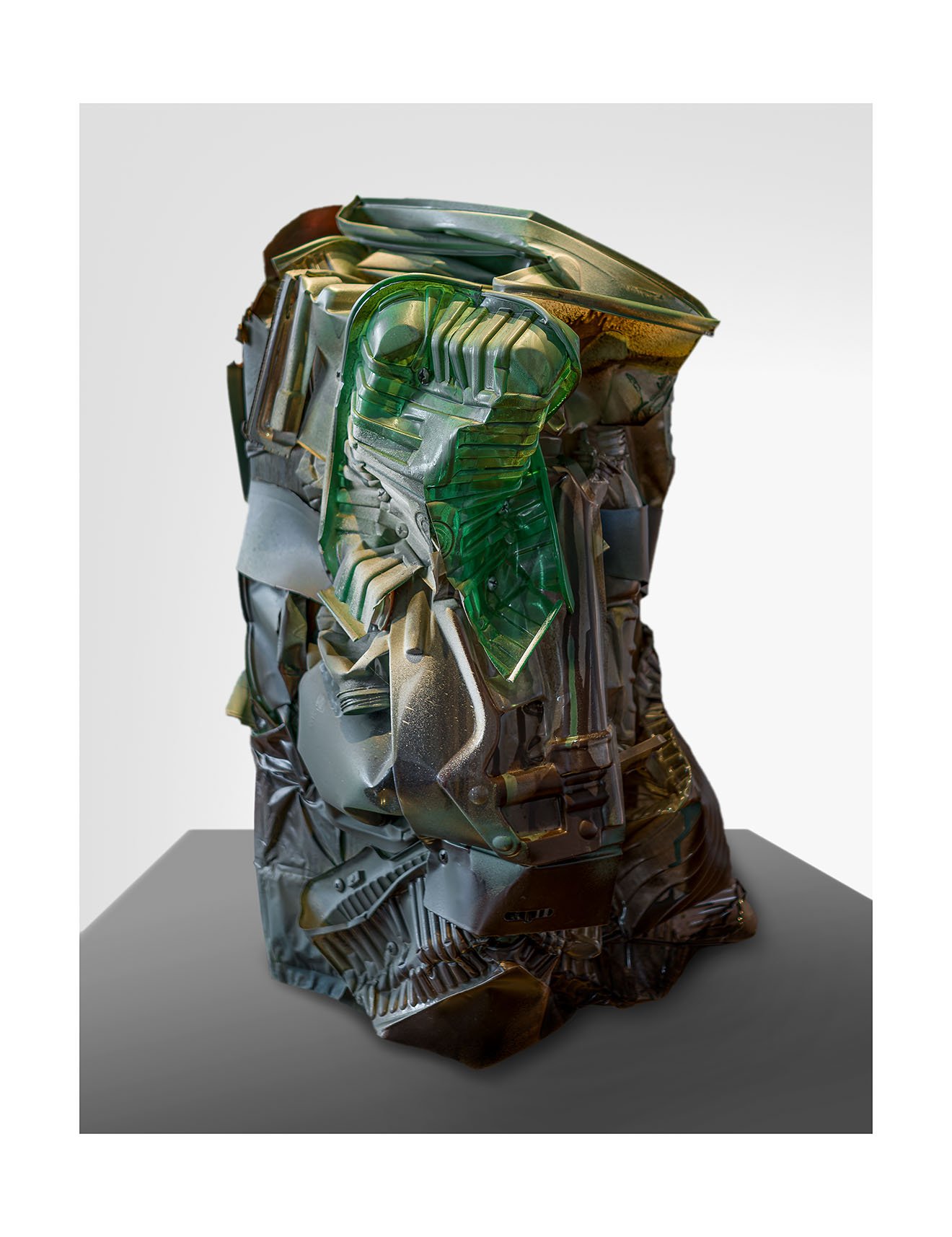
Murray Hochjman, Camo tower No. 2, 2023, plywood, plastic and aerosol paint, 21.5 x 10 x 10 in
U: What is the single best piece of life advice that has impacted you as an artist?
M: A Zen master once told me, whether it was about painting or anything else, “When you do something, do it completely.” So, I’ve always tried to stay focused on the present, doing whatever I am doing.
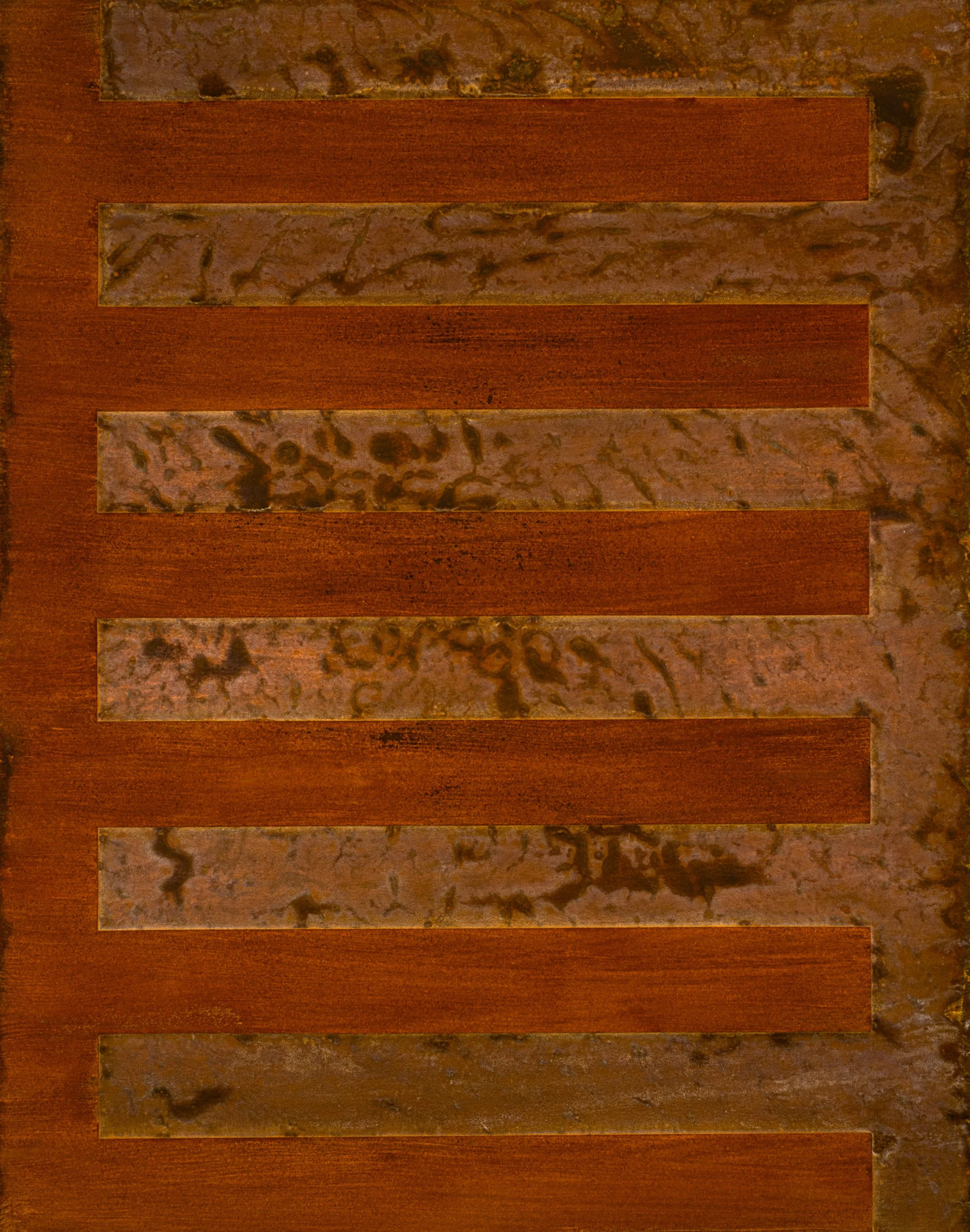
Murray Hochman, Study for Rust No. 4, 1998, metal acrylic and patina on paper, 24 x 19 in
U: How did your upbringing in New York City’s Lower East Side specifically influence your art practice?
M: Of course, growing up in New York City was an education in itself. Unbeknownst to my mother, I spent many school days at Broadway matinees or uptown museums. And as an adult, I availed myself of all the arts the city offered, including film, theater and music, especially by minimalist composers such as La Monte Young, whose Dream House I visited regularly.
But if you are speaking about formative influences, I would have to say it was my time in the military. In the mid-1950s, in the aftermath of the Korean War, I was drafted into the Army and stationed at Kaiserslautern, Germany, where I hung out with a lot of Ivy Leaguers. Although I was an average student in high school, it was these guys, one of whom kept an Oxford English dictionary in his locker, who introduced me to world literature. In fact, it was the books I read in the Army – ranging from the ancient Greeks to Dostoevsky – that got me admitted into New York University when I returned from the service. I also had the opportunity to travel throughout Europe, which was amazing to me – a kid from a working class family that had one book in the house. So, it opened up whole worlds to me. It was also through an Army-base crafts class that I was introduced to ceramics, which I pursued in graduate school at Alfred University.
U: For those unfamiliar with your work, in what ways does Dissolution/Resolution at Gallery AP SPACE reflect your artistic process?
M: From the late 1960s until today, I’ve mostly worked with spray paint, the medium of graffiti culture. Layers of paint, of sometimes arbitrary colors, are applied, then scraped or dissolved by solvents until I feel the piece is resolved. I often use auto lacquer spray paints, which create a luminescent surface that shifts with the light. That quality, combined with the fact that underlayers of paint are exposed, yield interesting and often unpredictable results.
All of the works in the current exhibition at AP SPACE were made post-2000 using this technique. The show features my largest, most lyrical paintings on canvas as well as 10 works on paper and one sculpture.
U: With a career spanning six decades, which is more vital: staying relevant or staying true to your art? How would you advise emerging artists to balance these priorities?
M: I’ve never really been concerned with relevance since, for most of life, there has not been a strong demand for my work. Rather, my painting has been largely an internal process. Of course, I have always followed what is going on in the art world, and my work over the last 60 years has certainly been influenced by artistic trends, but that has never been what has moved me in different directions.
U: The Japanese concept of wabi-sabi has heavily influenced you as an artist. What makes the concept unique, and how has it increased your creative output as an artist?
M: I’ve always had an affinity for Japanese culture, so I was fascinated to learn, a decade ago, about the concept, since it aligned with my own aesthetic. From that point on, I began thinking about my work through the lens of wabi-sabi.
Though it defies translation, the concept sees perfection in the imperfect and the impermanent. In Japan, for example, a broken teacup that has been exquisitely repaired, and has a rich patina from years of use, is more highly prized than a perfect new one. The loveliness of spring and cherry blossoms is only magnified by their transience.
At the same time, wabi-sabi celebrates the beauty of humble, common objects. A Westerner named Leonard Koren, who has written several books on the subject, describes wabi-sabi as “materiality, pared down to essence, with the poetry intact.”
I see elements of wabi-sabi in the distressed, layered surfaces of many of my paintings. My Studies for Rust, from the mid-1990s, could also be called studies in impermanence. Using patina solutions popular with interior designers I painted simple geometric forms. Over time, they transmuted into powdery rich-brown rust along with olive green and dusty blue metallic surfaces. And they are still changing.
More recently, I began to re-use everyday materials such as plastic waste and empty spray paint cans. I’d go hunting at the local dump and find interesting throwaways that I refashioned into sculpture. This brings out the tension between discarded base materials and their transformation.
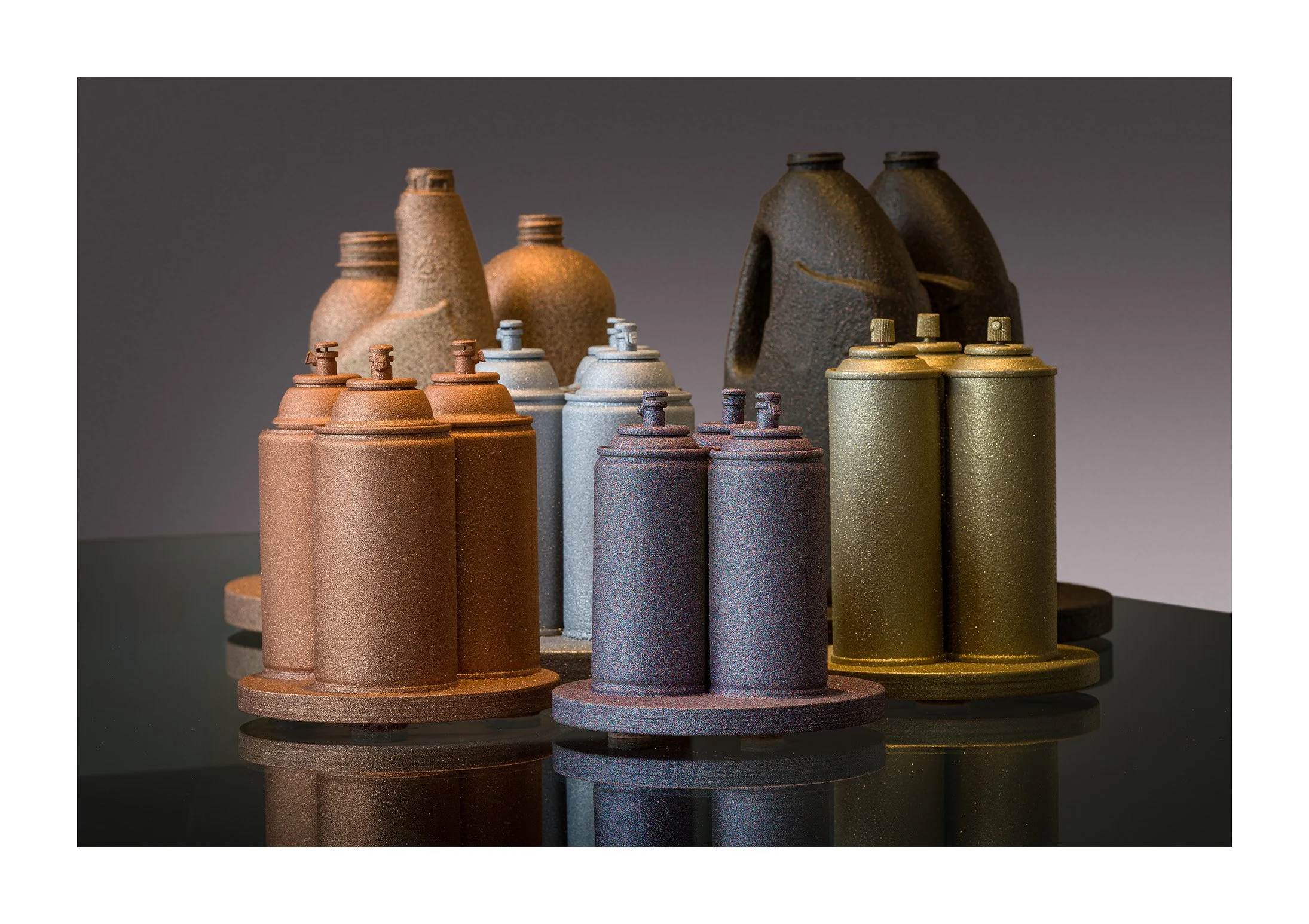
Murray Hochman, Still Life, 2021-2022, Plywood, aerosol cans and aerosol paint
U: As an artist, what would you like to be remembered for in terms of how and what your art stood for?
M: Well, if I am thought about at all, I would like to be remembered for finding beauty in unexpected places.
U: Can one separate the art from the artist and the artist from the art?
M: Not if it is good art.
U: Who are your favorite authors, writers, or poets? In what ways does writing become visual artistry beyond words, and how does art exhibit poetic qualities?
M: I’ve always been an admirer of minimalism, of getting down to the essence of things. So, throughout my life, I’ve been an avid reader of poetry, the distillation of language. I’ve read all kinds of poems – from Zen haiku to Baudelaire and Rimbaud to more contemporary poets such as Charles Wright and Frederick Seidel. For a long time, I immersed myself in the poems of Rilke, and studied the ways in which he and Rodin influenced one another.
Aside from poetry, I have read a wide variety of other forms of literature: classics from Melville to postmodernists such as Michel Houellebecq and Elfriede Jelinek. I used to read some history and social commentary as well, such as The 1619 Project. Literature for me is not an inspiration to make art, but it is certainly a source of inspiration for how to live your life.
For more information about Murray’s artwork, please visit his site here. He can also be found on Instagram here. Information about Murray’s latest exhibition, Dissolution/Resolution, at GALLERY AP SPACE on their website here. The exhibit will close on the 10th of this month. The magazine did a feature on the exhibition, which can be found here.