In Conversation with Bobby K. Hill
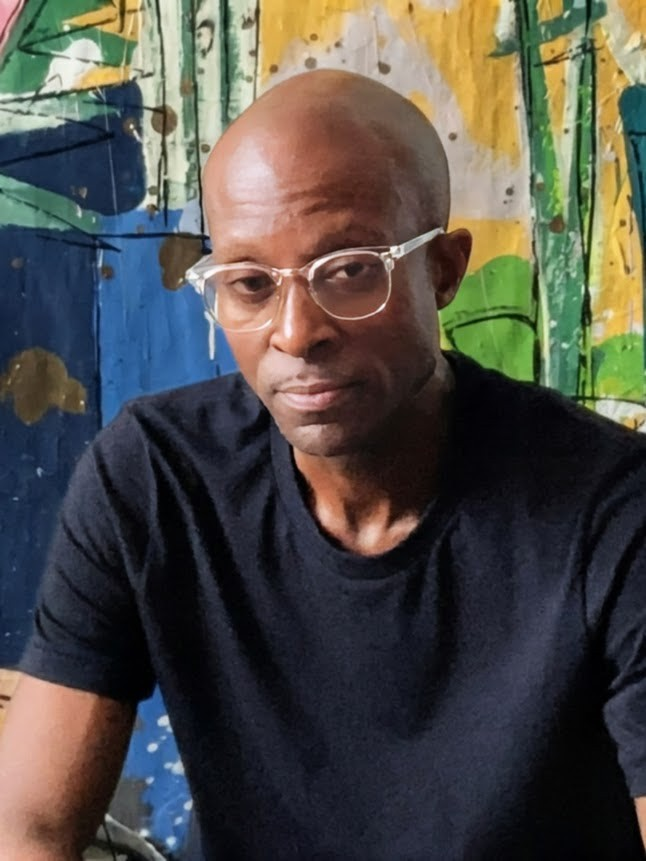
Courtesy of Artist
Born in 1973, New York–based mixed media artist Bobby K. Hill stands at a pivotal creative threshold. While this exhibition marks his first major presentation of large-scale paintings, it is the culmination of a career that has been incubating for over three decades. Hill’s visual language was forged in the high-stakes world of commercial illustration, where his distinct fusion of silkscreen printing and hand-painted imagery earned commissions from global icons like Nike, Coca-Cola, and XXL. Yet behind those professional accolades lay a private, intensive period of study and experimentation. This debut marks the long-awaited transition from the commercial sphere to a focused fine-art practice, capturing the energy of an artist who has spent a lifetime mastering his craft just out of view.
Hill’s work is a tactile exploration of the African American experience, rendered with a richness that demands physical presence. His canvases are rife with texture and nostalgia, capturing familiar vignettes—from intimate living room scenes and men congregating on urban milk crates to the quiet, bucolic stretches of Central Park. These works embody a complex emotional landscape, distilling decades of observation into a singular, powerful vision. For the discerning viewer, this exhibition offers an opportunity to engage with a seasoned practitioner at a defining moment of professional transformation. As Hill’s work moves into the gallery space, these paintings stand as a testament to a storied past and a rapidly accelerating future.
I had the pleasure of asking Bobby how he defines success as an artist, what happened when he met Warhol, and how it impacted his career, and so much more.
UZOMAH: How does your art directly engage with and influence the ongoing narratives surrounding societal and political issues facing African Americans?
BOBBY: What I like to do is art that will help people, so their lives can get better. We’re all trying to figure out this thing called life—maybe to have your life go a certain way, you have to give yourself a purpose. I figure talent plus helping people equals your purpose, and I feel as if my talent is art, because I studied it and focused on it for extended periods of time. So my purpose is to help people through my work.
In certain works, I make images to activate the mind in us as a people to help give us new ideas, to give us inspiration to understand that we can all be revolutionaries at heart. Even with paintings that don’t have any cop vans burning, it's just showing Black families together. And in this day and time in the history of America, just showing Black families together is revolutionary in itself. For many years, Black fathers got a bad rap, but I feel like my generation, we're there for our kids… so just showing Black fathers with their kids is revolutionary.
Even with the pop culture images that I do, I make sure to include iconic figures in Black history—people like Malcolm X, Tupac, Angela Davis, MLK, Nina Simone, Assata Shakur, and the Black Panthers, along with everything else. With some of the abstract stuff, I'll show somebody holding up a little baby, African sculptures, etc. At other times, I'm just thinking about the act of creating without a lot of the other stuff that's going on in the world. My #1 goal is to inspire the little Black children…and at the same time I make my work to inspire people around the globe, no matter what race they are—people that really love art and art techniques, that love to study images, love to spend hours in museums and look at every detail of the paintings, sculptures, drawings or whatever else is in there. I make my work for them as well.
But also, I make art for myself, so that my life can continue to go in a certain direction, which is moving forward and upward. Art for me is like a journey. You can start off one way, but if you practice, dedicate yourself and focus over long periods of time, you get better. When I look back at work I’ve done, I like to see that progression amongst everything else.
U: What advice would you give to a young emerging artist in terms of finding their artistic statement?
B: Keep creating. Once you start, don't stop. You might take breaks here and there, but just work, and what'll happen is you'll find your voice. You might start one way, thinking that you're talking about one thing in your work, but as you go along, you'll begin to tweak things, and other messages will come out. It's a journey. You'll figure different things out as you go along that you didn't know in the beginning, which will help you find your voice even more. A lot of artists, when they start, copy the work they like, but as a real artist, you don't want to just stay in copy mode. You want to add to that and innovate, then eventually do something that’s never been seen before.
U: How would you define success as an artist?
B: So back in the day, success to me was just being able to live off my art. I first wanted to have my illustrations in magazines, and when I finally did that, that meant I was successful. Then I started doing t-shirts, so then being in retail clothing stores was successful. After I accomplished that, I wanted to get my small screenprints in gift shops and galleries. After that, I wanted to do art shows, and I was included in group shows and financed my own shows, so that was success at the time. Now I would like to be in museums or major galleries. Money, for me, just buys time to make more art. When I have a cushion, I don’t have to think about bills, etc., and I can just focus on creating. Right now, I’d say being successful as an artist is having large canvases selling for five, six figures and doing that consistently. That would give me the cushion to not be on the grind so hard, to buy property, and leave something for my kids. At this stage, that’s important because I have kids now, and it’s not only about me anymore. I want to make their lives easier, especially in this world right now. This shit is wild. I make art to express myself and to help people in the world, and if it sells, that’s a bonus. That helps me make more work and take care of my kids. Real talk, a “successful artist” for me is also being in the conversation of who the best living artists are while I’m alive—like, “Yo, he’s one of them.”
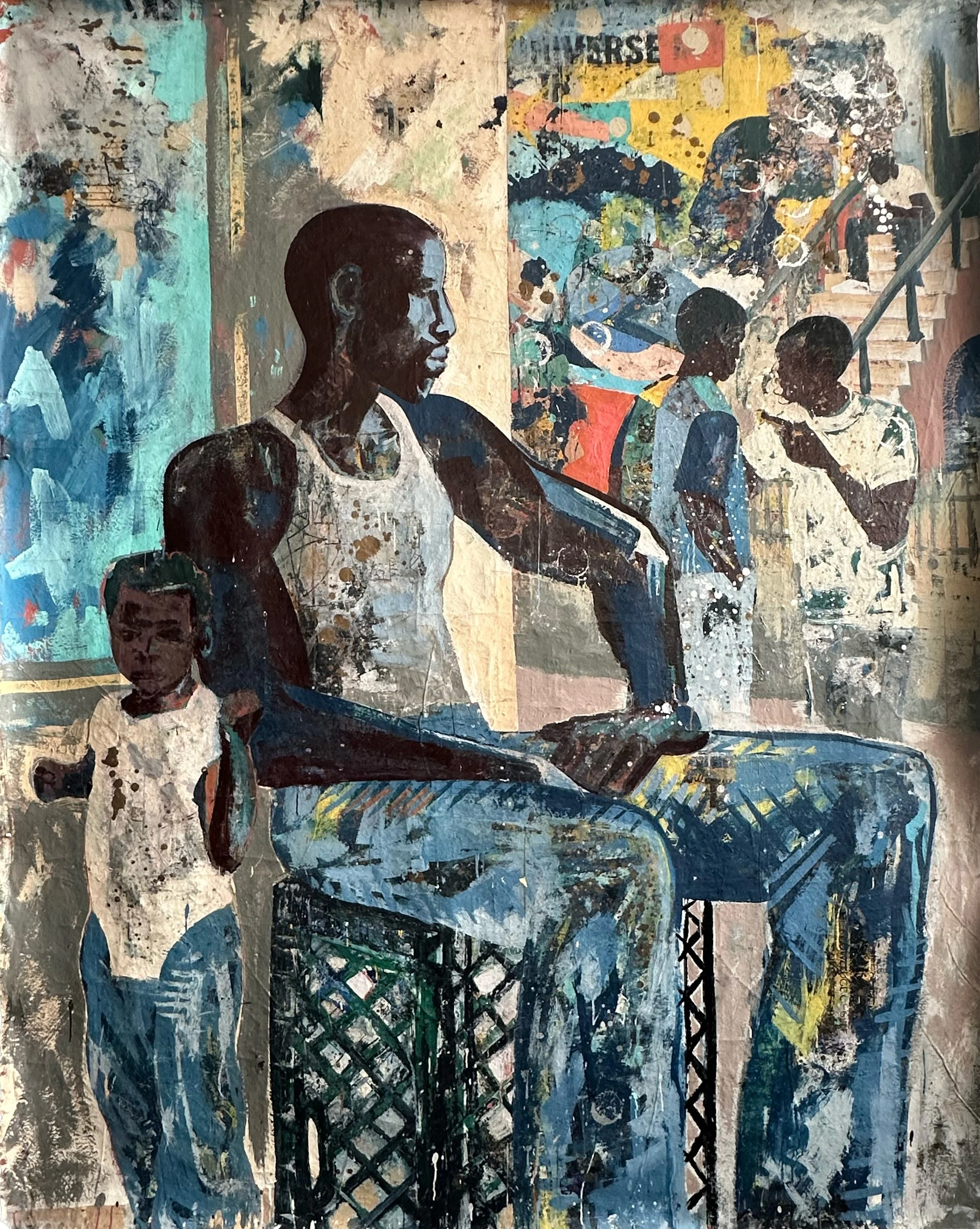
Bobby K. Hill, Insight, 2025:2026, mixed media, paint on canvas, 96 x 77 in
U: You met Andy Warhol at age seven or eight. Later, after viewing his art, when did you realize the significance of his artistic impact?
B: I went to LaGuardia Music and Art HS in NYC and was an art major who had art history classes, so I’m pretty sure they told me about Andy Warhol, but I wasn’t really interested in art history at the time and probably wasn’t paying too much attention to what they were saying.. So, I would say it was after high school when I went to Atlanta. I was in the library looking through books on printing and how to replicate my drawings when I saw his name, and I started really understanding what he added to the game. I was about 20, 21 years old.
Years later, I also saw a dope documentary on PBS. It was two parts, and it broke down his whole life, including everything he did. That’s when I learned that before he was doing his photographic screen-printed paintings, he was a magazine illustrator.
U: What did you notice about his presence during your meeting, and how did he interact with you?
B: I met him during a Michael Jackson concert at the Garden (Madison Square Garden) with Rick James being the opening act. I was sitting very close to the stage in the 3rd, 4th, or 5th row with a girl from my elementary school and her mother. I remember a weird-looking guy turning around and asking the mother if he could take a photo of the girl and me. The mother said yes, so he did. Then she took a photo of him afterwards. Once the interaction was over, I asked her who was that guy and she said he was Andy Warhol. I then asked her what does he do and she said I’ll find out when I get older. What I remember most was that he looked very weird…he was very pale and had white hair in a wild hairstyle. He looked crazy to me. After that, Michael Jackson popped out of a metal dish on the stage with a bunch of smoke, and that was amazing. Just from that little interaction with him and being at that Michael Jackson concert, I think about greatness.
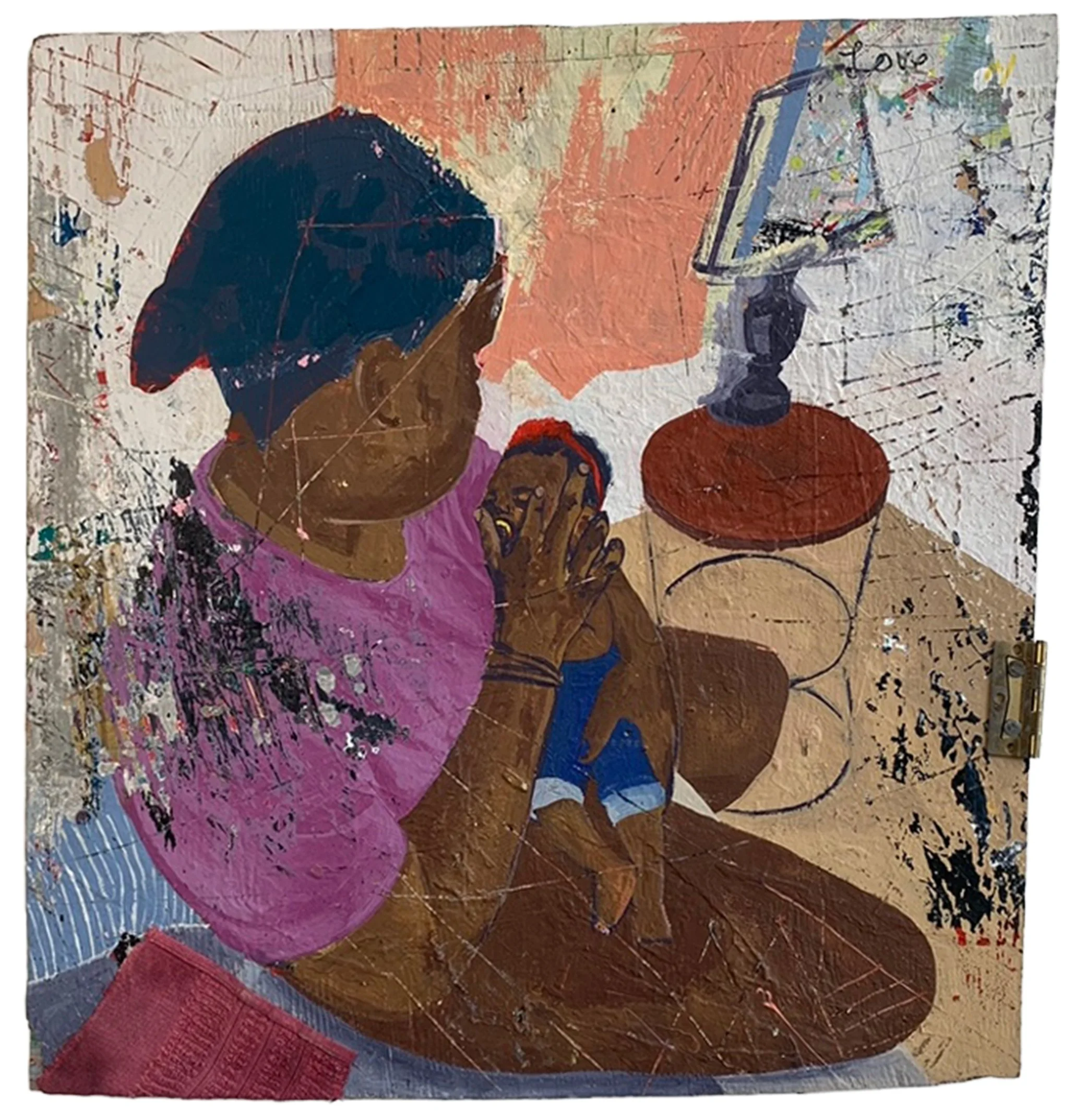
Bobby K. Hill, A Mother's Love, 2019, mixed media, paint on repurposed wood, 24 x 23 in
U: Where do you see yourself in five years?
B: I see myself with a large studio which I own—a live/work space, maybe some other buildings as well, a nice size bank account, and also I see my work all around the world, in museums…and chilling with my kids. At the end of the day, you can have all that other stuff, but for me, I love my kids, so all of that shit is cool, but if I got my kids with me, man… that’s everything. Also traveling around the world doing shows, being known as one of the best out here, and creating large-scale canvases while all the bills are taken care of…and to inspire everybody else while doing that, man.
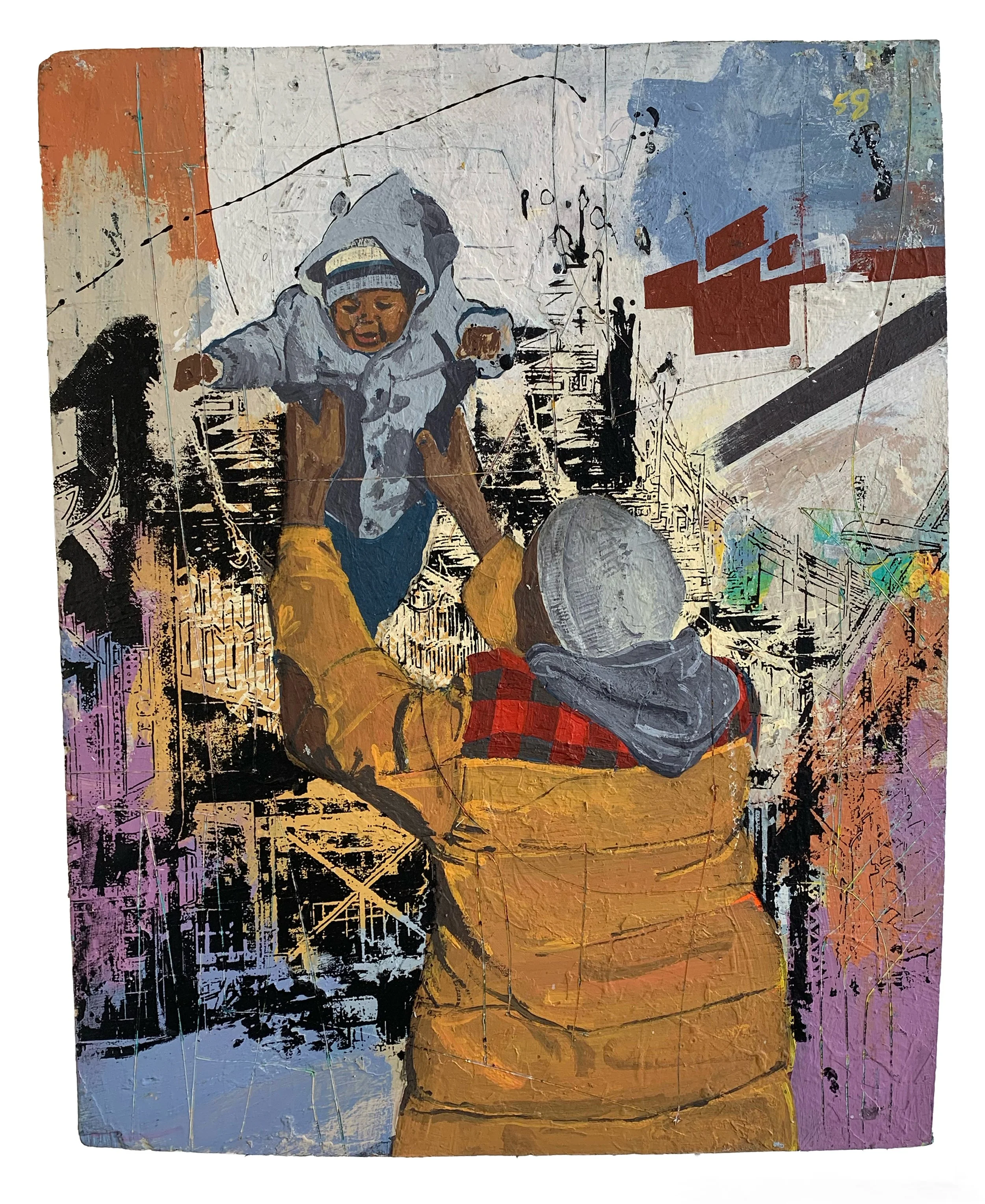
Bobby K. Hill, Lifted, 2019, mixed media, paint on repurposed wood, 24 x 21 in
U: You first started as an illustrator and, upon returning to the USA, decided to become a painter. What made you choose the switch? What do you like more about painting?
B: So what made me actually make that switch…I was in Paris at the Louvre after doing a show in Spain, and I saw the Mona Lisa in person. It was a small painting all the way in the back, behind bulletproof glass and a velvet rope, with security guards on either side and a huge crowd in the room. I'm thinking, all the people are here for this little painting, and it’s mad old. I said to myself, I guess people really love art. I figured I have talent, so let me really dedicate myself to this game and take it up some notches. So when I returned to NYC, I started painting.
With painting, if you don't like it, you can go over it. You can scrub that shit off. It's a lot more forgiving than drawing with pen and ink, so I like that. I also like what you can do with textures, and I love how you can start one way, and it ends up totally different... that’s with art in general, though. Then there’s the colors. Someone asked me this question about Andy Warhol: “What’s the most significant thing about him?” I initially thought it was the fact that he used screenprinting as art. They told me no, it’s the way he uses his colors. With art, you’ve got the images, but equally as important, if not more important, is also the way you hook the colors up next to one another…the unlimited amount of possibilities you have with just three primary colors plus black and white.

Bobby K. Hill, Seen This Before, 2025:2026, mixed media, paint on canvas, 96 x 77 in
U: Have you always wanted to be an artist? When did you start pursuing art as a career?
B: I would say my whole life. There was a time I wanted to be an architect. But this is what happened... and this is why I tell my kids, you could do anything. I was nine years old. An architect came to my fourth-grade class, and she had us making little cardboard model buildings and houses using X-Acto knives, and also creating floor plans and blueprints…you know what I'm saying? I would do that in class, and I would also go home and do it on my own time. One evening, a next door neighbor came over to my mom’s apartment, saw me making my little cardboard model building, and asked, "What you doing?” I said, "I'm doing some blueprints, and I want to be an architect." She said, "You can't do that…you have to be good at math." After she said that, I stopped and never made any models again. Hindsight being 20/20, the wild shit is, who would say I was not good at math? I actually wasn't bad at math. The good thing was, maybe a year or so before that, I did a Snoopy drawing from my pillowcase, and my mother liked it. So I just kept on doing stuff like that, plus a little superhero stuff. Basically, I wanted to be an artist my whole life…from the beginning. I could have been an architect, too, though, you never know. Yeah.
U: What has been your favorite solo or group exhibition?
B: I liked mostly all the shows I’ve done—solo shows and group shows. From the first time I was overseas in Seville, Spain at a place that was half gallery and half restaurant to the group street art show I did in SoHo, to the shows I financed out of my own pocket using money made from sales of my small screenprints—they were all fun to now with the current two-person show in L’SPACE Gallery in NYC, which is the first show I’ve done since 2019. I really like doing solo shows, too, because I can really control the space and create a vibe with multiple pieces of work.
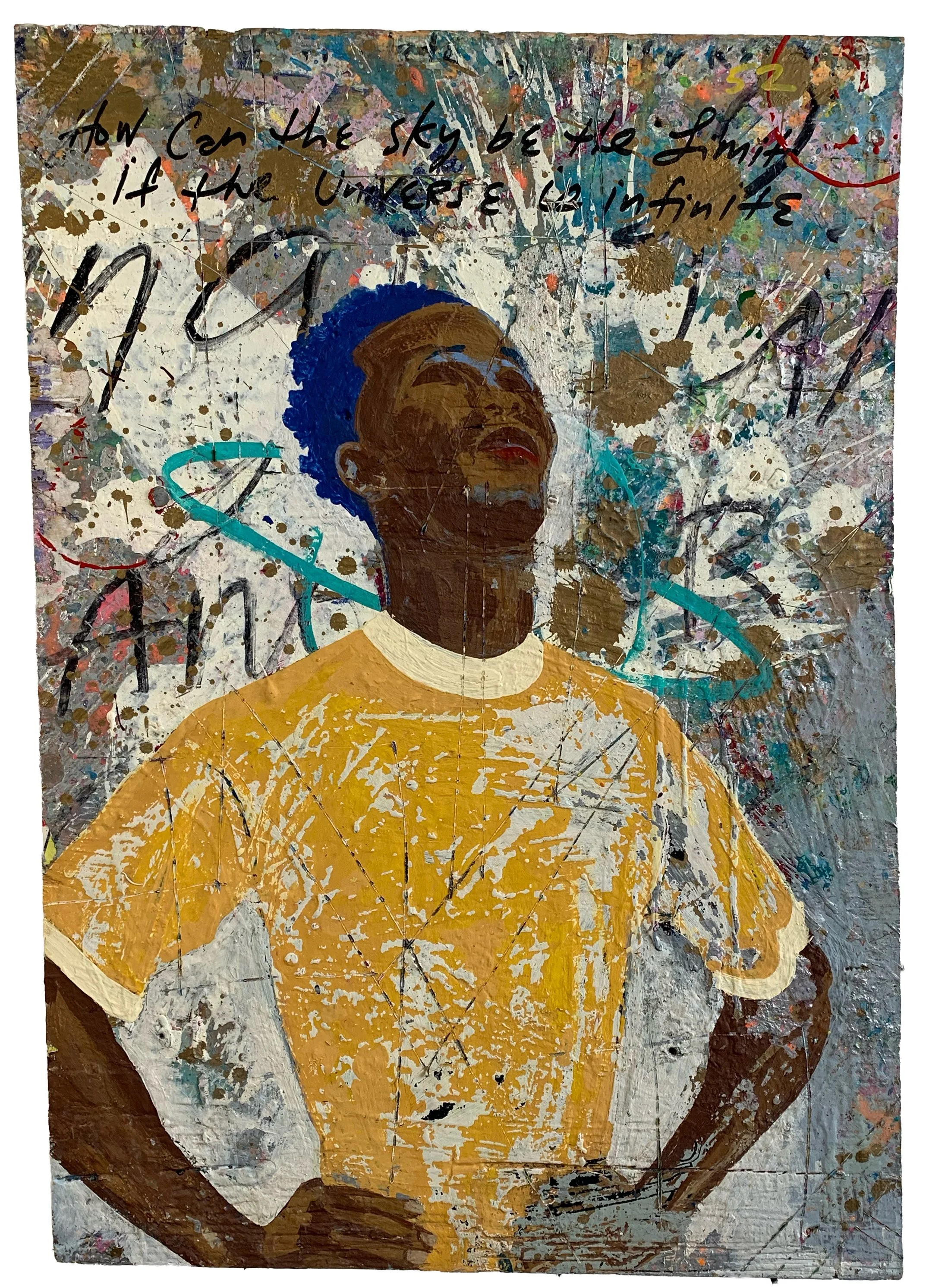
Bobby K. Hill, The Universe is Infinite, 2019, mixed media, paint on repurposed wood, 24 x 16 in
U: How has the art world changed since you became an artist?
B: First, I think there are different art worlds. They can range from the street art/graf world with muralists and graffiti artists, to the artists who focus on selling print editions of their originals and limited edition toys, to artists who focus on direct sales at flea markets and self representing art fairs around the country, to artists who are known for their commercial work with companies etc. Then there’s the art world I think you might be referring to which is the one that revolves around galleries, major art fairs and auctions. With all those art worlds, I think the most significant change has been how important the internet and social media have become in getting the word out to the masses and ultimately giving the individual more control of their own narrative.
U: How do you decide which narrative elements to depict in your art? How do you ensure your ideas make an impact?
B: I would say the impact comes from working all these years and knowing what makes an image dope. There’s something I made up years ago when I was doing t-shirts, and I call it the ‘Oh shit’ factor. I would be in certain retail stores in the tri-state area, dropping off dozens of tees, and overhear customers looking at my creations saying “ohh shiiitt.” I always knew I had a hit when that happened. I used to love that, and I still do, regardless of if it’s the smaller size mixed media screenprints on paper or large-scale original paintings on canvas. I like to hear that, “wow”.
When I make art, I like to give people something to really look at and study. For the most part, while creating my work, the way I know that an image is working is a feeling that I get in the left side of my stomach. I think that feeling stems from a few things too…from making art for many years and knowing what works and what doesn’t work, to seeing tons of images over the years from the best to the worst, to having to live off of my work and understanding what makes dope images because my livelihood depended on it, to talking to so many people about art from many different backgrounds, states in America and countries around the world and getting different perspectives, to also just being from NYC—Harlem to be exact—which was the epicenter of culture starting from way back in the day, which gave me an ability to gauge when something is extraordinary and impactful or just mediocre.
As for a narrative, I'm just working out the ideas, and wherever those ideas fit into a narrative, that's just what it is. I just create. Right now, I’m painting on a larger scale with the Inner Child images. I’ll probably move on from that after some time and do something totally different. Some ideas I've had since the 1990’s, while other ideas are brand new. I'm really just going through all my ideas one by one, knocking them out, and wherever they fall, that's where they end up. What I find is that when I work in that capacity, collections happen organically.
At the end of the day, I just focus on being as creative as I can be and making the best art that I can with all the tools and techniques I’ve learned over the years.
Conditions of Inheritance is Bobby K. Hill’s latest exhibition with Coby Kennedy at L’SPACE Gallery in NYC. The exhibition will end in April. The magazine did a feature on the show, which can be found here. For more information about Bobby’s artwork, please follow him on Instagram.