In Conversation with Coby Kennedy
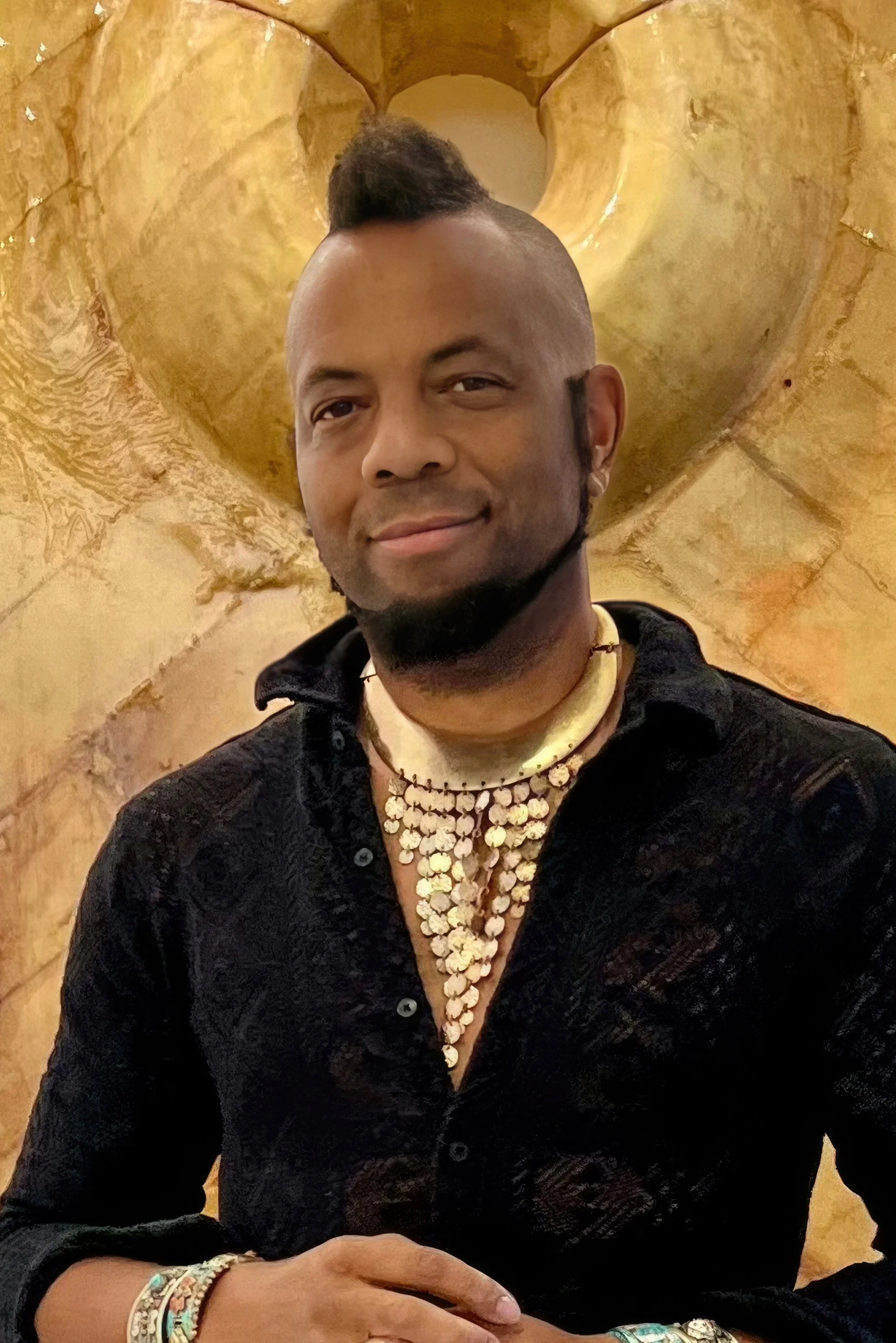
Coby Kennedy (b. 1977) is an interdisciplinary artist whose work serves as a potent bridge between cultural realities and high-concept mythology. Raised in Washington, D.C., within a lineage of artists and academics immersed in the Black Arts Movement, Kennedy’s vision was shaped by a fiercely progressive household that dismantled “prescribed standards of thought” early on. After honing his craft at the Pratt Institute and Columbia University, he garnered international acclaim with reviews in The New York Times and The Guardian, alongside collaborations with global icons like Ferrari and Sony. His landmark sculpture, Kalief Browder: The Box, remains a seminal example of his ability to confront the systemic “horror movie” of American life through unflinching, monumental form.
Kennedy’s practice has evolved into a “material manifesto” where industrial expertise meets ancestral empowerment. By utilizing bulletproof Kevlar as a substrate, he creates a literal architecture of defense designed to absorb the impacts of a hostile world. His process—treating synthetic fibers with oxidation to create a primal pigment of rust—transforms the canvas into a scarred artifact that carries the weight of both history and future ruin. Since becoming a father to two daughters, Kennedy has deepened this focus, weaving a “mindset of protection” into his work that evokes the hands of ancestors reaching in to arm the next generation. The resulting oeuvre is an elegant, resonant blend of narrative and material, offering a portal where generational trauma is met with an enduring spiritual counter-force.
I had the pleasure of asking Coby what criteria he uses to determine when a piece of artwork is complete, how he uses his art to engage with societal, cultural, or political issues, and so much more.
UZOMAH: How do you personally define the act of creating art?
COBY: It's literally every single thought, action, movement, mistake, fall, get up, trip, burp, blink, that I do ever all the time…and it's because of the way that I grew up. I grew up in a bubble. Both my parents were practicing professional artists in art communities; deep in our communities, all of my friends were kids of their friends for a long time, so they were artists and artists of a certain ilk, you know, artists where it was like, everything you do. You are a creative, so everything you do is creative. So everything is the art. And the stuff that goes on on cameras, that goes on a wall, that goes on a coffee napkin, is just the physical manifestation of it. I never thought differently than that. And, I never was really around anyone who thought differently than that.
The first time I was around anybody that wasn't of that headspace was when I moved to Japan in 2000 and back until, you know, almost a decade, 2008. And so when I came back from Japan, that was my first time being in America and being around people that did not think like me, in that way, and it was a bit of a culture shock. It was about a five-year culture shock.
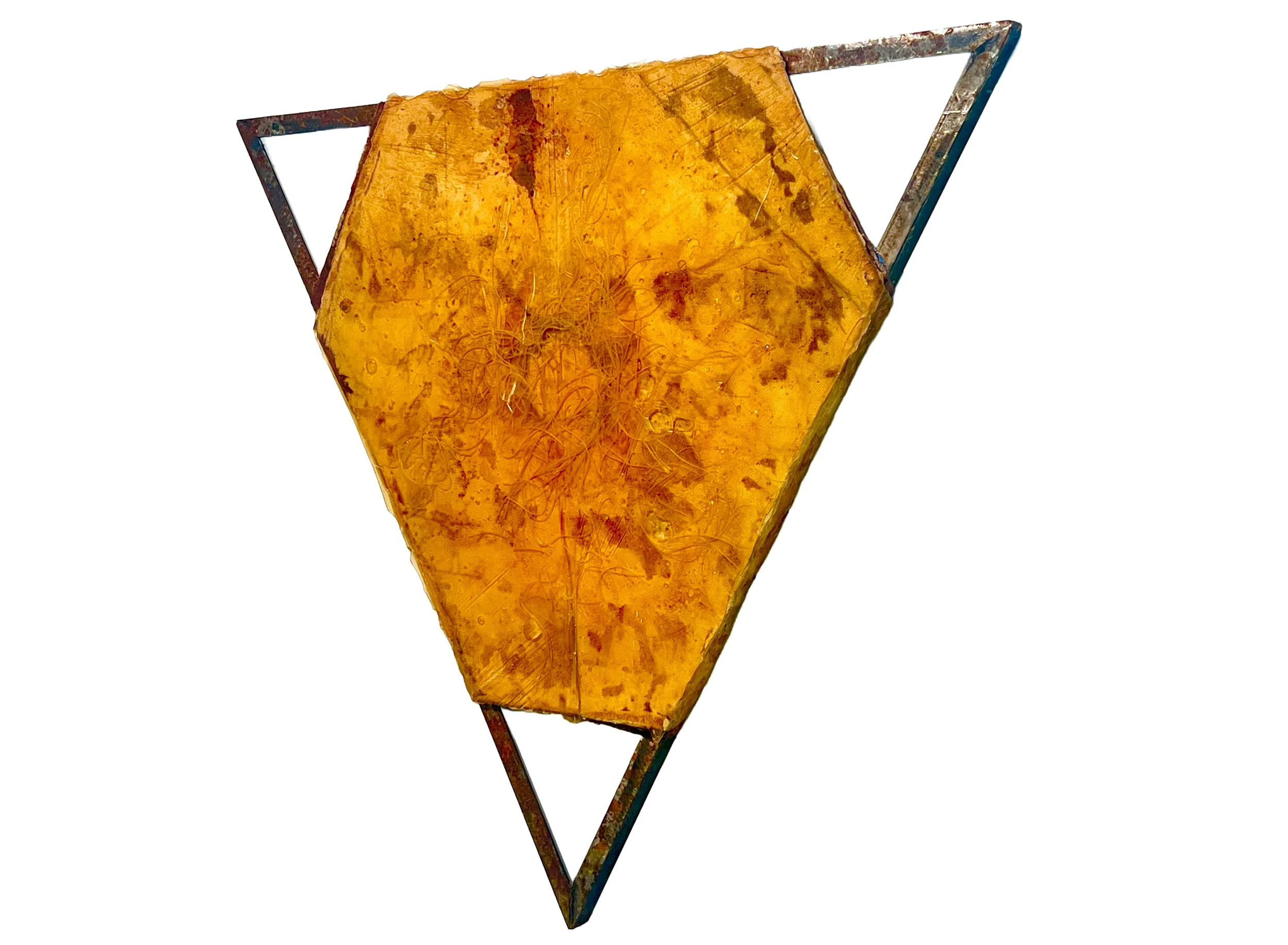
a = 2GMd_R3, 2025, ballistic grade Kevlar, steel, rust, resin, fiberglass, 32 x 28 in (81 x 71 cm)
U: Is your primary motivation for creating art the creative process itself or the final outcome?
C: I'll tell you this, my whole life, it's just been something that you do, you know, something like breathing or eating. I've had moments where I wasn't able to make art for one circumstance or another, you know, later in life, and it's been unbearable. It's just part of your molecule. Part of your DNA, part of your everything, my everything. Um, I can't breathe. I get to shake. I start hyperventilating. I just, I have to create. I have to make, you know. And there's all this stuff going on in my head, and I didn't know what it was until a few years ago. It's ADHD. You know, it's just constant images, voices, thought patterns, thinking about this, thinking about that, and it's a cacophony that just keeps training out, ideas and concepts and images…
I just have seen it as the way that my brain works, and I love it. It's great. You know, it makes me... viciously creative when I look at it. I'm constantly in other worlds and other places. I don't see one as an effect of the other. It's all one thing. And then, once I started getting treated for ADHD, and it's been about two years, maybe three years now, with medications, different headspaces. Even in those, the drive and the waterfall of creativity just keeps pouring just in a different way, a different kind of calm, a different kind of perspective… My motto for years has been, make cool shit. That's it, just make, whatever it may be, 'cause I make music, I make visual art. I made products in industrial design for years. In fact, that's how I got into product and industrial design and car design, and started doing that internationally, because I never saw fine art as a career. I thought it was literally just something that everyone did. And it wasn't until my brother double-dog dared me to be a full-time fine artist after I got back from Japan, that I saw it as a career path.
I think that one thing that does stand out for me, especially, I don't know when it kicked in, whether it was during my teens or whether it was in college or after. I think that one of the things that I do want to do with my work, with my fine art, is to have an effect on people, the way that other people's work had an effect on me when I was a kid. Inspired.
U: What criteria do you use to determine when a piece of your artwork is complete?
C: None. None. You just gotta drop in where you drop it. You know, just pick a point. And just be like, well, that's where we are. And honestly, for me, my work is complete when it leaves my hands or my ability to work on it anymore. You know, from the early 2000s, I'm still going back on stuff and working on it.
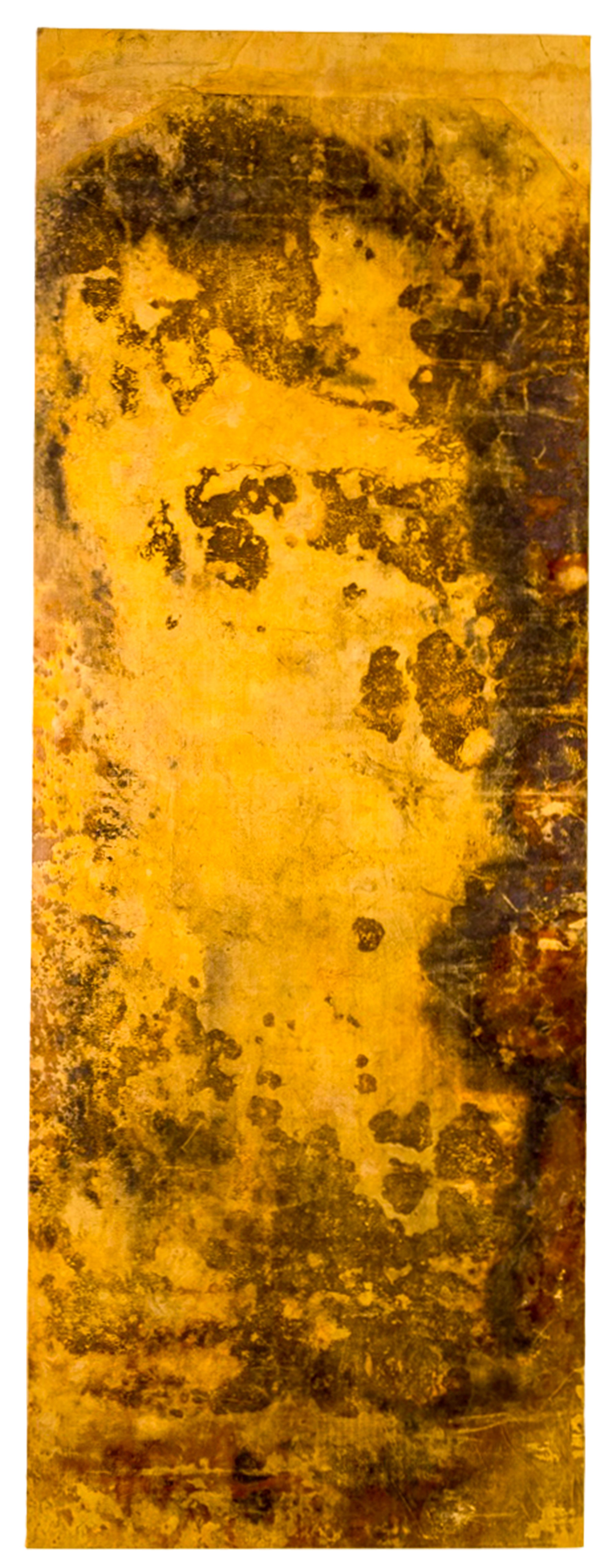
, "...A Simple Offering of Earth and Water", 2023, ballistic grade Kevlar, steel, rust, resin, fiberglass, 96 x 35 in
U: What is the most impactful advice you’ve received as an artist, and how do you apply it to your work today?
C: I guess I can start with the most recent first. Um... No filter. Don't filter or limit or hold back, because of hesitation or trepidation on how anybody else might react, or how anybody else might feel about your work. Or aiming for any particular circle or market. Like, don't hold back. Change, modify, morph. Be organic. But don't subtract, you know? Don't diminish yourself. Even broader than that. Even if it's not about yourself. If you feel like you need to subtract, then you're shooting in the wrong direction anyway.
A lot of that comes down to this thing where you have to be true to yourself. If you're in anything for the long haul and if its roots are deep in you, you gotta be true to it. Because honestly, the only people that I've seen, God's honest, that can go the length while faking it, in any large macro micro aspect of it, faking it…the only people I've seen that can do that are sociopaths, you know? Anybody that I've met in my long and illustrious life and career who has to fake it for a long time ends up cracking, crashing, and crashing out. It's just human, especially on the creative side of things, you know, for most creatives. It eats you up from the inside.
It's like regret. People talk about: have any emotion you want, just don't have regret. Regret is acid. It will eat you to death. And I feel like another version of that is how faking it can eat a person to death if your whole thing is based on getting something out that's true to you. It really depends on what kind of artist a person is. That comes from a bunch of different places. Yeah.
I think it really kicked me in the head in the last two months. I mean, it's always been my thing. I've always been weighing, you know. It's like a family, you get kids, you get responsibilities. You think, well, hey, look, if I just make my stuff like this, financially and opportunistically, blah, blah, blah, blah, blah, blah, blah, blah, blah. But whatever happens, it's like that thing that people can see. It's like that uncanny valley, you know? When they see a 3D movie, and it's supposed to look super tight, but it's just that one little thing that makes the characters just look like they're not real. We subconsciously see it, and I think that a lot of folks, depending on how deep they get into your work, and especially gallerists, especially writers, especially people that are making an effort to become familiar with you, they'll feel, and they'll see that, you know, the casual viewer on a Saturday afternoon, they'll see that there's something not really hitting or connecting about the work, or you, you know, over time. And even if nobody feels that it sees it, like, you'll feel it. You'll know. You know, you won't be able to make the work.
And then going back, a couple of the others that were really hitting were, don't scare your audience. If you want to make things a little easier for yourself, don't scare them. Don't stop saying what you need to say. Say it differently. Don't stop building on the themes you want to build on. But if you want certain things to come out of your work, and if you want to connect with folks, there are lots of ways to do it…learn to speak different languages. That's not subtracting. That's just translating. And if a person's goal is to connect with people, is to have an effect on people, is to start conversations, is to engage in the zeitgeist of whatever, then the more people that can connect and hear your conversation, the better.
I've had experience early in my career where I would have whole curatorial boards from institutions come through, and they love the work. But it was just so intense and heavy for them that sometimes they would just be like, That was a lot. And it was hilarious. Hilarious.
People talk about the art market a lot. It's the biggest unregulated market in the world. Yeah, the actual act of being an artist, you know, it's the biggest unregulated state of existence in the world. It can be anything it wants to be. Literally anything. And that's what's got me in trouble so much…in grad school, people got pissed off at me because in film class, I would always reference Hollywood movies and stuff I grew up on. Everybody else was referencing, you know, the six-hour art film they saw one time… listen, there is some existential shit in the narrative of Die Hard. And don’t get me started on the Matrix… Even growing up, I was deep into Syd Mead, you know, the futurist designer, the car design thing, went on to do all kinds of designs for movies and stuff. And people look down on it. It wasn't highbrow enough. It wasn't pure art enough, but I feel like there's no such thing. Plus, artists, we swim between highbrow and lowbrow all the time, you know? There's something that can change your life in almost everything.
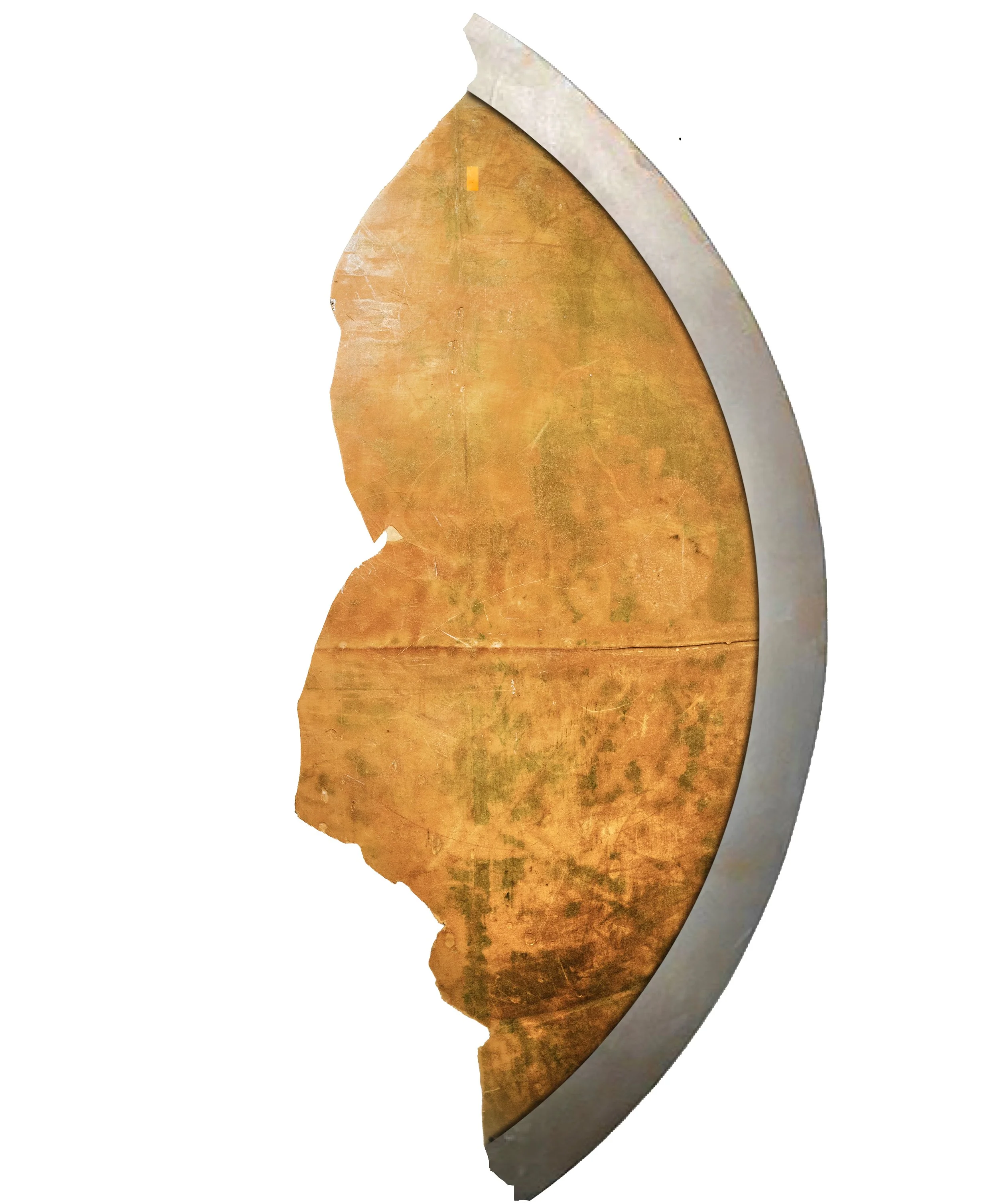
Accretion Collision, 2025, ballistic grade Kevlar, steel, rust, resin, fiberglass, 76 x 36 x 9 in.
U: Did your latest exhibition meet your original vision? What aspects of the show best showcased your theme and dedication?
C: This exhibition, in particular, I enjoyed riding the organic wave of its development. I went into it with no expectations, and I could experience, minute by minute, all the developments of the exhibition. It wasn't me putting on a solo show that had to be in my complete language because it was me. It wasn't a rock-solid thing that couldn't be molded or didn't have any room to breathe, so I wasn't focused on trying to make anything fit with anything. What it really felt like was that there was some element of my work and Bobby's work that spoke to people in a strong way that connected. And I was completely open and game for finding that myself. And it definitely helped a lot that I have 1000% trust in the curators and the people behind the show, so I could, basically, let Jesus take the wheel. Even folks that I didn't know that were involved with the show, I got a chance to really meet, and we all hit it off. We all had a vibe, different vibes. It was great. The space is beautiful. You know, there's stuff in there that I wouldn't have done, you know, some of my pieces are hung in ways that I wouldn't have hung them. But I get to see my pieces in new perspectives. You know what I mean?
I've always said that one thing I love about doing artist talks, having openings, and having people talk to me about the work is that I learn more about my work. Third, the biggest thing that somebody's told me…they were like, look, you gotta make your work in ways that people can connect with it and make it their own. They have to see some part of themselves in it or some part of it in themselves.
U: What are the key similarities and differences you notice between collaborating with one other artist versus a group?
C: It depends on who you're with. It depends on what the group is and what the other individual is. I can tell you the last two times that I've had a duo show—one was my first show at C24 Gallery and one was this one—the person I was showing with, I just respected them so much, and they were so dope… Both of them are great people…it's like, you're just hanging out. I know that if you do a larger group, they're more impersonal. Or they can be. It's almost like donating your piece to an auction or something. Which, you know, sometimes there’s a time and place for that.
I definitely have enjoyed the experience of the two-person shows that I've been in because it's really kind of like two artists coming and hanging out together, talking trash, and talking shop. And it can be a conversation, you know? There are so many more elements when it gets bigger and larger, which can be more enjoyable sometimes with a two-person show than doing a solo show. You know, solo things can be more stressful on artists, depending on what kind of artists you are, because it's like, oh, I gotta, gotta get it the way I want it. There are other people who are throwing into the pot, and it's not all on you. You know, it can be a lot of weight off your chest. Easygoing, yeah, for sure.
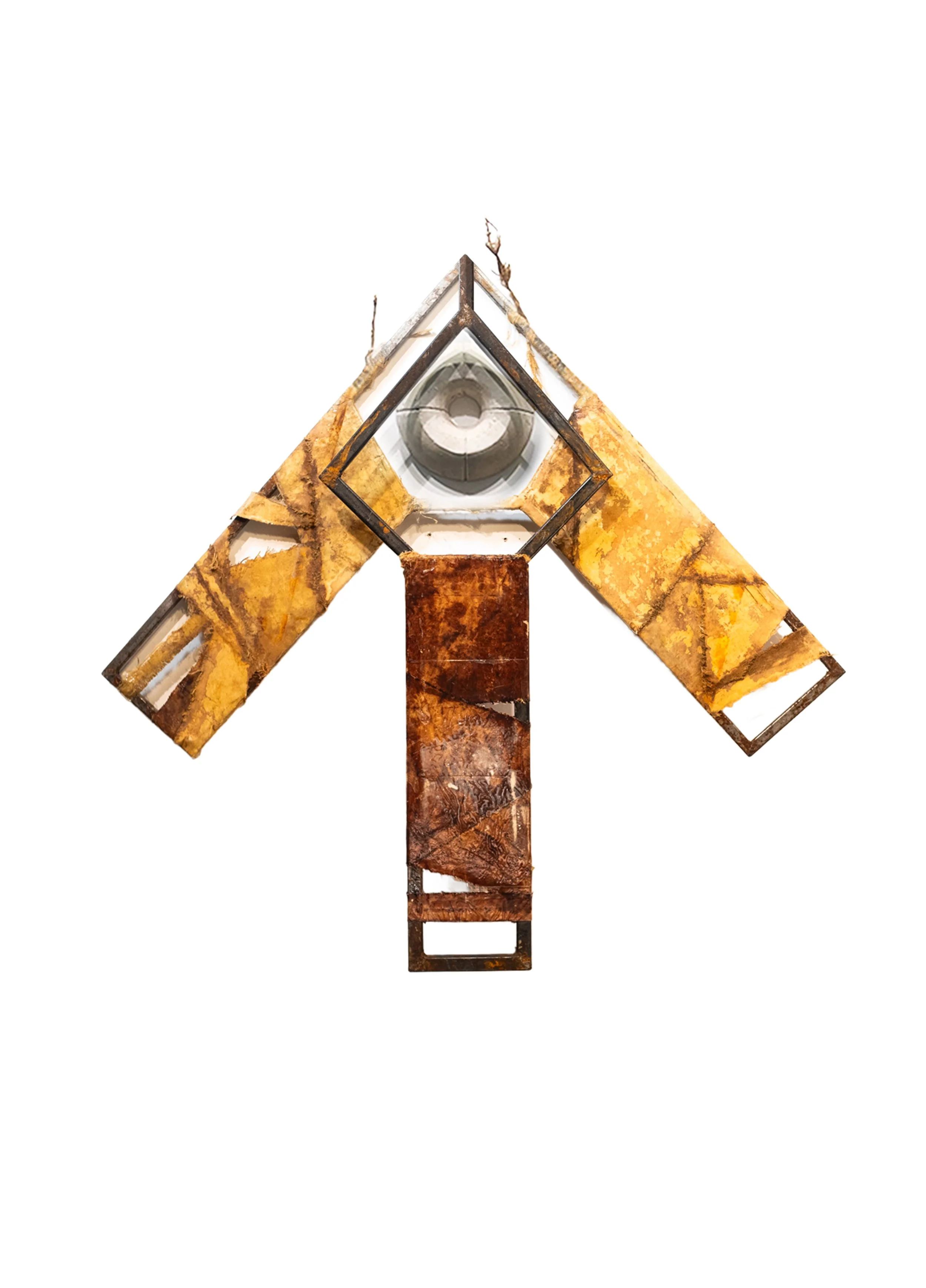
Diaspora Portal_Gate Lock #1, 2025, ballistic grade Kevlar, steel, rust, resin, fiberglass, 50 x 48 x 5 in.
U: In what ways do you use your art to engage with societal, cultural, or political issues?
C: I've always felt like, and my brother, Hank [Hank Willis Thomas], is always saying, all art is political. And it is because, again, I don't see any separation between any of this. You know, Syd Mead, my childhood artistic hero, ever since I saw Blade Runner when I was seven years old. Syd Mead, who created the future, he just saw himself as drawing some cool stuff and making some things that people got entertained by. But everything was in there, you know, patriarchy, non-patriarchy, religion made it in there, politics, foreshadowing the future—anytime you talk about the future, you're talking political and cultural anyway. It's all embedded in everything we do—literally everything. And it's not even like a scale thing. Somebody would take the smallest comment or the smallest thing that you may have dropped in there for something, and it will have a lasting impact on the way that they see you, your work, and life, the universe, and everything as a whole.
Personally, I've had many adventures and misadventures through the murky swamps of political and cultural and societal discourse, throughout my life, my artistic career, my creative career, my creative everything, my practice, because, I mean, I've made art since I came out of the womb. It's always been that for me; that's the thing. I've met a lot of people who got into the art track in college, and that's dope. But it's hard for me to plug into a lot of ways that people see their life and their practice at large that come from those circles. There's something intentional about a lot of the things they do. And for me—not better or worse, I'm not putting value judgment on it— for me, it's no different than choosing toilet paper to wipe your butt, or deciding if you're going to sneeze in your hand or the crook of your arm. It's just the world.
My being so open and frank about society, politics, and culture comes a lot from being who I am. You know, being a Black American, we've grown up in a dystopian society, and lots of people don't get it. Like all those horror movies and sci-fi movies of the 80s and 90s that we all grew up on, we've known that we live in that. You know, we live in a society that was built on genocide, slavery…every company, every top company out right now came straight out of slave catchers. And we've been getting lynched since we got here, and we're still getting lynched to this day—this year, there were lynchings. People just killing Black folks because they're Black.
A comedian said this one time. He's like, every year, white folks put slavery back another 100 years—y'all, that happened 500 years ago. But no, that thing got abolished 140 years ago. That's two seventy-year-old black ladies living and dying back to back. So for me, it's all intertwined, and I've been so frank and honest about it that it's gotten me in trouble a lot.
In high school, I was the pariah because I was labeled a poster boy for patriarchy and misogyny. Because, and I figured it out, it's because, for a long time, I was critiquing by example. My whole thing with a lot of the things that I worked on is, oh, y'all treat us like this in this society? Well, here's what society's gonna end up with if you keep treating us like this. And then I make a depiction of a future that has been inundated with theocracy… When I got back from Japan, and I came back to America, I was stunned to find, in my perspective, how religious this country is, how it's a theocracy, it's a technocracy. It's all these things, and I was surprised I didn't see it before I left. And a lot of the work that I did, a lot of the series, a lot of the media that I put out was a forecast into the future, just painting a picture of what the future of that would be, painting a future of how black folks and people of color of all different cultures are seen in this society. Women are heavily gendered, and how that happens. And so I would take these things in these elements and make these very realistic realities. This is the stuff that was scaring people. I put it out there to, not to shock people, but to be like, this is now. I’m critiquing by example. And so a lot of the elements that I would take out of these societies and make into an art thesis, people were like, are you critiquing, or are you just perpetuating?
By definition, to be an activist, you need something to fight for, fight against. And so, it needs to be a this versus that, and so everything is distilled into these boxes. Binaries, you lose all the nuance of existence, a reality of the world, the universe that we live in. And, you know, people get pissed at me. They're like, you get to the point, get to the point when we're talking about stuff. I'm like, look.. You wanted it served up simple and easy, but it's not. It's not.
U: Which single item in your studio is most essential to your creative process, and why?
C: I’m entering new territory. This is the first time that I've been a practicing artist who knows that they have ADD. My whole life up until a couple of years ago, the most important thing in the studio was wall space. I could put all my sketches, notes, and everything else. I needed to see everything at once. I needed to have that because that made me think about that, have that, that, there. I hated books. I loved sketchbooks, but then I was like, it's gotta be all laid out there. I finally understood all those scenes in movies where some quack has a room in the back that's dimly lit and like little strings going from map point to map. I don’t even know, because every studio I've had since I was diagnosed with ADHD has been to serve a specific purpose—they were temporary…

Diasporia Communicatus, 2023, ballistic grade Kevlar, steel, rust, resin, fiberglass, 97 x 48 x 11 in.
U: How do you think art facilitates healing for both artists and audiences, beyond communicating social or cultural messages?
C: Art is everything; it does everything. I will say that beyond the didactic, social, cultural, political messages, themes, and conversations, art itself—visual art, audio, music, culinary, olfactory art, everything—connects to some element of the human spirit experience. You see it all the time. You know, when a song comes on, and one person or five people are just like, oh…they get the doodoo face? Like they're emotional, they know that they're alive. They're being reminded that they're alive and they can feel something. You know that song, Sunday, Monday, Tuesday, Wednesday, Thursday, Friday, Saturday, that song… I was in a supermarket in South Carolina, in Charleston, and that song came on. And I realize the entire supermarket is having this cultural connection. And everybody looked around like, oh, yeah. Uh-huh. It's like a dance party in the aisles. And that's one out of a bajillion ways that people are impacted and have these moments. And in that movie, Basquiat, you know, when he's having a flashback of him and his mom going to the Met, and they were looking at Guernica. And she just starts crying, like weeping? I have had that happen. I've been to museums, and there'll be a piece that just hits so deep. I don't even know what it's about, you know, but it brings something up in me that I get all teary-eyed and, you know... There are songs that come on that just make me start turning into a big, mushy one, you know?
The healing comes in when the work lets you know things about you…you're like, oh, why did I start crying with that? You know, and then you see stuff… Or if there's work that will give you strength and power. There's no cathartic anything. It's just like, wooh, yes, let’s go!
U: After developing an exhibition concept, what are your key creative steps to translate the idea into a completed show?
C: From an artist’s standpoint, this goes to a lot of stuff that goes on in the head. And for me, it's starting with blue sky, pie in the sky, no holds barred, if I were to have this show in any way that I would desire it, what would that be? What have I always wanted to do? Okay, what can I do? Okay, how much time is there between now and the show? Okay. Um, what will I be able to do? How can I not piss off the curators by having the stuff not finished? How much fucking Aderall is in the state of New York that I can get my hands on in this drought? And then, taking all those elements of what you desire and what's realistic and having a constant juggle between them, bouncing between them. Can I do this? Oh, nope, not enough time. Wait, what can I do in this time? Or I can do that. Well, that sucks. Well, what if I did it like this? Oh, yeah, that'll work. Okay, let's do, you know, it's like back and forth all the time. It's a give and take. And I think overall, you know, in a sentence, it's a constant, crazy making, yet oddly satisfying, ricochet and back and forth bounce between what's possible and what's desired and what's possible, all the while maintaining, how can I impart the core theme or themes of what this work and this time in my artistic life is about? How can I say what I need to say to the viewer, to the people, to the folk? How can I do all of this without compromising my integrity, my artistic outlook, my aesthetic?
Conditions of Inheritance is Coby Kennedy’s latest exhibition with Bobby K. Hill at L’SPACE Gallery in NYC. The exhibition will end in April. The magazine did a feature on the show, which can be found here. For more information about Coby’s artwork, please visit his website here. Please follow him on Instagram also here.