In Conversation with Rachel Youn
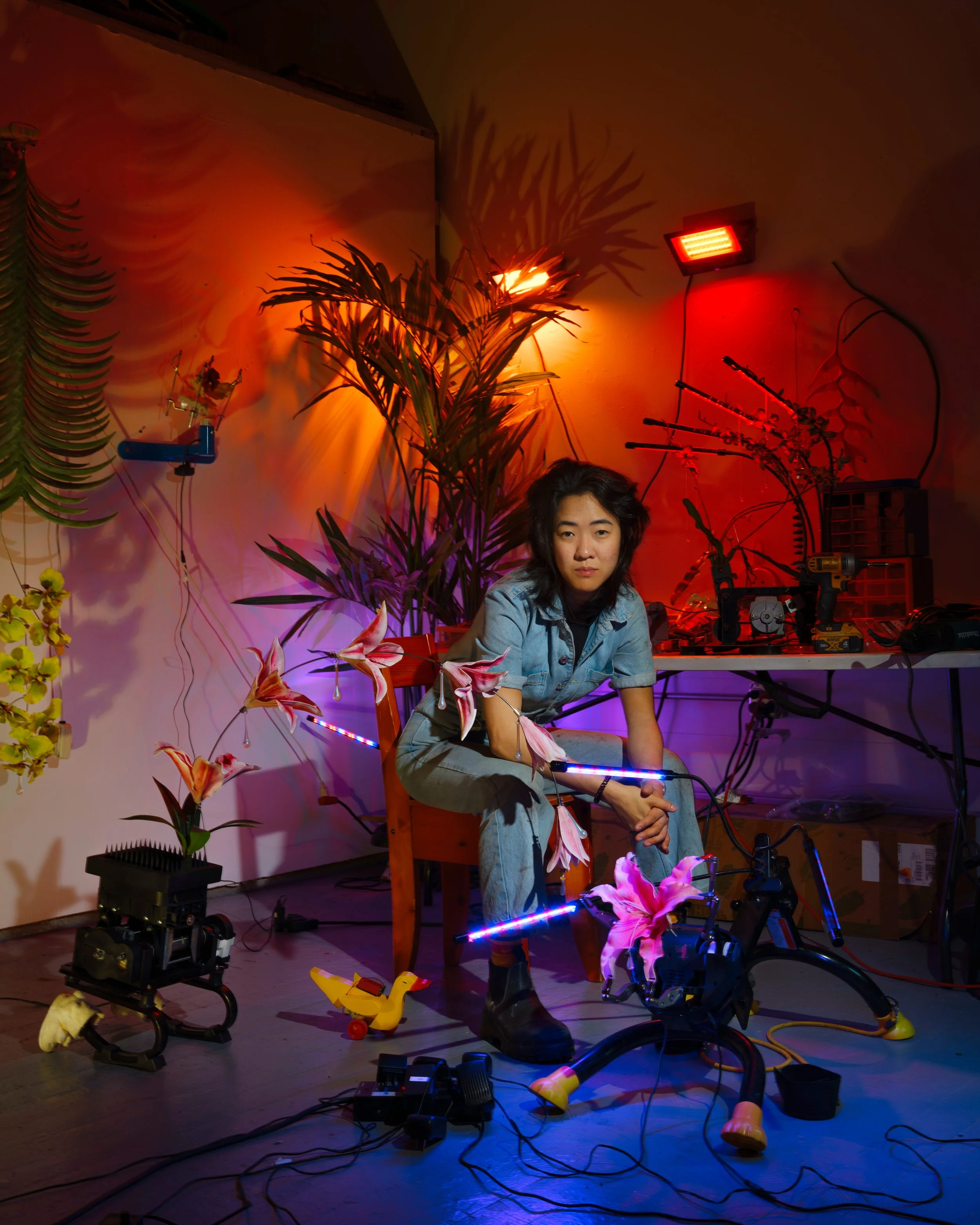
Portrait of Rachel Youn by Jarod Lew"
Rachel Youn (b. 1994, Abington, PA) has had solo exhibitions at Night Gallery, Los Angeles, CA; Sargent’s Daughters, New York, NY; G Gallery, Seoul, South Korea; and Soy Capitán, Berlin, Germany, among others. Youn has participated in numerous group exhibitions at venues including Fondazione Sandretto Re Rebaudengo, Turin, Italy; FuoriCamp, Siena, Italy; Kunsthalle Barmen, Wuppertal, Germany; DOX Centre for Contemporary Art, Prague, Czech Republic; Alice Amati, London, UK; PODIUM, Hong Kong, China; The Aldrich Contemporary Art Museum, Ridgefield, CT; SHRINE, New York, NY; Gallery Belenius, Stockholm, Sweden; and Contemporary Arts Center, Cincinnati, OH, among others. Youn is a recipient of the Vermont Studio Center Fellowship and the 2020 Great Rivers Biennial Award. They received their BFA from the Sam Fox School of Design & Visual Arts at Washington University in St. Louis, St. Louis, MO. Youn holds an MFA from Yale School of Art in New Haven. They live and work in Albuquerque, NM and are represented by Sargent’s Daughter (New York), Soy Capitán (Berlin), and G Gallery (Seoul).
I had the pleasure of asking Rachel about when they/them realized they wanted to be an artist, how creating art is profound for them, their new exhibition, and so much more.
UZOMAH: Can you discuss your approach to art-making? Where do you draw your greatest influences from? Whether from artists, writers, poets, or societal and cultural movements.
RACHEL: On a technical level, my approach comes from a love of repurposing found objects, used materials, and moving mechanisms. There is already so much interesting material that exists in the world, and I’m giving myself the assignment to reconfigure it together like I’m clicking together a completely inane puzzle. I draw influence from spaces of movement like car washes, dances, amusement parks, and places where machines and objects come together to feel alive. I’m also drawn to spaces of deep bodily and spiritual transformation like gyms, saunas, and churches.
On a personal scale, my work comes from discomfort, frustration, and anxieties stemming from gender essentialism, capitalism, impulsivity, conditional love, religious control, and my own personal history.
U: What inspired you to continue your art studies at Yale? What one lesson from Yale has most influenced your creative process, and why?
R: I was working full-time in St. Louis before I left for grad school. When art opportunities started increasing, I had to make a choice on which career to focus on. I wanted to stop compromising on my practice and to buy myself two years of time and investment that would continue to fuel the work after graduation. To be honest, it felt like I was gambling my life away by leaving stability for whatever life I’m living now, but I knew I’d always regret not going and giving it my best shot.
One important lesson I learned from Yale is that I don’t need to, nor should I, do everything myself. It is a constant lesson I am learning and re-learning over and over again. Friendship and support are everything; no artist is an island.
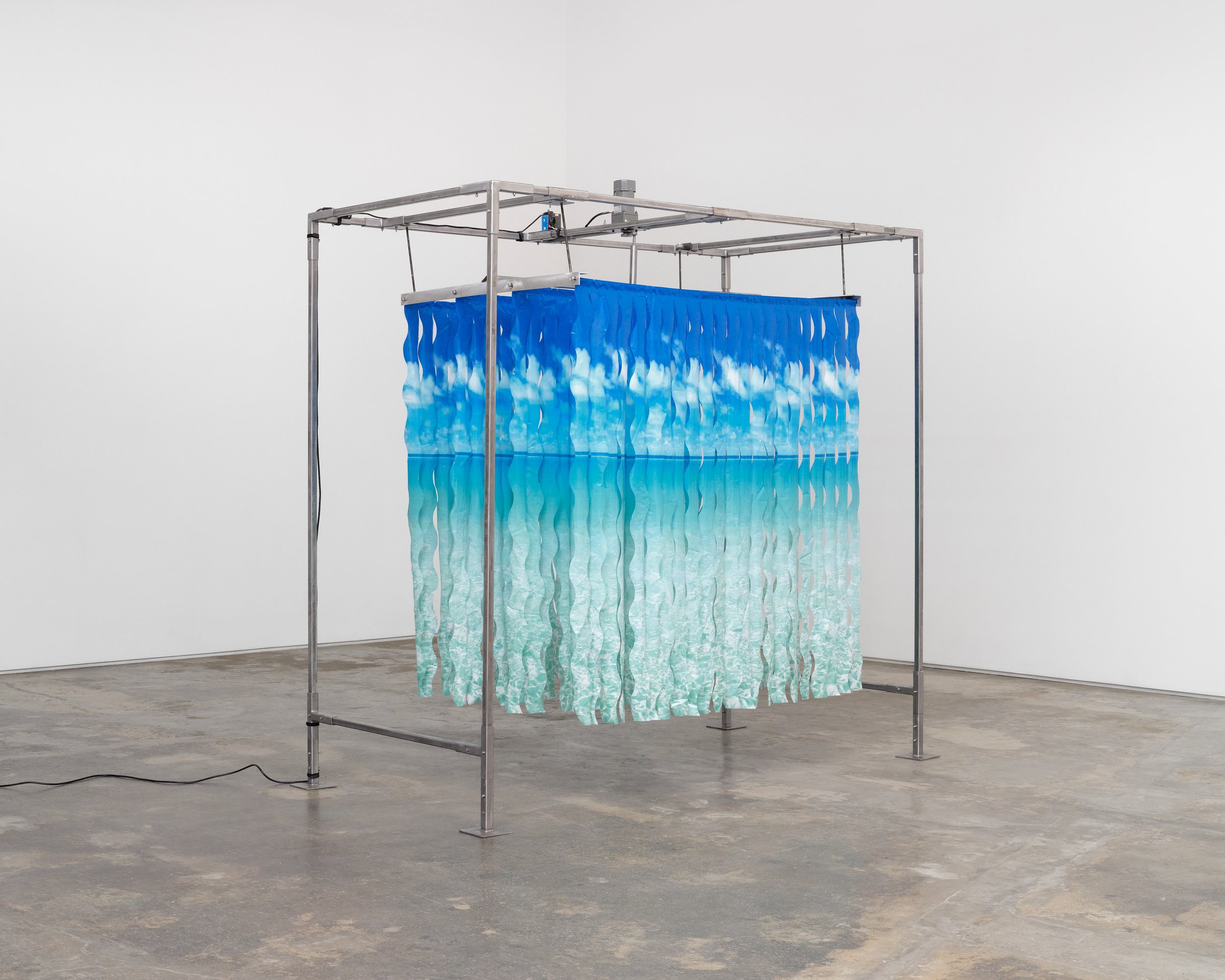
Rachel Youn CLEANSE (I’ll do it myself), 2024 steel, aluminum, AC motor, hardware, nylon, UHMW, "escape photo real ocean" PEVA shower curtains 106 x 106 x 56 1/2 in (269.2 x 269.2 x 143.5 cm). Courtesy of the artist and Night Gallery, Los Angeles. Photography by Nik Massey.
U: In what ways is creating art meaningful and profound for you?
R: It’s profound that I get to do this, and it keeps me constantly grateful. It sounds cheesy, but making art has helped me to not only understand more about myself, but also realize that I am not alone in my feelings. It is a constant challenge, and agonizing as much as it is a blast.
U: If you could eat dinner with any artist, writer, or poet, dead or living, who would you pick and why?
R: I would love to meet the late Feliza Burzstyn, a Colombian artist whose work I adore and feel kinship with. She was a badass sculptor working with metal and kinetic components, a feminist and leftist, and labeled a “madwoman” by the Colombian press. There’s so much emotion to her work, and I would love to learn more about the details of her life that are not captured in her biography.
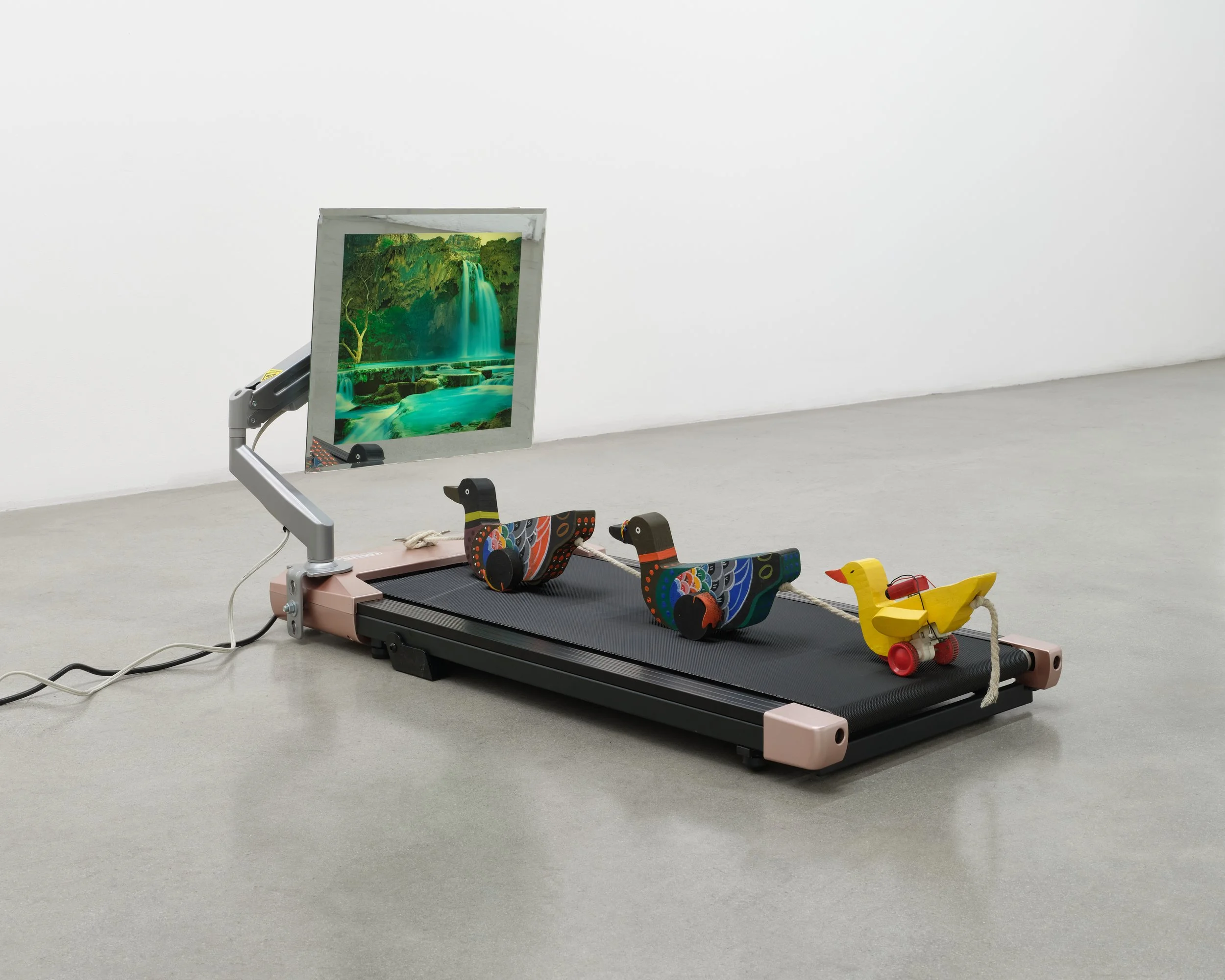
Rachel Youn No Pain No Gain, 2025 walking band, wood, paint, brass, vinyl, cotton rope, cotton thread, hardware, motor, dead battery, found moving waterfall picture frame, monitor arm 25 1/2 x 46 x 21 in (64.8 x 116.8 x 53.3 cm). Courtesy of the artist and Night Gallery, Los Angeles. Photography by Nik Massey.
U: What is the single most important trait in artists that enables them to see the world differently through their work?
R: To me, the most important trait in artists is the understanding that we will never have the answer or solution, that the work is never “done.” Artists take meaning and connections from disparate ideas and materials and digest them into a new form. We cannot leave anything alone.
U: Are you currently reading anything? How has your current reading specifically influenced your creative process?
R: Lately, I’ve been reading texts about asylums, discipline, and how madness has been villainized and institutionally treated throughout the last few hundred years. For me, reading and making are reflexive practices, and this research informs my understanding of how different modes of treatment, like restraint and labor, were used upon others and how we inflict them upon ourselves.
I also recently listened to Youngmi Mayer’s I’m Laughing Because I’m Crying. It was such an emotional experience, and especially as I’m in the midst of reading academic and theoretical texts, it really reaffirmed how important and meaningful it is to create from a deeply personal place.
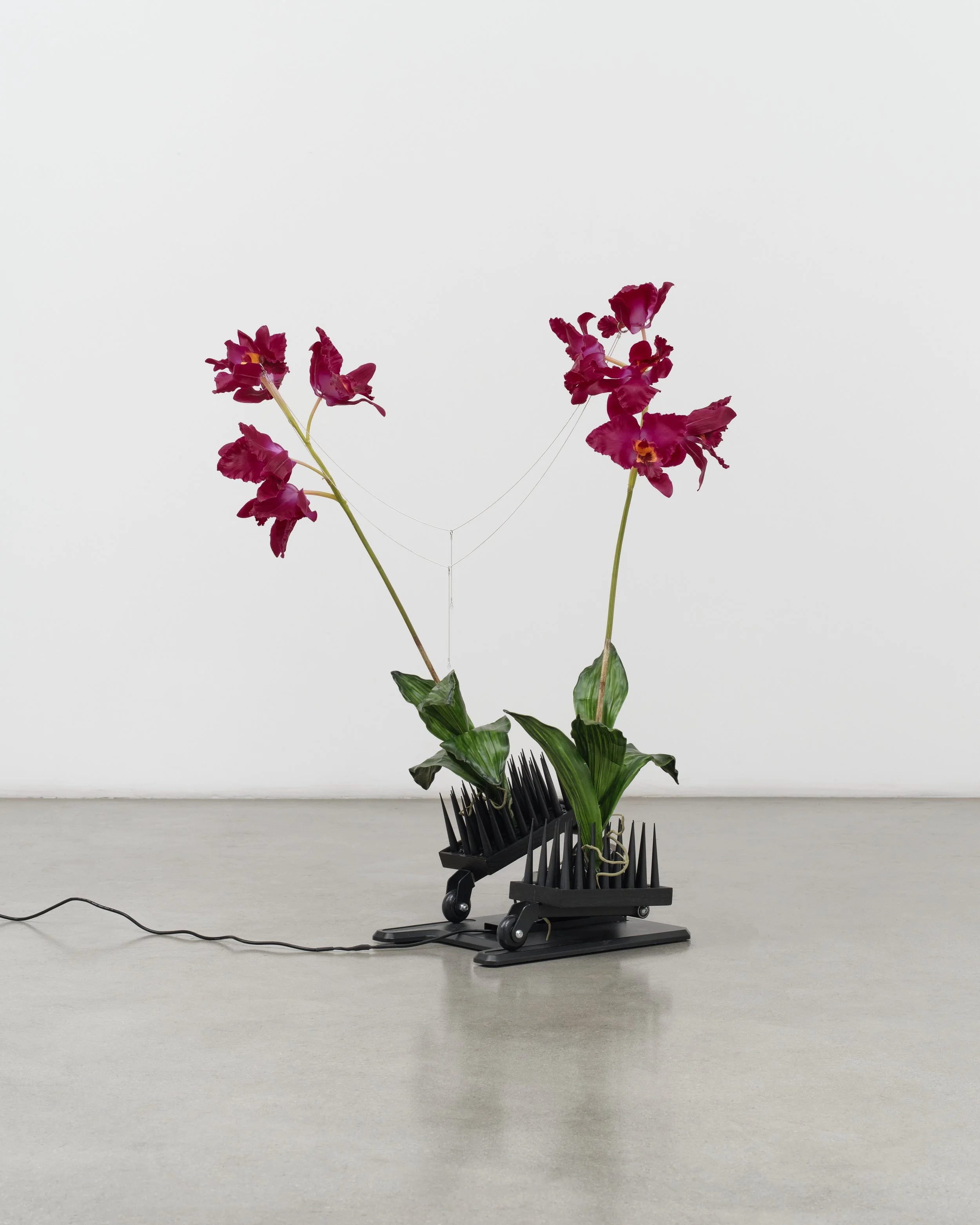
Rachel Youn Perfect Lovers II, 2026 under-desk elliptical machine, artificial orchids, wood, paint, bird spikes, glass, snake chain, hardware 41 x 28 x 38 in (104.1 x 71.1 x 96.5 cm). Courtesy of the artist and Night Gallery, Los Angeles. Photography by Nik Massey.
U: What are the key advantages you see in participating in a two-person exhibition like Factory Doomscroll?
R: Meeting Christine and talking and working with her at the gallery in the days before the opening, it was apparent that we shared a lot of similar feelings, and that totally manifests in the show. It’s amazing to see how we’ve both arrived at these feelings through vastly different approaches.
U: How do you know when you are satisfied with your artwork, and it's ready for presentation? Do you have specific criteria you must meet?
R: On a technical level, I’m satisfied when the hardware and different materials come together in a way that feels resolved and not slapped together. On an emotional level, I’m satisfied when I feel a little icky and slightly embarrassed about what I’ve made and am about to show.
U: How did you realize you wanted to pursue art as a career?
R: Even when I was in art school, I kind of putzed around the idea of being an artist for a while, and I don’t think I totally committed to an artistic career for several years after. Truthfully, it’s still wild for me to understand this is what I do, and that I chose a way to live that forces me to constantly confront myself. I realized that pursuing art wouldn’t be lucrative, but it would keep my life meaningful and interesting.
For more information about Rachel’s artwork, you can visit her website here or follow her on Instagram here. The magazine also featured her latest exhibition at Night Gallery, which can be found here.