In Conversation with Richie Hofmann
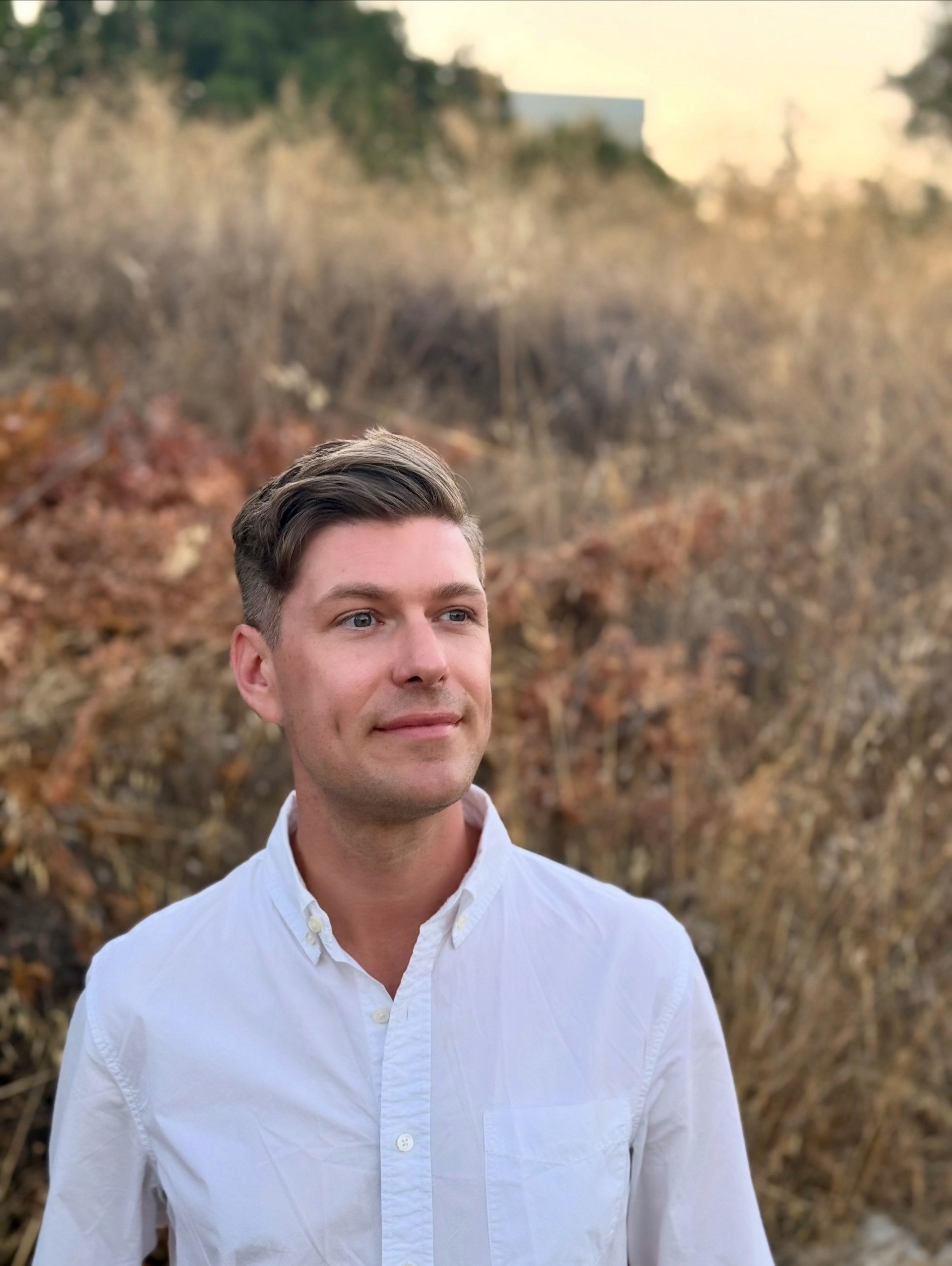
Photo Credit: © Ryan Hagerty 2025
RICHIE HOFMANN is the recipient of fellowships from the Guggenheim Foundation and the National Endowment for the Arts. His poetry appears in two previous books, A Hundred Lovers (2022) and Second Empire (2015), and in The Paris Review, The New Yorker, Poetry, The New Republic, and The Yale Review.
I had the pleasure of asking Richie what he would be doing if he were not writing, how writing has changed his life, and so much more.
UZOMAH: Where and who would you suggest reading if someone wanted to get into poetry? Where is a good place to start?
RICHIE: There’s not proper prescription for poetry—and my advice is always to find what thrills you and to follow it… Today, I might suggest starting with some exhilarating modernist poems—H. D.’s “Heat” is a favorite of mine. T. S. Eliot’s “The Love Song of J. Alfred Prufrock” is a classic gateway drug.
U: How has writing changed your life?
R: I often think of poetry as a worldview, a way of seeing and feeling one’s way through life. The intensity and distillation of image-making, the artistry of line-making—writing poetry is a form of attention I love to live inside. I think my experience of the world would be very different without it.
U: As a professor and Lecturer, what is the most crucial aspect you emphasize when guiding the development of a writer or poet?
R: Two things immediately come to mind. First: I want to impart the sense that form is not a decoration but an engine; the shapes and sounds of the poem, its deployment of a traditional structure should be a vital part of its communication. Second: to embrace your individual music. The languages you grew up speaking, the songs you listened to, the patois of your place or your community or your family—all of these elements converge to make a writer’s voice forceful and original.
U: How did the use of Ekphrasis and the use of art as inspiration to write come into your writing practice? How does this personal inspiration help a writer or poet to be more vivid with their word choices?
R: I write a lot about visual arts and music because they’re essential parts of my life, as important as reading and writing to me from a young age. I think an immersion in different arts and artists can offer new ways of thinking through technical and imaginative problems. Artists are restless, and they tend to absorb everything in pursuit of their art—and so I find in other arts a wealth of strategies and stances I might test out in my own work. I’m inspired by many artists from history—I’ll name Felix Gonzalez-Torres and Simon Starling as contemporary visual artists whose works and methods have influenced my own.
U: Where would you be if you were not writing?
R: Most of the time, I’m not writing. I’m getting ready to teach classes or going grocery shopping or traveling. My greatest passion is classical music—I love attending concerts and recitals and opera.
U: With the LGBTQIA community being under attack more than ever, how can the power of the literary and visual arts be a vehicle for change and proper representation?
R: Art can be a place where individuals find themselves—where emotions and desires and fears are named and described and transformed. I certainly had that experience, reading the poems of Hart Crane and W. H. Auden, Jorie Graham, and Natasha Trethewey. Some poems speak to political moments and yet transcend the specificity of those events to speak to us now (like Yeats’s “Easter, 1916” or Gwendolyn Brooks’s “Boy Breaking Glass”). Cavafy, one of my literary heroes, writes (in translation by Keeley and Sherrard) “Later, in a more perfect society, / someone else made just like me / is certain to appear and act freely,” in a poem called “Hidden Things.” I think about those lines all the time. Poetry can recognize us. Poetry can change the people who read it, but people must enact the change they wish to see in the world.
U: Why poetry? Why poetry now?
R: Poetry is older and more important than nearly everything else.
U: How are visual artists, writers, and poets all visual storytellers? What makes them the same? What makes them different?
R: I suppose on a basic level, all artists are responding to the stuff of life and imagination, trying to scratch something more lasting than ourselves onto paper, canvas, or stone. Reading very ancient poetry or looking at very ancient art, for instance, I’m struck by how little distinguishes us from the people who came before us. It was always so wonderful and terrible to be a human.
U: Can you expand on your recent collection of poems, The Bronze Arms, and where the inspiration came from when writing the poems? How is this collection different from others?
R: This poetry collection has at its core a childhood memory of nearly drowning, and of being rescued by my father. It’s different from my other collections because of this backward glance toward childhood and memory. I also think I’ve become more interested in mythology—cultural and personal—as a way of understanding narratives.
U: How has your personal journey with poetry, particularly in understanding your queer identity, influenced your writing?
R: For me, the writing of poetry feels refining and clarifying, and at the same time ferocious and complicating. When it comes to questions of identity, sexual or otherwise, I feel poetry allows for complex things to commingle. As Dickinson says, you can “dwell in possibility.”
U: Your German ancestry has had a profound influence on your life. How has it shaped your unique perspective as a writer?
R: Thinking about family history has given me a context for making sense of the world. More importantly, though, living in Germany, as a small child, opened up my imagination to art and music—Mozart, especially, who has been my most constant companion. I’m not sure exactly how it has shaped me as a writer, but hearing Mozart’s music does something to me—I feel more alert listening to it than in any other activity. I won’t ever tire of it.
U: What makes poetry a good medium to use to tell stories?
R: I’m not sure poetry is good at telling stories. Not very much ever happens in most of them. Rather, poetry urges us to slow down, to inhabit the sensuous moments, to notice details, which are always as meaningful and life-changing as dynamic events. Poetry is not an efficient way of divulging or distributing information. I’m always asking my students to consider, given this, “What does poetry offer?”
For more information about Richie’s most recent collection of poems, The Bronze Arms, please visit here. Richie’s website with more details about his writing can be found here. He can also be found on Instagram and X.