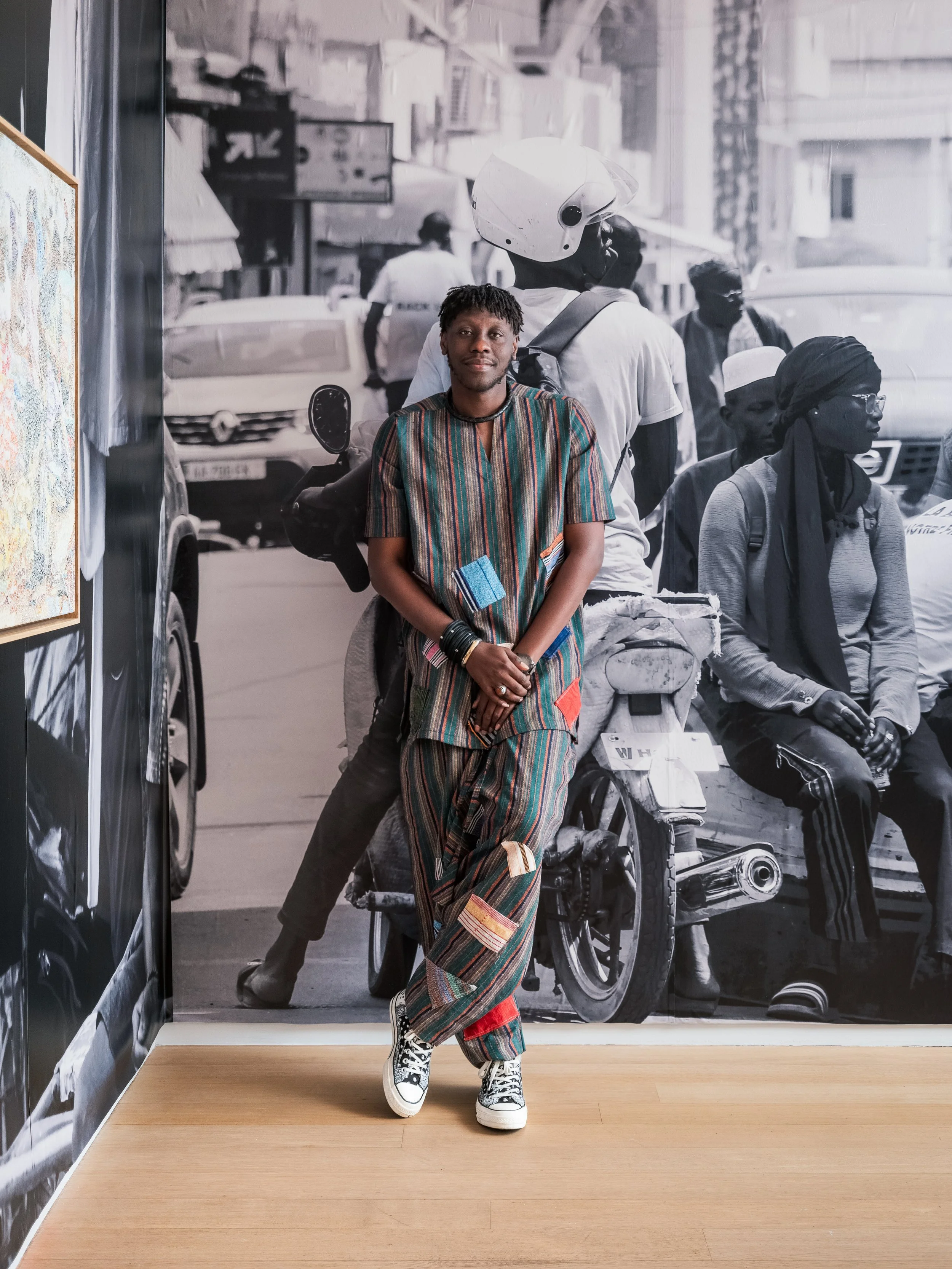
Photo Credit: © Charles Roussel
Born in 1985 in Kaffrine, Senegal, Alioune Diagne lives and works in Senegal and France. After studying at the Dakar École des Beaux-Arts in 2008, Alioune Diagne developed an imaginary script as a universal language and intimate account of fragments of his life in Dakar and on his travels. A socially engaged artist, he opens the door to a deep-seated exploration of the major challenges facing the world today: ecology, the place of women in society, racism, and the notions of transmission and heritage. His work has featured in a variety of solo and group exhibitions in Europe, Africa, and Asia since 2011, including Sink or Swim at the 11th Dakar Biennale, Villa Spivey, Dakar, Senegal (2014), Itinéraire en Couleurs at Espace Jean Drevon, Saint-Jean-de-Bournay, France (2014), the off-site show at Art Basel, Switzerland (2017), and Un nouveau regard, Aosta, Italy (2017). His work has also been part of Senegal's national art collection since 2019 and was featured in the 2022 Dakar Biennale exhibition at the national theatre in Dakar. In 2023, he won the Norval Foundation Public Vote Prize and saw his work exhibited in the Netherlands as part of the group exhibition Africa Supernova and at the Musée des Beaux-Arts de Rouen with the solo exhibition Ndox-Glint. Galerie Templon in Paris held the Seede exhibition of his work in January 2024. And in April 2024, the artist had the honor of representing his country on the Senegalese pavilion at the 60th Venice Biennale international art exhibition with the project Bokk - Bounds. He has been represented by Galerie Templon since 2022.
I had the pleasure of asking Alioune what inspired him to become an artist, how he developed the Figuro-Abstrak movement, and so much more
UZOMAH: What inspired you to become an artist? Was there any moment or even an artist that made you want to pursue art?
ALIOUNE : I've been drawing for as long as I can remember. It's something deeply instinctive for me, my way of expressing myself. I grew up in Kaffrine, in the Sine-Saloum region, in an environment where the concept of "artist" didn't really exist as such. I knew nothing about art history or the great painters. My earliest references were closely tied to the community I was raised in, to our traditions, our stories, and our culture.
Later on, someone introduced me to the École des Beaux-Arts de Dakar, and I realized I could actually make a living from what I loved doing. That was a real turning point. At the École des Beaux-Arts, I discovered art history, the great artists, and different approaches to painting.
After that, I moved to France and began developing projects in Europe and the United States. In museums, I encountered major works of Cubism, Impressionism, and contemporary art, all of which left a deep impression on me. Seeing these works in person only strengthened my desire to keep going down this path.
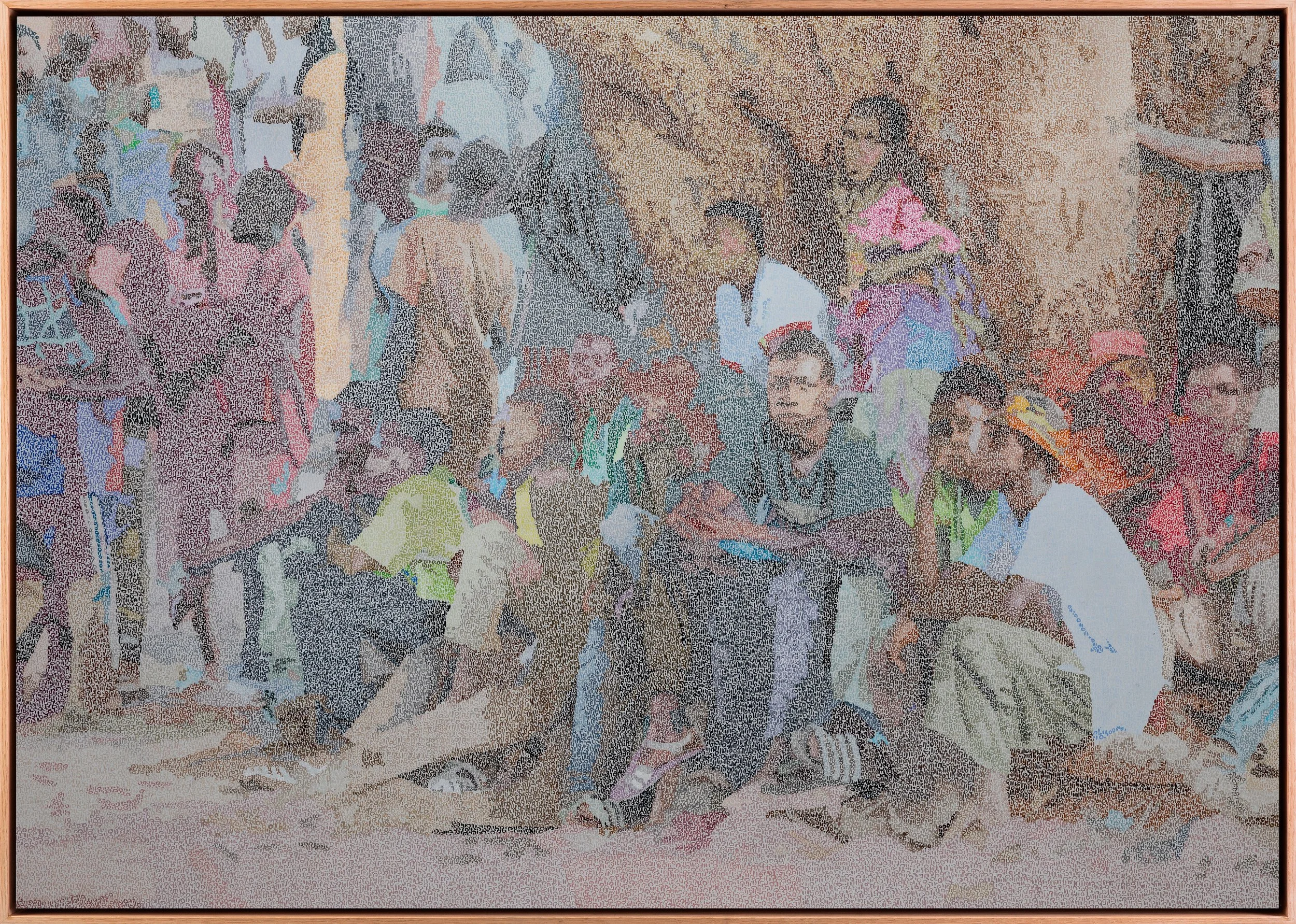
ALIOUNE DIAGNE, Sous l'arbre sacré, 2025 Acrylique sur toile | acrylic on canvas 145 × 210 cm — 57 × 82 3/4 in. Courtesy of the artist and Templon, Paris – Brussels – New York. Courtoisie de l'artiste et Templon, Paris – Bruxelles – New York. Photo © Laurent Edeline.
U: You are known for the Figuro-Abstro movement. Can you clarify how this movement affects future African artists and artists more broadly, particularly in their exploration of art and in their approach to issues through a distinct artistic lens?
A: I developed Figuro-Abstro in 2013, after completing my studies at the École des Beaux-Arts de Dakar, because I felt driven to create my own visual language. This approach involves building figurative images from a multitude of abstract signs, creating an ongoing dialogue between abstraction and figuration.
This language is deeply rooted in my personal history. It draws on the calligraphic work of my grandfather, who was a Koranic teacher. Growing up surrounded by those signs, that script, it naturally shaped the way I paint. But even though this approach comes from something intimate, it can also carry universal reach, because anyone can connect with abstract writing and the universal themes I explore.
I believe it's essential for any artist, regardless of nationality, to seek out what makes them singular, to develop a language that is genuinely their own. One of the keys, I think, is to build a body of work rooted in something familiar, something you know deeply, something intensely personal, which can at the same time resonate with and engage people from different cultures and backgrounds.

ALIOUNE DIAGNE Les danseuses Bassaris (Eyok), 2025 Acrylique sur toile | acrylic on canvas 124 × 182 cm — 48 3/4 × 71 3/4 in. Courtesy of the artist and Templon, Paris – Brussels – New York. Courtoisie de l'artiste et Templon, Paris – Bruxelles – New York. Photo © Laurent Edeline.
U: If you could go back to any artistic movement in time, which one would you most like to be an artist in and why?
A: In 2023, I held an exhibition in dialogue with Impressionism at the Musée des Beaux-Arts de Rouen. That's when I truly discovered this artistic movement, and I was fascinated by it. The Impressionists were among the first painters to leave the studio and paint outdoors, immersing themselves directly in landscapes and observing the changing qualities of light, especially on water, in order to capture those shifts in their work.
This approach speaks deeply to me because it's grounded in observing the real world in light and sensation. I would have loved to be part of that era, not least because these artists profoundly transformed the practice of painting and revolutionized the art of their time.
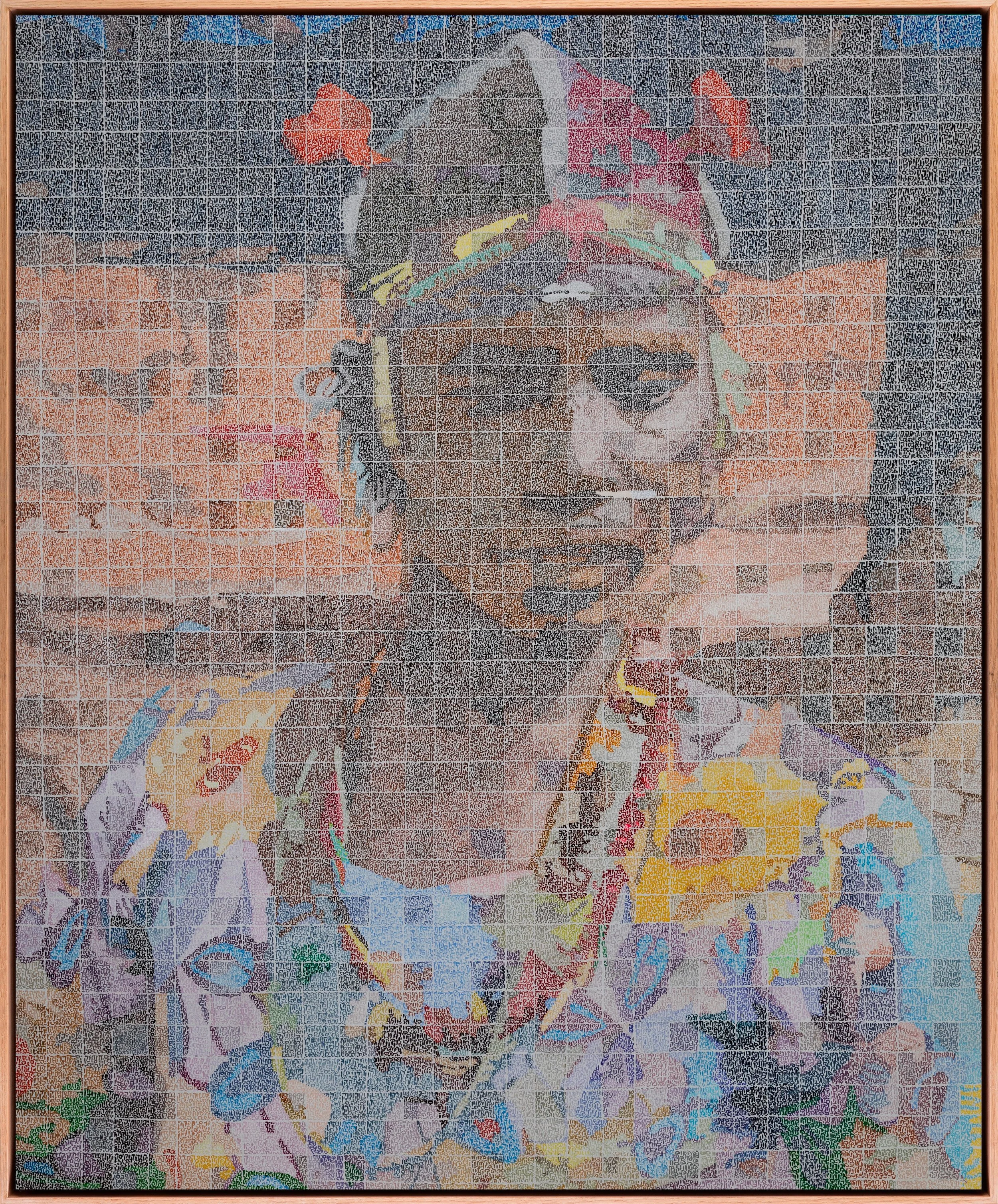
ALIOUNE DIAGNE Jeune fille Bassari, 2025 Acrylique sur toile | acrylic on canvas 213 × 175 cm — 83 3/4 × 69 in Courtesy of the artist and Templon, Paris – Brussels – New York. Courtoisie de l'artiste et Templon, Paris – Bruxelles – New York. Photo © Laurent Edeline.
U: Can you describe your technique and how it allows you to apply your theme in the truest sense?
A: Figuro-Abstro is a technique I developed organically following the passing of my grandfather, who was a Koranic teacher. I build my compositions from a multitude of abstract elements that I call my “unconscious signs.”
When viewed up close, my paintings appear primarily as a network of signs and abstract fields of color. But as the viewer steps back, a figurative image gradually emerges, and the scene begins to take shape. I am fascinated by this idea of an image revealing itself little by little to the viewer.
This fragmented construction also reflects the way I approach my subjects: through memories, stories, and multiple realities that come together within a single image.
Through this technique, I address issues that are deeply important to me, including racial discrimination, the overexploitation of fishing resources in Africa and its impact on Senegalese fishing communities, questions of coexistence, memory, and the transmission of traditions, as well as the place of women in society.
This visual language encourages a particular kind of engagement from the viewer. First, they are drawn in by the signs and colors; then, by stepping back, they gradually discover the scene and its meaning. I believe this process of looking can spark reflection and awareness, and that is at the heart of my practice.
U: How can an artist be more in tune with their creativity? How do you stay creative?
A: For me, there isn’t a clear line between everyday life and painting. I have set up a large studio in my home, and I paint every day. My artistic practice is a constant presence in my life.
What truly fuels my creativity, however, is travel and human connection. I need to immerse myself in places, landscapes, and everyday situations in order to create. Observing people, listening to their stories, sensing the atmosphere of a place, and discovering different ways of living, this is often where my ideas begin.
For example, my exhibition Ndox-Glint at the Museum of Fine Arts in Rouen grew out of extensive work along the Senegal River, where I spent time with fishermen and the communities who live there. Similarly, my 2025 solo show Jokkoo at Templon was shaped by my travels to New York and the energy of that city. The same is true of my new exhibition, Saytu, which is the result of a long journey of research and encounters.
I need to engage directly with social and human realities, both in my own country and abroad. These experiences, conversations, and observations of everyday life are what sustain my creative momentum and ultimately give rise to my paintings.

ALIOUNE DIAGNE La foule qui danse, 2025 Acrylique sur toile | acrylic on canvas 156 × 216 cm — 61 1/2 × 85 in Courtesy of the artist and Templon, Paris – Brussels – New York. Courtoisie de l'artiste et Templon, Paris – Bruxelles – New York. Photo © Laurent Edeline.
U: How do you know when your painting is finished, and you are satisfied with it?
A: I often work on several paintings at once. As a result, some pieces remain hanging in the studio for a long time, allowing me to revisit them regularly and observe them at different times of day and under different lighting conditions.
I take a great deal of distance from my work, both literally and figuratively. I move closer, step back, focus on details, then look at the composition as a whole. I make small adjustments until I find the right balance between composition, color, and the overall energy of the painting.
That is usually the moment when I feel a work is complete and I can be fully satisfied with it.
U: Is there any message or concept you feel art cannot express that you wish another medium could convey?
A: Painting is my language, my way of expressing myself, and it always has been. I often find that I can communicate emotions, ideas, and memories more effectively through painting than through words.
Figuro-Abstro allows me to translate the complexity of reality, memory, and lived experience by moving between abstraction and figuration.
Of course, other mediums such as music, for example, can also convey powerful emotions and capture things that are intangible or difficult to define. But for me, painting remains the most accurate and natural way to express what matters most, particularly the human and social issues that are central to my work.
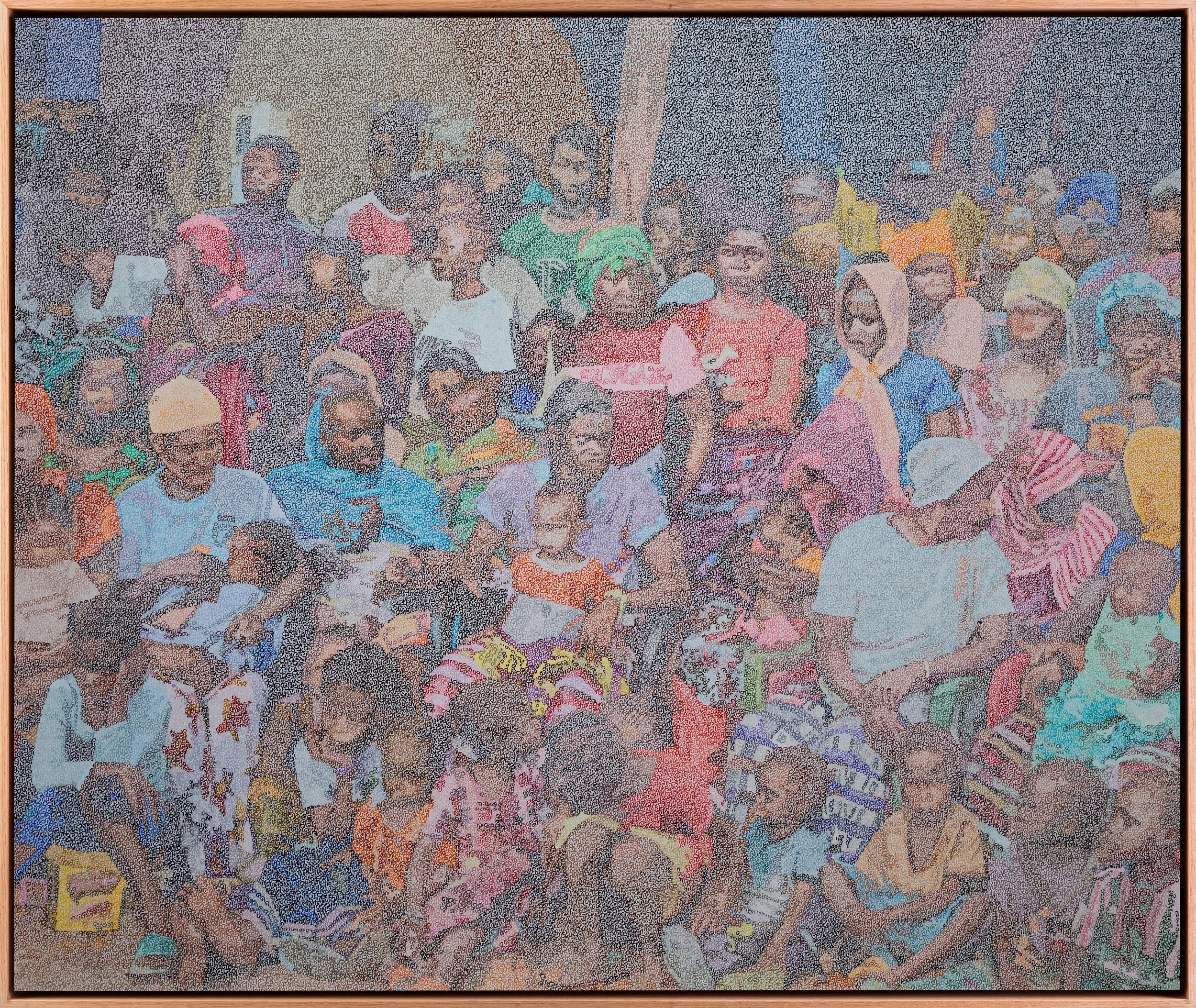
ALIOUNE DIAGNE La première ligne, 2025 Acrylique sur toile | acrylic on canvas 156 × 216 cm — 61 1/2 × 85 in Courtesy of the artist and Templon, Paris – Brussels – New York. Courtoisie de l'artiste et Templon, Paris – Bruxelles – New York. Photo © Laurent Edeline.
U: How did you come up with your most recent exhibition’s theme at Templon Gallery?
A: For several years, I had wanted to travel across Senegal and parts of West Africa to meet communities that continue to preserve ancestral rituals and traditions. I wanted to understand how these cultures endure today, how they are evolving, and what daily life looks like for minority communities living in remote regions.
More broadly, I see myself as an archivist of my time, in my own way. I strive to create works that may one day serve as visual archives of Senegal.
The project is called Saytu. In Wolof, the word refers to an observation, an assessment, or a survey of a situation. It also carries the idea of watching over, examining, and preserving what is valuable.
Over several months, I traveled to the Kédougou region near the border with Guinea, where I met Bedik, Bassari, Coniagui, and Dialonké communities. I attended initiation ceremonies marking the transition into adulthood, seasonal celebrations, dances, weddings, and other communal gatherings. I shared moments of everyday life with people and listened to their stories.
What struck me most was the role of the younger generation. Many young people are gradually drifting away from traditional practices, drawn instead toward social media and an increasingly globalized culture. During these ceremonies, one can sometimes sense a tension within them, as though they are caught between two worlds: the traditions passed down by their communities and the contemporary influences that shape their aspirations.
It is precisely this coexistence of continuity and change, these lived realities and ongoing transformations, that I wanted to explore through this exhibition.
U: What does making art mean to you? What makes you happy in creating art?
A: Creating art is truly my language and my way of expressing myself. It has always felt natural and instinctive to me, something I need, rather than simply something I choose to do.
What brings me joy is witnessing the gradual emergence of a painting. I love seeing a scene, an emotion, or an issue that matters deeply to me slowly take shape through my signs, my colors, and the composition itself. There is something deeply rewarding about that process of construction, when an image begins to reveal itself, and I succeed in translating a lived experience or an important subject into paint.
But what moves me most is the moment when a painting meets its audience. That exchange, that act of transmission, is incredibly important to me. When I meet a Senegalese visitor at an exhibition who recognizes a part of their own experience in one of my works, it is deeply meaningful. At the same time, I am equally touched by viewers from all backgrounds who take the time to look closely, to decipher the painting, and to reflect on its meaning. Those moments of connection remind me why I paint.
For more information about Alioune’s artwork, please visit his site here, and he can also be found on Instagram.
The magazine did a feature on Alioune’s latest exhibition at Templon, which can be found here.