In Conversation with Ina Cariño
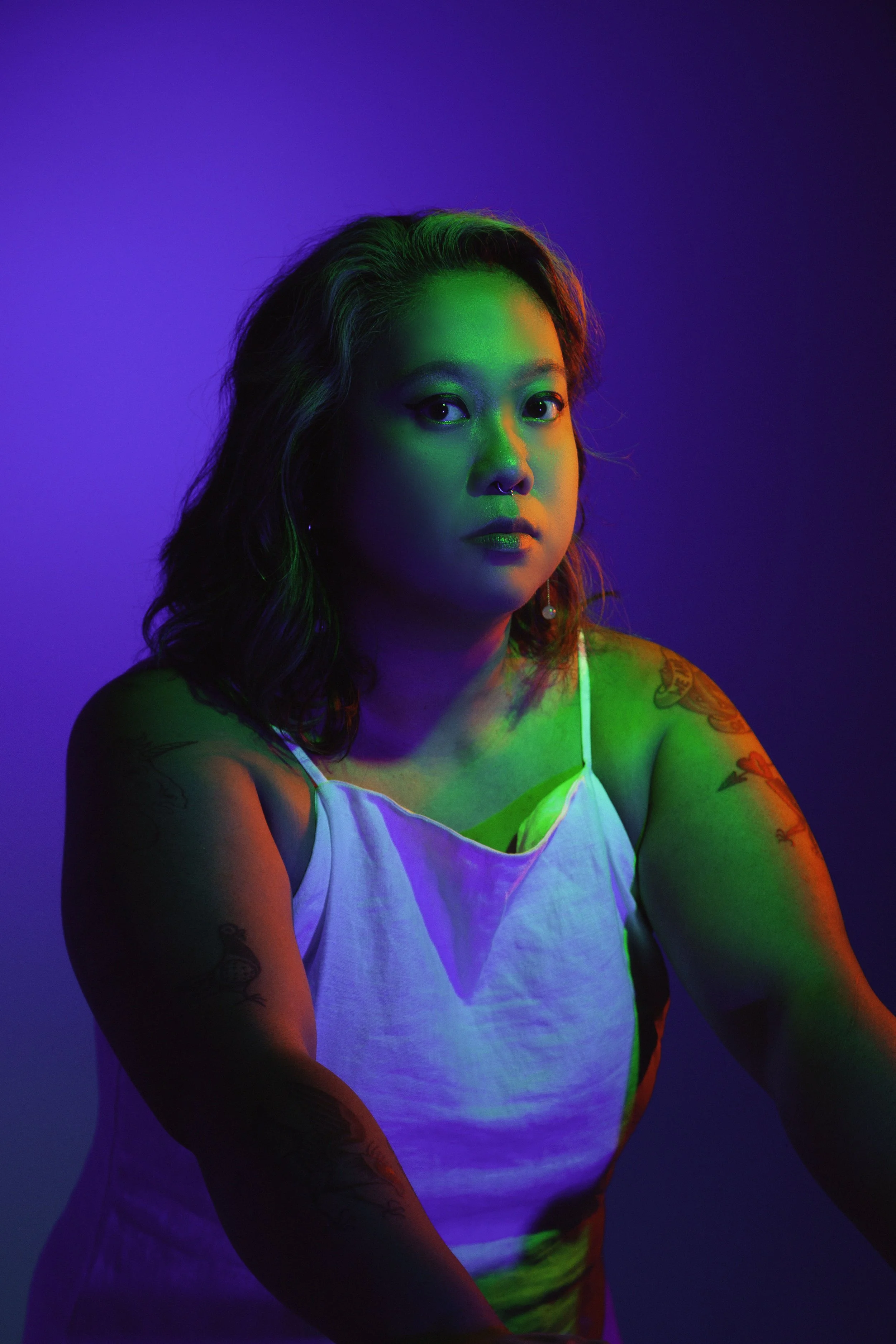
Photo Credit: Sass Art.
Originally from Baguio City in the Philippines, Ina Cariño is a 2022 Whiting Award winner for poetry. Their work appears in the American Poetry Review, the Margins, Guernica, Poetry Northwest, Poetry Magazine, the Paris Review Daily, Waxwing, New England Review, and elsewhere. She is a Kundiman fellow and is the winner of the 2021 Alice James Award for Feast, published by Alice James Books in March 2023. In 2019, Ina founded a poetry reading series called Indigena Collective, a platform that aims to center marginalized creatives in the NC community and beyond.
I had the pleasure of asking Ina what poem by another poet, living or dead, reminds them of why they love poetry. If they could write a poem based on a work of art, which artist and artwork would they choose, and why, and so much more.
UZOMAH: What do you find in poetry, in terms of self-expression, that other media cannot communicate as well or at all?
INA: In some ways, communicating through poetry is actually more of a challenge. Music is heard when it starts. A painting is seen when someone turns their eyes to it. And it’s never guaranteed that the audience will even “understand” what they’re listening to or looking at. But I can’t force someone to interact with a poem I wrote, whether it’s narrative or lyrical—and the latter doesn’t promise a story in the same way a novel does. Maybe the reader won’t stay past the first line, or even the title.
So for me, it’s not a matter of what is and isn’t communicated well. There’s no singular feeling or idea that any art form can truly encapsulate. I like to approach writing a poem with that challenge in mind: creating art that isn’t constrained by its brevity, by an audience’s unfamiliarity with its vessel. To use all I know about the craft of writing to reach an audience that may still never understand.
U: Is there a poem by another poet, living or dead, that reminds you why you love poetry?
I: Yes; “Supper” by Iraqi poet and novelist Yousif Al-Sayegh (also seen spelled Youssef Al-Sayigh or al-Sa’igh), who died in 2005. There’s not a lot printed about him in English, but he was known to have lived a tragic life: though he was staunchly communist before Saddam Hussein assumed power, he made the choice to switch political parties under the threat of exile, for which he was condemned by former friends and colleagues until his death. Poetry, as a cultural product and as proof of loyalty or political support, often masks things. In reality, maybe he did support the new regime—though his poetry suggests he was also trying to protect his life while remaining in the country he knew and loved. I suppose I love poetry because each poem is a little world, part of a larger emotional whole that’s more nuanced than we often take other humans to be.
Supper (trans. by Saadi Simawe)
Every evening when I come home
my sadness comes out of his room
wearing his winter overcoat
and walks behind me.
I walk, he walks with me,
I sit, he sits next to me,
I cry, he cries for my cry,
until midnight
when we get tired.
At that point
I see my sadness go into the kitchen
open the refrigerator
take a black piece of meat
and prepare my supper.
U: How do you choose a form for a poem, or do you write freely and decide during editing?
I: I do a little bit of both. When I have a form in mind beforehand, it’s usually because I’ve already had a line in mind or a feeling that won’t leave me alone. Often, those inform me of what might best serve the words. For example, I once wrote a pantoum after I’d had a phrase stuck in my head for days; the phrase had a chant-like nature. When I play with form during editing, I think about how what’s already written might be best honored, and how different forms can help or hinder the words.
U: If you could write a poem based on a work of art, which artist and artwork would you choose, and why?
I: I don’t have a particular piece of art that already exists that comes to mind for ekphrasis—but I am always excited to collaborate with living, working artists. My contemporaries, people whose work I respect. In the past, I’ve worked with Filipino composer and ethnomusicologist Paul Gabriel Cosme, whom I met a few years ago while at the University of Hawai’i at Manoa to give a reading and workshop. Paul has composed works based on my poems, and we’ve talked about my writing something for him to set to music as well—though I guess these lean more towards collaboration rather than ekphrasis.
U: Can you discuss the editing process of your latest project? Was it different from other projects?
I: My first collection, Feast, was a carefully polished version of what was my thesis manuscript from my MFA program. I had deadlines, workshops, and regular meetings with my advisor. During the publication process with Alice James Books, the timeline was, of course, less focused on revising. But overall, editing that manuscript felt more structured.
Reverse Requiem didn’t really come together in one go. I wrote poems without anything in mind over the course of two years, during which I didn’t really know what was coming into shape. I edited each poem mostly by itself, but later found the poems I’d written had a throughline I hadn’t been aware of.
U: How do you know when a poem is complete? What should a finished poem look like?
I: This sounds super contrarian, but I really do believe a poem isn’t ever really finished or complete. There’s an infinite number of ways a poem can be successful. By “successful,” I think about what the poem does when it’s being read by both the reader and me, out loud or silently, on the page. When I feel like a poem’s nearly “done,” I read it out loud over and over, almost obsessively. When I read it quietly, I want to be surprised even if I’m the one who wrote it. Sometimes, a sure feeling of finality is actually a sign the poem is too finished—that it has something tacked on at the end that makes you think it’s “finished,” but that gives too much away.
U: What is a constant inspiration for why you write?
I: My mother, Luisa A. Igloria, is a fantastic, prolific poet; she served as the Poet Laureate of Virginia for a term, and has also taught creative writing for over 40 years. She’s a teacher who’s well-loved by many of her present and former students, for good reason. This probably sounds sappy, but I think it’s already rare that a poet also has a creative parent encouraging them to do what they love. Even rarer (unfortunately) is being Asian and being encouraged to pursue something that’s generally not lucrative. I’m grateful she’s my mother; I’m privileged to read her work. I’m grateful for everything she’s done and still does for her children, and for her own continued artistic endeavors. Thinking of her makes me want to keep writing.
U: How did you know you wanted to be a poet?
I: In 10th grade, I zoned out during English class (my best subject) because I wanted to write a poem. So I did. It was the very first time I intentionally had something to write about as a poem, and the first time I finished a draft in one go. I had no idea what the lesson that day was about.
U: As the world turns and shows more hate toward long-targeted groups, including the Asian population, how do you navigate your own experiences and being a target through poetry?
I: Ever since my work’s been more widely published, I’ve had interactions with people, both in person and online, who assume things about me through my work: what topics I allude to in a poem, what I must be like in person, and even what I’ve written and how I’ve written it is in poor taste. Once, I ran into someone in a cafe who hadn’t read any of my poems but who’d seen my book around; he said it seemed I just wrote to “make white people angry.” If someone is angry after reading my work, I can’t change that, whether it’s my goal to do so or not. When you send something out there, when it’s published, you can’t control someone’s reaction after reading it, despite any craft choices you’ve made. I get upset like anyone else with such realizations, but inevitably, I navigate these experiences by trying to accept that my work will reach who it was meant to reach.
U: How can poetry transcend being another literary art form and become a means of reform and change long in the making by poets of the past?
I: This is a tough one. This, I think, is the question more poets need to grapple with when they write. It’s not everyone’s responsibility to effect tangible change outside of their immediate spheres through their art. But I think much of what I’ve written, much of what others I know have written, often falls flat at the end of the day. The world has always been burning, but we’re able to see more of that now, and constantly, with social media and smartphones. Artmaking is a tradition, but just as art doesn’t exist in a vacuum, the tradition itself shouldn’t be treated as archaic or exist in a vacuum. I don’t have an answer to this yet. I’m still trying to figure it out for myself.
U: What was the process of selecting poems for this collection? Was it easy or difficult? How did you know which to cut or keep?
I: As I’d mentioned in a previous question, I didn’t realize the poems in this collection spoke to each other until I sat down and looked at all of them together. Those were the poems that existed then, so it was kind of a given they’d live together. And I was going through a rough time, so those poems were born from that time. The challenge was ordering the manuscript. The title suggests something going backward—something being undone, or maybe unraveling. I thought about how something being undone sounds like a bad thing, and what that could actually mean. Not necessarily something good, but rather, all the ways I could describe what that felt like, rather than calling it “good” or “bad.” So, of course, I didn’t want the book’s order to be too obvious in that unraveling. I did end up cutting a few, and adding a few new ones. That felt like pruning, a little bit. Sometimes a poem doesn’t belong nestled in the same pages, even if they’ve come from the same headspace as the rest of the manuscript. It might speak to other poems more fluidly in a different setting.
Ina’s latest collection of poems was recently published by Alice James and can be found here. More information about their work and other collections can also be found on Instagram, where they post updates.