In Conversation with María Elena Morán
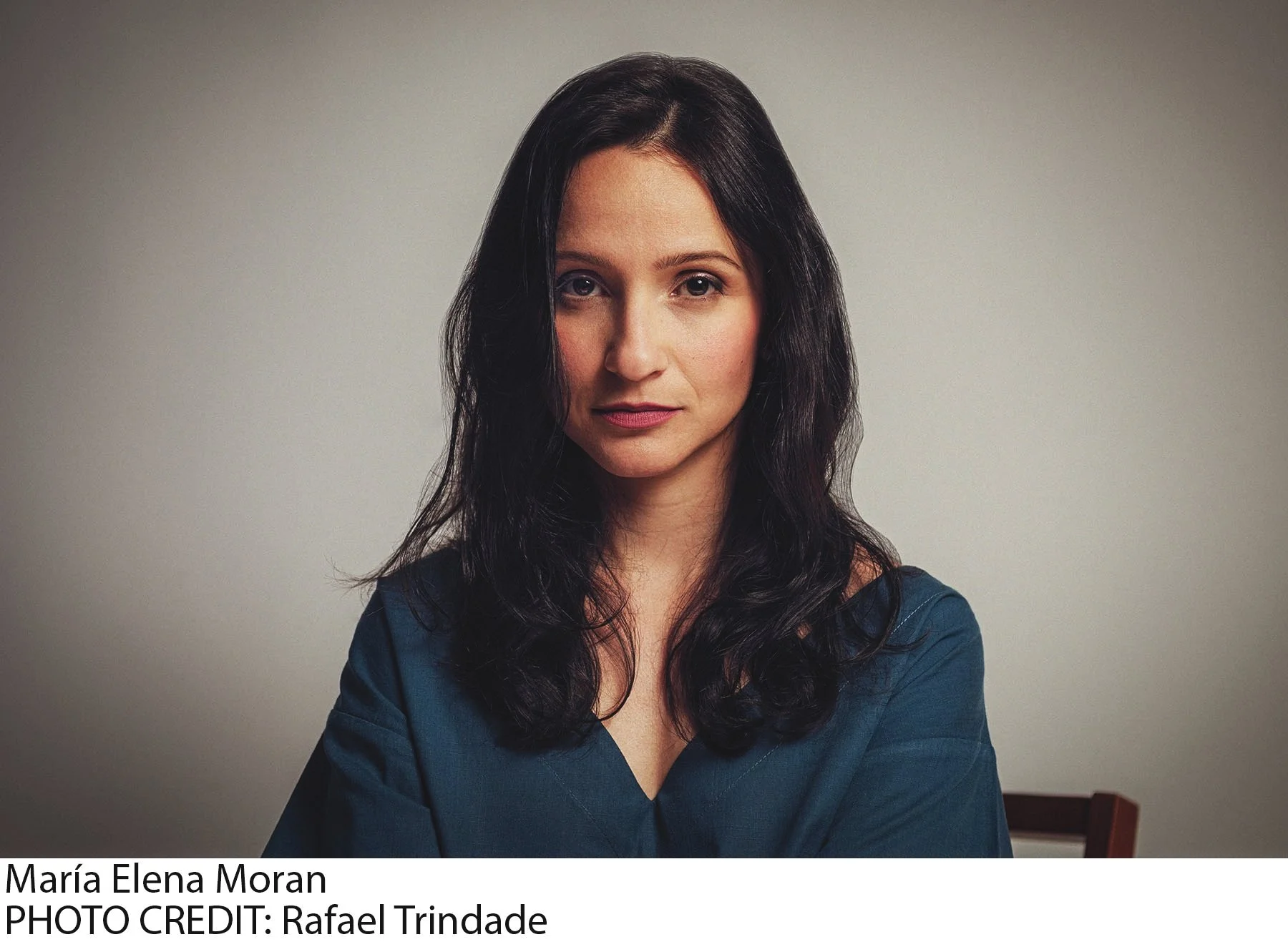
María Elena Morán is a Venezuelan writer and screenwriter based in Brazil. She is the author of the novel Los Continentes del Adentro. Her second novel, The Winds of Maracaibo (published as Volver a Cuándo in Spain), won the Café Gijón Prize in Spain and has been translated into Italian, Portuguese, and English.
I had the pleasure of asking María what inspired her to write and why she chose fiction, her latest title, and so much more.
UZOMAH: What steps did you take to get ready to write this book? How much research did you do, and how did you use what you learned in your writing?
MARIA: I spent a long time gathering material before writing the novel. The Winds of Maracaibo was my doctoral project in Creative Writing, so I had several years of reading, research, conversations with Venezuelans, and listening to stories from family and friends. I also followed the political and historical events closely, trying to understand not only what was happening, but how it was affecting people's everyday lives.
My own experience of migration was part of that process, but it happened years before the Venezuelan crisis and for personal reasons, so it has very little to do with the migration narrated in the novel. What I did share was the experience of leaving a country behind. The novel also grew out of my political disenchantment with a project I had once believed in, and with the erosion of democratic values I witnessed over time.
I didn't reproduce any of these stories literally. I mixed fragments from different people with things I had read, observed, and experienced, and transformed everything through fiction. I sometimes say the novel is biographical, but not the biography of one person. In a way, it is the biography of millions. The research gave me the context and the material, but fiction allowed me to explore what those historical events did to people's families, identities, relationships, and sense of home.
U: What inspired you to start writing, and why did you choose fiction?
M: Literature was an old desire that took me a long time to acknowledge. I arrived at it almost sideways, through journalism and then screenwriting, until eventually I couldn't keep looking away from it. I chose fiction because I'm interested in what becomes possible when we move away from the obligation to tell what literally happened. Fiction allows me to combine different experiences, enter different subjectivities, invent connections, and explore contradictions that don't necessarily have a place in testimony or documentary accounts. I write because I'm trying to understand something, not because I already do. Fiction is where that investigation happens.
U: How is writing a novel different from writing a screenplay? Do you have a preference between the two?
M: They are very different kinds of freedom. Screenwriting is deeply collaborative from almost the beginning, so the story is constantly being negotiated with other people and other parts of the filmmaking process. In literature, I have a much greater sense of sovereignty over the work. Everything that works and everything that fails belongs to me, and I find something very liberating in that risk.
Literature also gives me something cinema can't give me in the same way: the word itself becomes the place where everything happens. I can enter a character's mind, move through memory, linger inside a sensation, and let language itself construct the experience. I love both, but for different reasons. They offer different kinds of pleasure and different kinds of problems to solve. But if I had to, I would choose literature.
U: Are there any contemporary writers you would recommend to readers?
M: There are so many contemporary writers I would recommend. In Latin American literature, I've particularly enjoyed Samanta Schweblin, Pilar Quintana, Fernanda Melchor, Valeria Luiselli and Cristina Rivera Garza. There are many Venezuelan writers I love, such as Alberto Barrera Tyszka, Héctor Torres, Rodrigo Blanco Calderón and Keila Vall de la Ville. I also read a lot of Brazilian literature and, among contemporary Brazilian writers, I would recommend Camila Maccari, Taiane Santi Martins, Jeferson Tenório, Natalia Zuccala and Paulo Scott.
U: In your view, what is the most important role literature plays in society?
M: I think literature's most important power is its ability to make us inhabit the experience of another person. History, sociology, journalism, and political analysis can give us knowledge about the world, but fiction can place us inside someone else's subjectivity. It can make us feel the beauty and ugliness of that particular world and, for a moment, make us care about it.
For me, literature should question, disturb, and complicate what we think we already know. It can resist absolute truths and easy moral conclusions, and it can create a space where we encounter people whose experiences or beliefs are very different from our own. If a book can make us see the Other with a little more complexity, I think it has already done something important.
U: How do you create characters and plots that keep readers interested and wanting to learn more about them as the story unfolds?
M: I think readers become interested in characters when they sense that there is more to them than what they can see at first. I try to give each character a very specific inner logic, shaped by their history, their desires, their fears, their values, and their contradictions. I don't want them to be there simply to serve the plot or represent an idea. I want their choices to emerge from who they are, even when those choices are difficult to understand or disagree with.
With The Winds of Maracaibo, I was also very interested in the relationship between character and point of view. The novel moves from one character to another almost like a relay race. You receive one person's version of an event and may begin to sympathize with them, or judge someone else, and then another voice comes in and changes what you thought you understood. I think that creates a different kind of curiosity: not only "what is going to happen?" but "what am I still not seeing?"
For me, plot grows out of that tension. I spend a lot of time planning the sequence of events and deciding what information the reader receives, when they receive it, and from whose perspective. But I also leave room for the characters to surprise me. In fact, some of the possibilities I hadn't planned emerged precisely because, once I knew the characters well enough, I understood that they could not behave in any other way.
U: What do you think makes a book truly great?
M: A great book is one that changes something in the reader, even if that change is minuscule. Some of the books that have stayed with me the longest aren't the ones that gave me answers, but the ones that left me with better questions than the ones I had before reading them. That is an enormous change, if you ask me.
I also think great literature contains a kind of formal necessity: the form and the subject seem to belong to each other. You couldn't tell that particular story in quite the same way otherwise. And, above all, I look for narrative complexity without losing emotion. A book can be intellectually ambitious and formally daring, but if I don't feel something at stake in it, I lose interest.
U: How has writing changed the way you see the world, whether politically, culturally, or socially?
M: Writing has made me much more suspicious of simple explanations. The more deeply I enter a character's subjectivity, the harder it becomes to reduce a person to a political position, a social category, or a single decision. It has also made me more attentive to the way large historical forces are lived through very small things: what a family eats, how long someone sleeps, whether a mother has enough time to be with her child, what happens to people's relationships when they lose electricity or work or the possibility of moving freely. Politics is constantly entering our lives, often in ways that don't look political at all. And perhaps writing has made me more comfortable with contradiction. I don't think literature can or should resolve the contradictions of the world. It should allow us to see them more clearly.
U: Your latest novel offers a unique look at migration and touches on themes like separation, asylum, bigotry, and resettling. What inspired you to write this story?
M: The novel emerged from several forms of loss that had become impossible for me to separate: my father's death, the collapse of a political project that had shaped my generation, and the country I felt I was losing.
.
At the same time, I was confronted with the images coming out of Venezuela: overcrowded borders filled with my fellow Venezuelans, people leaving everything behind, and people close to me living in extreme vulnerability and uncertainty. There was a profound sense of being exposed, of having nowhere safe to stand. I wanted to move beyond the headlines and statistics and try to understand what all of that meant inside people's lives.
So the political crisis was never separate from the intimate story. I wanted to tell History through individual lives, and to let the particularity of each character reveal different dimensions of a collective wound.
U: What do you think makes a plot great? How do you develop your characters so the story fully explores its themes?
M: I think a strong plot is one in which the external events and the inner life of the characters are constantly affecting one another. I don't like the idea of plot as something that simply happens to characters. The most interesting events, for me, are the ones that emerge from who they are, from their desires, fears, limitations, and contradictions, and that in turn transform them.
That's also how I approach themes. I don't want characters to exist in order to carry an idea. I want the themes to emerge from their individual lives. In this novel, for example, migration is not one single experience. It looks different depending on a person's generation, class, political history, family values, gender, and psychological makeup. The same historical catastrophe produces very different responses.
So I try to give each character a specific inner logic and then put that logic under pressure. When characters make choices that are emotionally and psychologically inevitable for them, the plot begins to acquire its own momentum. Ideally, the reader should be able to follow the story as a sequence of events, while also gradually discovering the deeper forces that made those events possible.
Please check out the acclaimed novel The Winds of Maracaibo by María Elena Morán here.