JULIE MEHRETU: Our Days, Like a Shadow (a non-abiding hauntology)

Exhibition view, Julie Mehretu, Our Days, Like a Shadow (a non-abiding hauntology), Marian Goodman Gallery, New York, 2026 Courtesy of the artist and Marian Goodman Gallery Photo credit: Alex Yudzon
Marian Goodman Gallery is pleased to announce our seventh solo exhibition by Julie Mehretu titled Our Days, Like a Shadow (a non-abiding hauntology), which will include new and distinct bodies of work from 2024-2026. Presented for the first time in the U.S., a prelude to this body of work was seen in the exhibition Ensemble at Palazzo Grassi in Venice in 2024, and Transcore of the Radical Imaginatory at MCA Sydney in 2024-25.
The exhibition, Mehretu’s fourth solo presentation in New York, will feature a series of live performances under the direction of choreographer John Jasperse, who was invited to create a new dance work in response to Mehretu’s works. John Jasperse Projects will perform the piece, Wandering, twice daily over four consecutive evenings from 20-23 May.
Referencing “our days, like a shadow” from Chronicles 29:15, and the Buddhist concept of “non-abidance,” the show’s title augurs life as a series of fleeting and transitory experiences, and existence as a passing shadow in search of enlightenment when walking in darkness. Mehretu explores these metaphors in conceptual and temporal terms, channeling abstraction as a vehicle of liberatory imagination, in her new cycle of Black Paintings, 2025-26 and in her recent collaboration with sculptor Nairy Baghramian, TRANSpaintings / Upright Brackets, 2023-26.
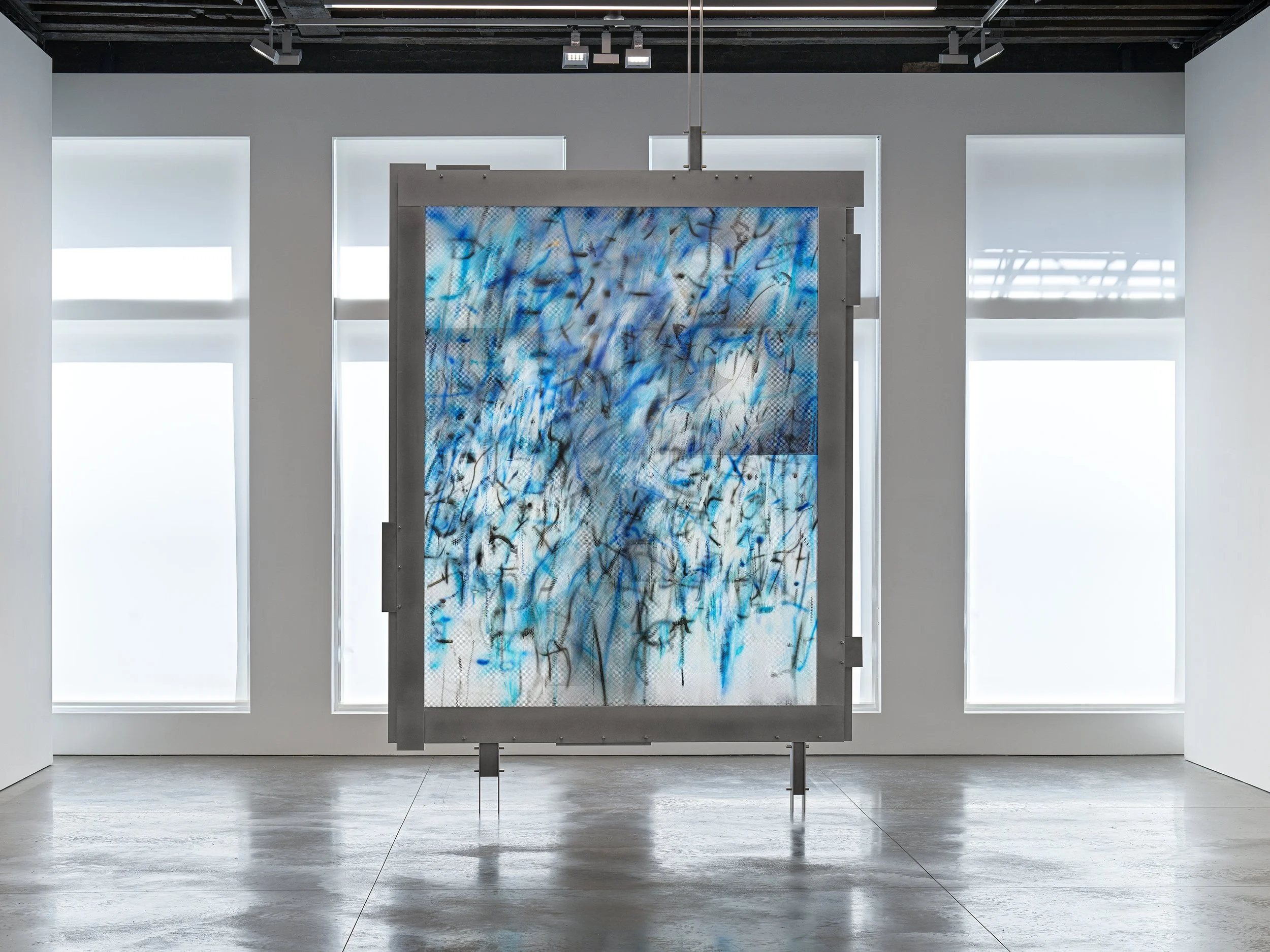
Exhibition view, Julie Mehretu, Our Days, Like a Shadow (a non-abiding hauntology), Marian Goodman Gallery, New York, 2026 Courtesy of the artist and Marian Goodman Gallery Photo credit: Alex Yudzon
Mehretu’s TRANSpaintings with Nairy Baghramian’s Upright Brackets enable a dynamic phenomenology of movement through upright works that invite display and interaction across a vertical expanse of the gallery’s first two floors. Permitting a view in and through the surfaces of abstract works which trade opacity for translucence, and the planar surface for three-dimensional space, itinerant shadows and optical effects are absorbed into the artwork, along with the viewer. One discerns the beginning, middle and end--or verso--of a painting. The TRANSpaintings/ Upright Brackets build from layers of inks and acrylics on translucent monofilament polyester fabric applied over residual ghost images from recent reportage of geopolitical events. Their permeable mesh surfaces provide an airy transparency antithetical to a canvas’ usual dense ground. Buttressed and embraced by the sculptural armatures of Baghramian which surround them, their taught stance emboldens participatory views from both sides, equalizing the relationship between artwork and audience. Bearing witness, the paintings summon the viewer into intimate encounters that fluctuate with each bodily circumnavigation in space. In this flux and multiplicity, ethereal images shift and change around blurs and traces in response to the passage of light, shadow, and corporeal actions in real time, becoming intrinsic to the work itself.
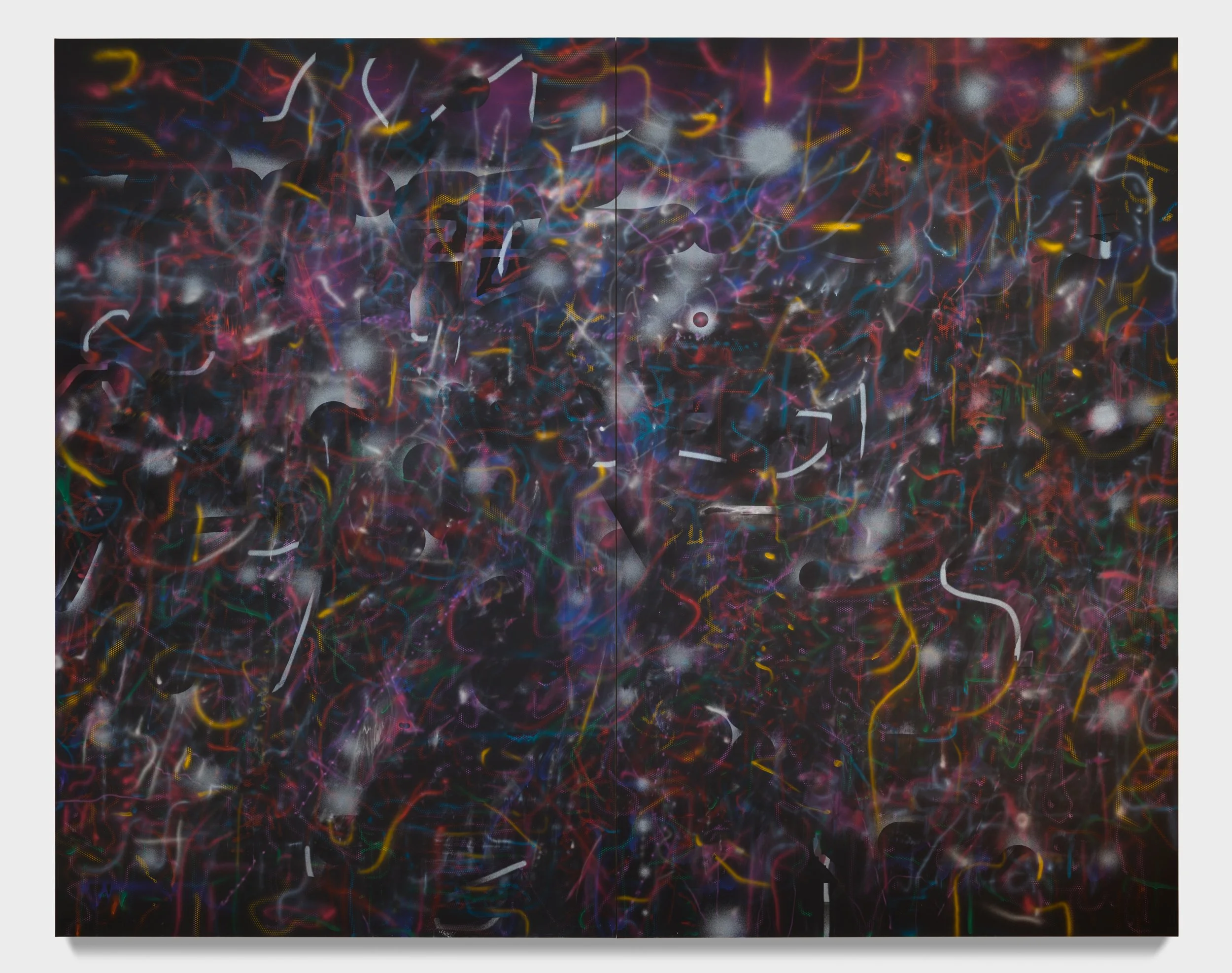
Julie Mehretu Black Monolith (after Atopolis: For Édouard Glissant by Jack Whitten), 2024-2026 Ink and acrylic on canvas 144 × 180 in (365.8 × 457.2 cm) (overall) Photo Credit: Tom Powel Imaging.
On the first floor, centered on the North wall, Black Monolith (after Atopolis: For Édouard Glissant by Jack Whitten), 2024-2026, a large-scale diptych on black ground evokes a grand cosmos and establishes a mise en scene for the convergence of abstract forms to unfold throughout the gallery’s tripartite space. Flanking this work are two large TRANSpaintings / Upright Brackets whose luminous energy flows through their porous surfaces. Resolute and horizontal, TRANSpaintings (night seam) / Upright Brackets, 2024, forms a perimeter within the space, its violet and black tones shifting from darkness to light. Opposite, in TRANSpaintings (the substanceless blue pour of tor and distances) / Upright Brackets, 2025-2026, a matrix of blue, violet and gold contains a flurry of black cross marks ascending whose verticality is a portal for transience.
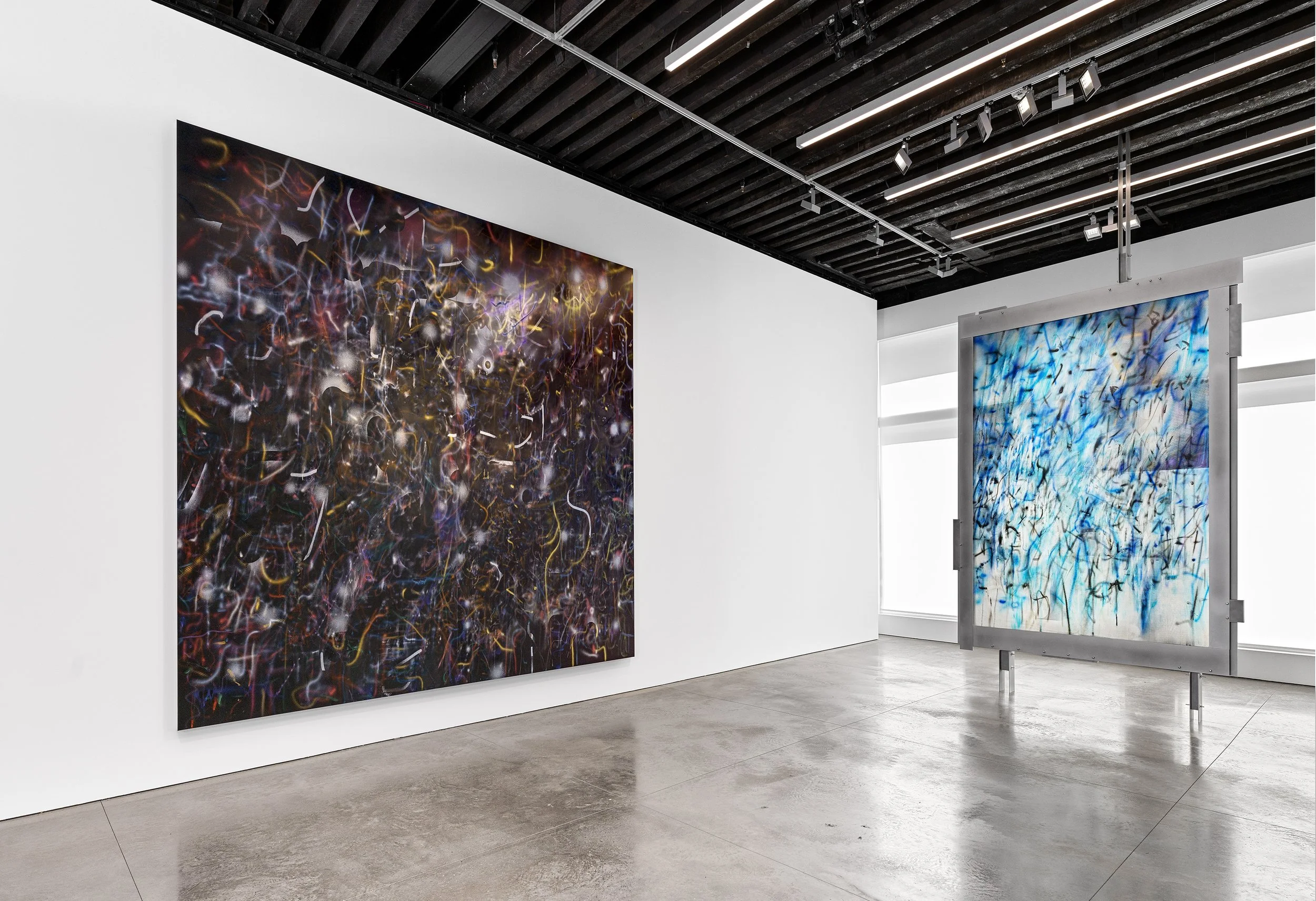
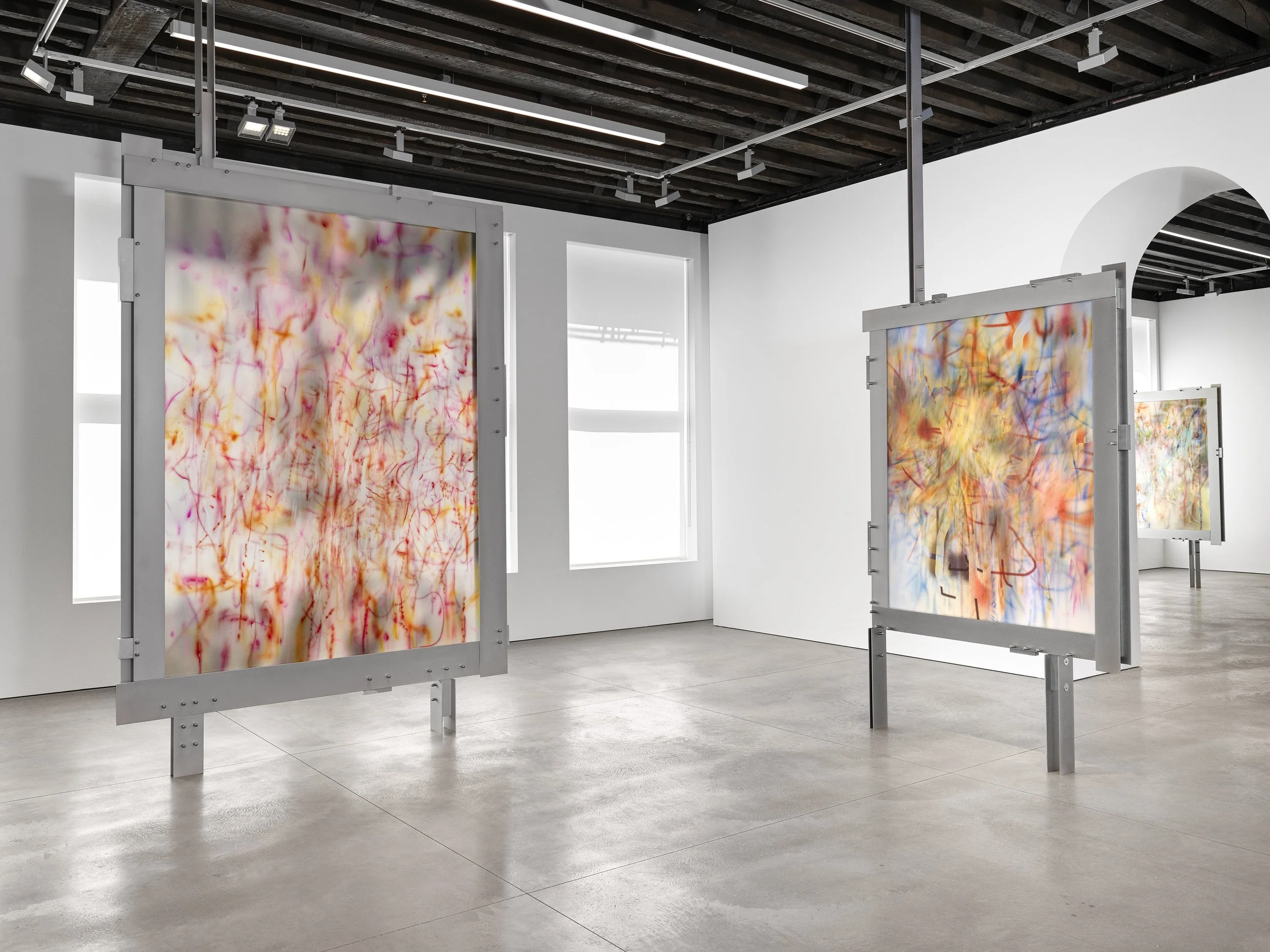
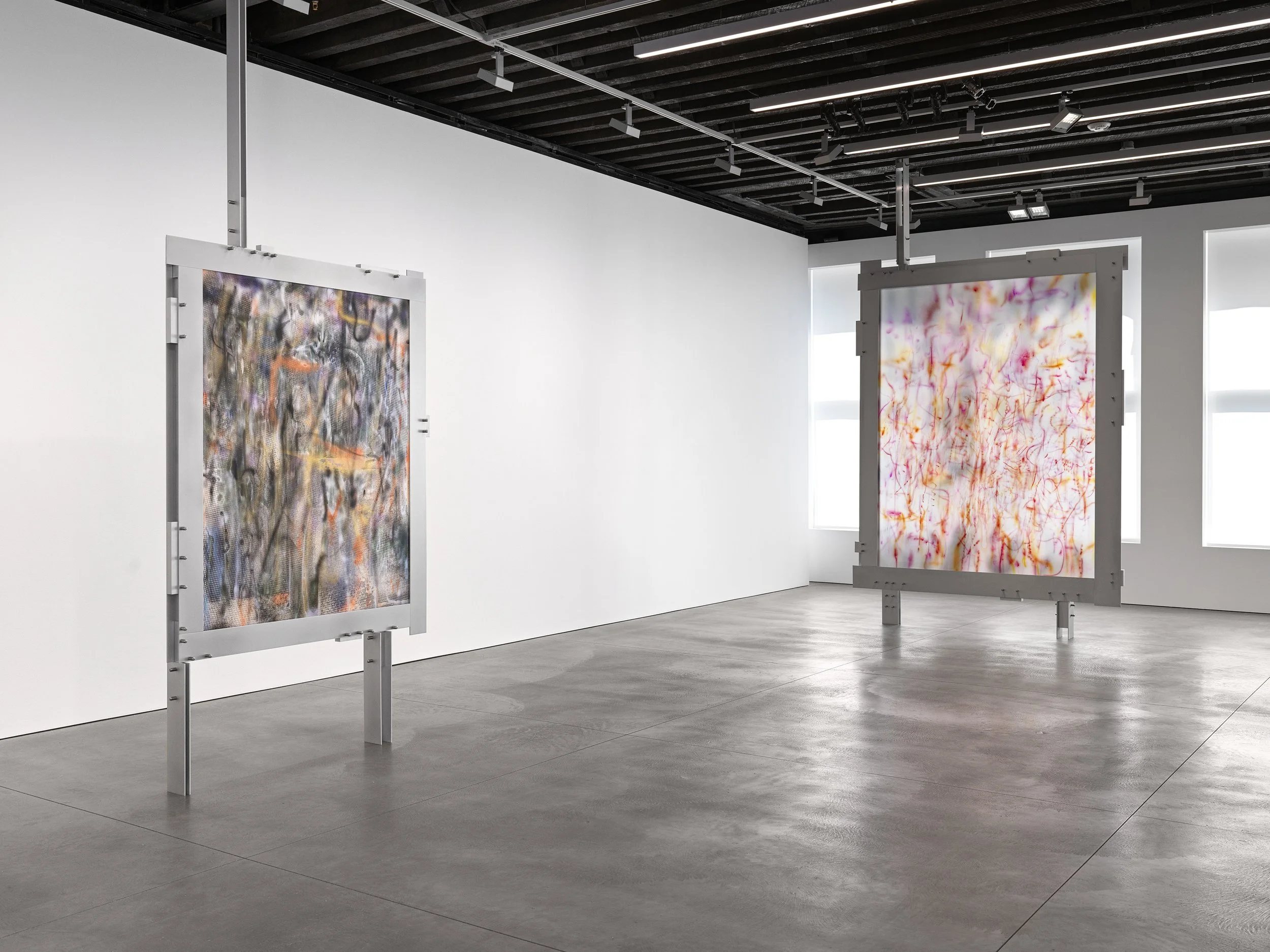

Exhibition view, Julie Mehretu, Our Days, Like a Shadow (a non-abiding hauntology), Marian Goodman Gallery, New York, 2026 Courtesy of the artist and Marian Goodman Gallery Photo credit: Alex Yudzon
On the first and second floor, a selection of what Mehretu refers to, in contrast, as her “TRADpaintings” continues the dialogue with the standing TRANSpaintings/Upright Brackets on view in both the North and South Galleries. One work, The Wine-Dark-Sea, 2023-2026, features a reprise of vivid ultramarine blue, white, black ink markings, and Ben Day dot screenprint, which pulse, fall, and reverberate across the canvas with foreboding urgency. In Our Waste Places, 2024-2026, vaporous emergent suggestions of bodies appear beneath a field of ardent hues, with recurring hand prints and agitated black markings traversing the work’s yellow and magenta undertones.
Mehretu’s process of activation is ever present and builds in a different way in the new cycle of Black Paintings, shown on Floor 3, which feature a meta-sampling of fervent markings and newly emergent matter. In this new cycle of works on black ground, a hauntology in majestic hues evolves through resonant layers of material disintegration which transform in real time. Beginning with the exploration of black, the actual and profound saturation of all colors, one that absorbs and reflects light, rather than emitting it, they mark a point of departure from her earlier cycle, Femenine in Nine, inspired by Julius Eastman’s 1975 musical composition of the same name. This newest sequence is emblematic of collective traces, initiated from intuition and improvisation rather than photographic images or social movements. Comprised of multiple layers which absorb into complex densities, luminous chromatic hues activate each work, integrating and prismatically shifting in response to the viewer’s choreography in the space. A visual meditation on darkness and immersion, the works are born from a multitude of influences: from a fascination with the primitive and haptic experience of mark making in the intimacy of darkness and caves; from primeval striations on ancient desert rocks; to age-old religious frescoes turned black with only their lustrous halo remaining. Propelled towards unprecedented autonomy in these new compositions which are free of embedded referents, the works are conceived in a chromatic reversal of black ground and white marks with multi-tone interference inks. Beginning from a fugitive interiority, they build in emergent strata from dark gessoed grounds forming environments and firmaments: each a universe of its own. Using techniques such as brush, screen print, tracing, erasure, and mark making, the tiers converge, rising and illuminating with iridescent energy and motion. Shifting from black to exultant hues of violet, white, silver, green, and pink, blue, or kaleidoscopic, they alternate and diverge from unfathomable to spatial to transcendent as the light and angles of perception shift. Dynamic graphic lines, scrawls, and marks are inscriptive and feverish; unconstrained by image, blur, outlines, apparitions, they become sentient and experiential, countering rupture and uncertainty with movement and a jubilant topography of space.
A core tenet to Mehretu’s recent abstraction, the dynamism born of motion in relation to the artwork, and collaboration as a discursive space for contemplation and creation, builds in this exhibition. Continuing with the collective as a place for reflection and unknowing, and abstraction as a site of communality, the fact of the performative underscores this new body of work. A duet is enacted in relation to the works: one becomes a dancer, transforming in three dimensions in response to individual vantage points and the paintings’ fluctuating rhythms.

Exhibition view, Julie Mehretu, Our Days, Like a Shadow (a non-abiding hauntology), Marian Goodman Gallery, New York, 2026 Courtesy of the artist and Marian Goodman Gallery Photo credit: Alex Yudzon
John Jasperse Project’s new dance work, Wandering, will further activate the space with a live intervention that will take place from 20-23 May. In this new choreo-sonic landscape, dancers and musicians will stage a kinetic encounter over three floors. In an all-encompassing choreography, seven dancers respond to the music of composers Hahn Rowe and Will Johnson, as well as to the architecture of the space and Mehretu’s works. The dancing, wandering body becomes an agent, a witness, an activator, a ghost—embodying and reflecting upon the presence and resistance of Mehretu’s paintings. Illuminating their liberatory potential, in tandem, the dancers will swerve… and [so too] resist apparatuses of control.
Forthcoming this June, Mehretu’s large-scale commission, Uprising of the Sun, will be unveiled on the façade of the new Obama Presidential Center in Chicago, IL.
Julie Mehretu, American (b. 1970, Addis Ababa, Ethiopia) lives and works in New York City. She received a B.A. from Kalamazoo College, Michigan, studied at the University Cheik Anta Diop, Dakar Senegal, and received a Master of Fine Arts with honors from The Rhode Island School of Design in 1997.
She has received many prestigious awards including the MacArthur Fellowship in 2005, the U.S. Department of State Medal of Arts Award in 2015, membership to the American Academy of Arts and Sciences, 2021, and the Officer of the Ordre des Arts et des Lettres by the French Ministry of Culture in 2025. Her work has been exhibited extensively in museums and biennials including the Carnegie International (2004–05), Sydney Biennial (2006), Solomon R. Guggenheim Museum, New York (2010), dOCUMENTA (13) (2012), Sharjah Biennial (2015), Museu de Arte Contemporânea de Serralves, Porto, Portugal (2017), Kettle's Yard, University of Cambridge, UK (2019); and the 58th International Art Exhibition, La Biennale di Venezia, (2019).
Julie Mehretu: Kairos / Hauntological Variations recently opened at the Museum of Modern Art in Warsaw, Poland and runs through 30 August 2026. In 2025 her work was exhibited in a solo exhibition at the Kunstsammlung Nordrhein-Westfalen, Germany. Julie Mehretu: Ensemble opened in 2024 at the Palazzo Grassi-Pinault Collection, Venice, Italy and in November that year the first exhibition of Mehretu’s work shown in Australia and the Asia-Pacific region opened at Museum of Contemporary Art, Sydney, Australia. In November 2019 a career survey opened of Mehretu’s work at the Los Angeles County Museum of Art, and traveled to the High Museum, Atlanta (2020), The Whitney Museum of American Art, New York (2021); and the Walker Museum of Art, Minneapolis (2021).
About Marian Goodman Gallery
Marian Goodman Gallery champions the work of artists who stand among the most influential of our time, representing over five generations of diverse thought and practice. What makes the gallery singular is its enduring and deep-rooted collaborations and understanding with the artists—a bond that is concurrent with curators, thought leaders, and art institutions worldwide. The Gallery’s exhibition program, characterized by its caliber and rigor, provides international platforms for its artists to showcase their work, foster vital dialogues with new audiences, and advance their practices within nonprofit and institutional realms.
Our enduring legacy persists through the combined strength and leadership of Partners Rose Lord, Junette Teng, Emily-Jane Kirwan and Leslie Nolen, whose extensive tenure with the gallery and its distinguished roster of artists began under Founder Marian Goodman.
Established in 1977 by Goodman, who had earlier co-founded the art publishing company, Multiples, Inc., the Gallery gained prominence early in its trajectory for introducing the work of seminal European artists to American audiences. Synchronous with the mission at hand, Marian and the Gallery were inevitably drawn to Europe, establishing a Paris location in the Marais district in 1995 and an adjacent space for books and editions in 2017. From 2014 until 2022, the Gallery also operated an exhibition space in London.
With its desire to expand and explore growing areas of interest for its artists, the Gallery recently moved its New York City headquarters to the historic Grosvenor building in Tribeca in October 2024 and inaugurated a new permanent space in Los Angeles in September 2023. With two major spaces anchoring each coast, and an ongoing program for over three decades in Paris, Marian Goodman Gallery is committed to further advancing new bodies of work and the creative practices of the leading contemporary artists of our time.
The artists in the Gallery’s program share a culture-critical approach to art, maintain extraordinary perception and integrity, and a tendency in their respective practices to propel the collective experience of art through empowering and sustaining relationships with others. These visionaries, with their distinctive means of expression and technical expertise, have been responsible for inspiring future artists and enriching the dialogue around art. Working in partnership with the Gallery leadership and directors, the artists have continually collaborated to create and stimulate the intellectual discourse within their own work and elsewhere - through their collective knowledge and expertise, the artists have created circles of impact and distinction that continue to impart, illuminate and ground us, and resonate through the industry.
The Gallery represents over fifty artists and estates working in the U.S. and internationally: Eija-Liisa Ahtila, Chantal Akerman, Giovanni Anselmo, Leonor Antunes, Nairy Baghramian, Lothar Baumgarten, Dara Birnbaum, Christian Boltanski, Daniel Boyd, Marcel Broodthaers, Maurizio Cattelan, James Coleman, Tony Cragg, Richard Deacon, Tacita Dean, Edith Dekyndt, Rineke Dijkstra, Cerith Wyn Evans, Andrea Fraser, Bernard Frize, Dan Graham, Pierre Huyghe, Amar Kanwar, Agnieszka Kurant, An-My Lê, Steve MᶜQueen, Julie Mehretu, Ana Mendieta, Annette Messager, Delcy Morelos, Sabine Moritz, Maria Nordman, Gabriel Orozco, Giulio Paolini, Giuseppe Penone, Edi Rama, Anri Sala, Matt Saunders, Tino Sehgal, Paul Sietsema, Robert Smithson, Ettore Spalletti, Tavares Strachan, Thomas Struth, Niele Toroni, Álvaro Urbano, Adrián Villar Rojas, Danh Vo, Lawrence Weiner, James Welling, Yang Fudong and Jongsuk Yoon.
In addition to its exhibition program, the Gallery’s continued legacy is strengthened by its institutional partnerships and philanthropic efforts. Through organizations such as The Marian Goodman Gallery Initiative in honor of the late Okwui Enwezor, a joint collaborative effort managed by the ICI (Independent Curators Intl.), and the Gallery’s education department, among others, the Gallery has continued to strengthen and expand opportunities for research, education, and access to higher levels of learning, and advocate for building stronger communities of diversity in the realm of art
The exhibition opened on the 14th of April and will conclude on the 6th of June 2026 at 385 Broadway, New York, NY 10013. For more information about the exhibit, please visit the Marian Goodman Gallery’s site. The gallery can be found on Instagram and Artsy, too.