In Conversation with Roméo Mivekannin
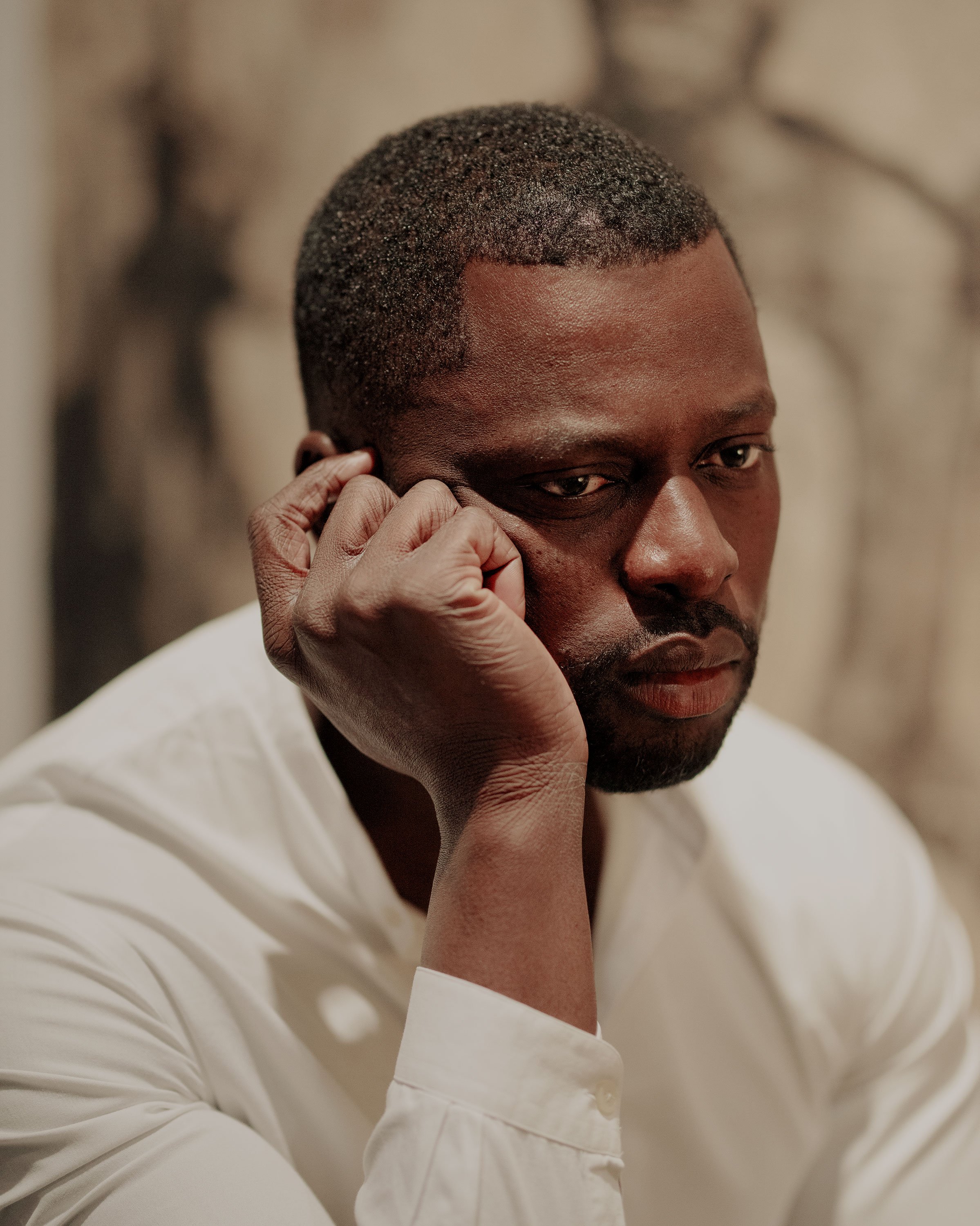
Roméo Mivekannin (b. 1986, Bouaké, Ivory Coast), is a multidisciplinary artist who lives and works between Toulouse (France) and Cotonou (Benin). After training as a cabinetmaker and studying art history, Mivekannin chose to enter the Ecole Nationale Supérieure d’Architecture de Toulouse. As a student, he experimented with several mediums from sculpture to painting. Following his studies, he devoted himself to his work as a visual artist while beginning a thesis on the history of art, sociology, and architecture. He is pursuing a doctorate in art and architecture at the École Nationale Supérieure d'Architecture de Montpellier.
Mivekannin works at the crossroads of inherited tradition and the contemporary world, integrating his creations into an ancestral temporality and making his own rituals, which echo the Voudou cosmology that is still very much alive in Benin. Between painting, sculpture, and installation, his universe is multidisciplinary and ambitious. The artist plays with materials and seeks to upset the established boundaries between disciplines, enacting a formal and symbolic defiance that is unique to him.
With strength and subtlety, Mivekannin unravels the threads of our confinement a little more each time, thus questioning our collective and intimate heritage. The artist’s works propose a form of strategic resistance that fuses critical engagement with emotion.
He has held solo exhibitions at Galerie Eric Dupont (Paris), Galerie Cécile Fakhoury (Abidjan and Dakar), Galerie Barbara Thumm (Berlin), Musée du Louvre-Lens (France), Collezione Maramotti (Reggio Emilia, Italy), Fondation H (Antananarivo, Madagascar), Museu de Arte Moderna da Bahia (Salvador, Brazil), Kunsthalle Giessen (Germany), and the Musée du quai Branly – Jacques Chirac (Paris), among others. His work has been featured in the FITE Textile Biennial at Musée d’Art Roger Quilliot (Clermont-Ferrand, France) and When We See Us: A Century of Black Figuration in Painting at Zeitz MOCAA (Cape Town, South Africa), Kunstmuseum Basel (Switzerland), Bozar(Brussels, Belgium), and Liljevalchs (Stockholm, Sweden).
He has participated in group exhibitions at the Collezione Maramotti (Italy), Musée du Louvre-Lens (France), Southern Guild Los Angeles (USA), Musée du Quai Branly (France), Sharjah Biennial (UAE), Royal Museum for Central Africa (Belgium), Fondation Blachère (France), Louvre Abu Dhabi (UAE), MUCEM (Marseille, France), Musée Albert-Kahn (France), Völklinger Hütte (Germany), and the Memorial de Caen (France), among others.
His work is included in the collections of the Cité de la Musique (Paris, France), Currier Museum of Art (New Hampshire, USA), Fondation Zeitz (South Africa), Fondation H (Antananarivo, Madagascar), Galerie Nationale d’ArtContemporain du Bénin (Cotonou, Benin), Musée National du Quai Branly – Jacques Chirac (Paris, France), Musée des Abattoirs (Toulouse, France), Sharjah Art Foundation (Sharjah, UAE), VERBUND Collection (Vienna, Austria), Collection Leridon (Paris, France), Centre national des arts plastiques (CNAP) (Pantin, France), CCS Bard (New York, USA), MO.CO. Montpellier (France), Fondazione Golinelli (Bologna, Italy), Collezione Maramotti (Reggio Emilia, Italy), Compagnie Bancaire Helvétique (Geneva, Switzerland), Groeninghe Art Collection (Bruges, Belgium), Musée d’Art Roger-Quilliot (Clermont-Ferrand, France), The Bunker Collection (Palm Beach, USA), and The Nixon Collection (United Kingdom).
I had the pleasure of asking Roméo, how he understands the role of the artist in society, his new exhibition and its themes, and so much more.
UZOMAH: What gives art its importance and meaning for you?
ROMEO: People often say that art is what remains when everything else disappears. For me, it is a vessel for memory. It is a way of recording life when others try to erase it. Artists are intermediaries, transmitting a history, a story, a fire. Art contributes to the beauty of the world, but I also see in it, for many people, a spiritual and existential value, like Gregorian chant or African ritual song. When I look at the work of artists who lived before me, I see libraries that have been passed down to us.
U: Can you speak about the central themes that have shaped your practice, and how your work has evolved while remaining connected to these concerns?
R: In terms of subject matter, I have explored the history of representation and the construction of the Western gaze through colonial photography. Starting from this body of material, I began to look more broadly at how images shape us, whether in the representation of Black people or of women. For my first exhibition in the United States, I wanted, in part, to question the representational canons of a nation – how an image acquires the status of an icon – and then introduce disruptive elements into those images.
In terms of materials, my practice has evolved because I am constantly searching for new forms and techniques. I made a series of paintings on sheets soaked in elixirs. For me, the sheet was an important support because of its relationship to the body, to life and death, to Vodun rituals, but also to European rituals surrounding life. For the works on velvet, I use velvet intended for fashion, so the relationship between textile and the body remains essential. I first used black velvet in response to a work by Julian Schnabel that I saw at the Collezione Maramotti in Reggio Emilia, Italy. I am fascinated by velvet because it reflects only a portion of the light: it absorbs light without giving it back. I find this interesting both conceptually and aesthetically. It was a very difficult material to approach, but it revealed beautiful qualities.
For a long time, I spoke the language of the masters. Today, I want to question my inner self.
U: Are there particular tools or materials that you consider essential to your practice, and why? What role do they play in the way you work in the studio?
R: I choose my materials according to the encounters I have. But the sheet was essential in developing my language because it carried so much history. I choose materials that are themselves carriers of memory.
The colour that returns consistently in my work is black, which has an essential symbolic, aesthetic, and political significance for me. I have also worked with colour, but colours have evolved according to chemistry and technological advances. There are also questions of layering, territory, and migration, whereas black, for me, is a primordial, essential place.

Roméo Mivekannin Bliz-aard Ball Sale (1983), after David Hammons 2026 Cr.Courtesy of the artist
U: How would you describe your artistic language to someone encountering your work for the first time?
R: It is a secret that speaks of another secret. There is always something hidden within what we see.
U: How do you understand the role of the artist in society today?
R: For me, the artist is someone who transmits. The artist is an intermediary, a bearer of fire. We live in a time when there is a great deal of discussion about displacement and speed. Artists pass the baton from one generation to the next.

Romeo Mivekannin 11 p.m. Tuesday 2010 after Lynette Yiadom-Boakye 2026 Cr.Courtesy of the artist.
U: Questions of restitution and the return of African cultural heritage held in Western museums have become increasingly urgent. What role do you think African artists can play in these conversations, particularly in engaging governments and institutions around the return of objects to the continent?
R: It is a political matter, and there is a great deal of rhetoric around it. In that sense, it does not concern me all that much. It is a subject that conceals a great deal of unease and many other underlying problems. The history of the world is one of migration and circulation, but also of dispossession.
I advocate for the circulation of artworks and images, so that beauty can belong to everyone. Of course, Beninese and African people must have access to the works of their own peoples. I cannot say today to whom these works belong. African artists are not simply commentators on this situation; they are continuing the dynamics through which images and artworks circulate throughout the world. Their work builds bridges across cultures and histories, creating new forms of dialogue between people and places.
U: Porteurs de feu (Bearers of Fire) considers migration, representation, and cultural memory. How does this new body of work relate to the broader concerns that have shaped your practice?
R: For me, this title represents a direct continuation of my practice. I have worked with bodies that have been rendered invisible within art, and with the underlying question of who has the right to be seen. Here, I turn the question around somewhat: What do we carry with us as we move through the world today, when we make ourselves visible? What are we going to pass on? The subject has not changed, but it has evolved over time.

Roméo Mivekannin Bashi-Bazouk (1868-9), after Jean-Léon Gérôme 2026 Cr.Courtesy of the artist
U: How can we encourage more young people to engage with art, and what role can art play in preserving culture?
R: A society without art is a society in danger of disappearing. Art remains largely elitist today; it should move beyond the white cube. The concept of the museum is European, but in Africa, artworks were objects used in processions and ceremonies. Art is alive; it is not static. I would like young people to become participants, not simply spectators.
U: Can you take us through a typical day in your studio? How do you move between research, reflection, and the physical process of making?
R: I don’t really have a typical day, but I often wake up very early, listen to music, spend time with my son, and take him to school. Then, I sit at a café terrace and read poetry. At night, I go to bed with my head full of images, and the ideas that emerge overnight often shape the day that follows.
For more information about Roméo’s artwork, please follow him on Instagram here. The magazine also did a feature on his current exhibition which can be found here.