In Conversation with Kris Knight
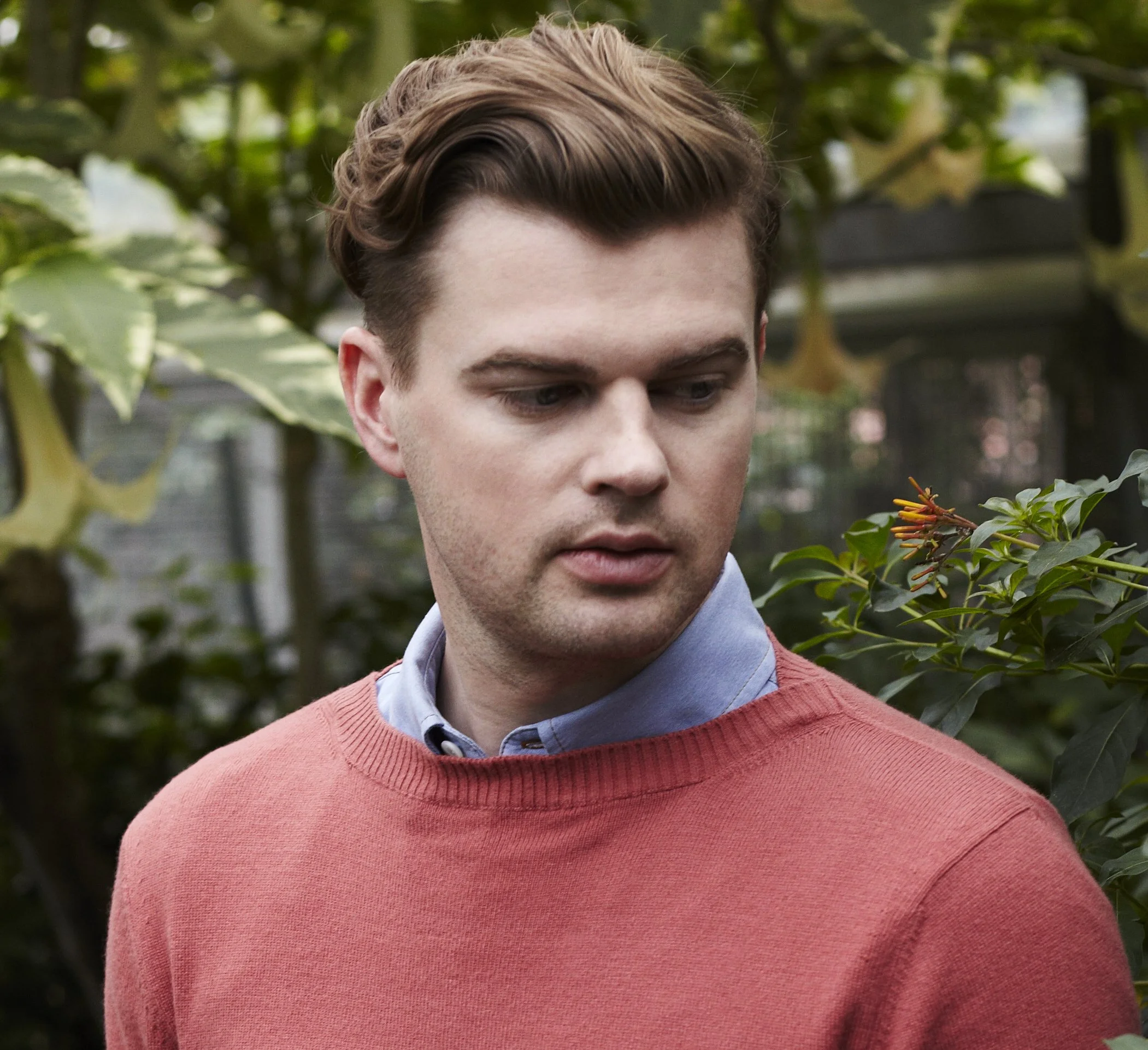
Photo Credit: Jaclyn Locke
Kris Knight is a Canadian painter whose work revolves around representation, queerness, and intimacy. He is interested in the portrayal of diverse modes of masculinity, creating work that celebrates tenderness, vulnerability, and ambiguity.
Knight’s romantic figurative paintings and portraits are simultaneously intimate and remote, heavy and light, dense and playful; presenting emotional worlds: portals of the artist’s past and present, retreating from the muchness of the world as much as they reflect it. The reflexivity of his narratives is rooted in personal memory but also depicts life in the present, imbuing his contemporary subject matter with historical art references and color palettes. His pastel and tonal oil paintings conjure a series of shifting moods, themes, and experiences that are connected by a wide range of positions regarding the private and public self. Working from personal images often collaged with found imagery, floriography, and historical references, Knight’s paintings present a quiet, elegant world dominated by sensitivity and subtle melancholy.
I had the pleasure of asking Kris why it is important for artists to use their art to address pressing issues, how they can do so in his new exhibition, and so much more.
UZOMAH: Your recent body of work invokes figures such as Oscar Wilde, whose life and writing are deeply entangled with coded aesthetics and queer subtext. How do you situate Wilde within your conceptual framework? Is he a historical reference, a symbolic device, or a contemporary interlocutor within the work?
KRIS: Like a lot of young people, my first introduction to Oscar Wilde came from reading his classic novel “The Picture of Dorian Gray” as a teen, but it resonated with me long past high school. I do believe The Picture of Dorian Gray was the first novel that I had read as a young person about queer longing (albeit veiled) in a society that punishes difference. It also switched on the empathy button in my brain for those who live on society’s margins. I could relate to Dorian’s exhausting performance of duality as a closeted gay teen, when I yearned to control how I was perceived, and the fear of being exposed seemed paramount.
I nicked the title of my current project, “Green Carnation,” from a storied event in 1892, when Oscar Wilde instructed his gay male friends to wear the green flower on their lapels to the opening night of his play, Lady Windermere’s Fan, as a way to secretly hint at their sexuality. As gossip amongst queer men prevailed, this witty act of mocking the “unnaturalness” of homosexuality by wearing a dyed green carnation became a subtle queer code that you were a man who desired other men.
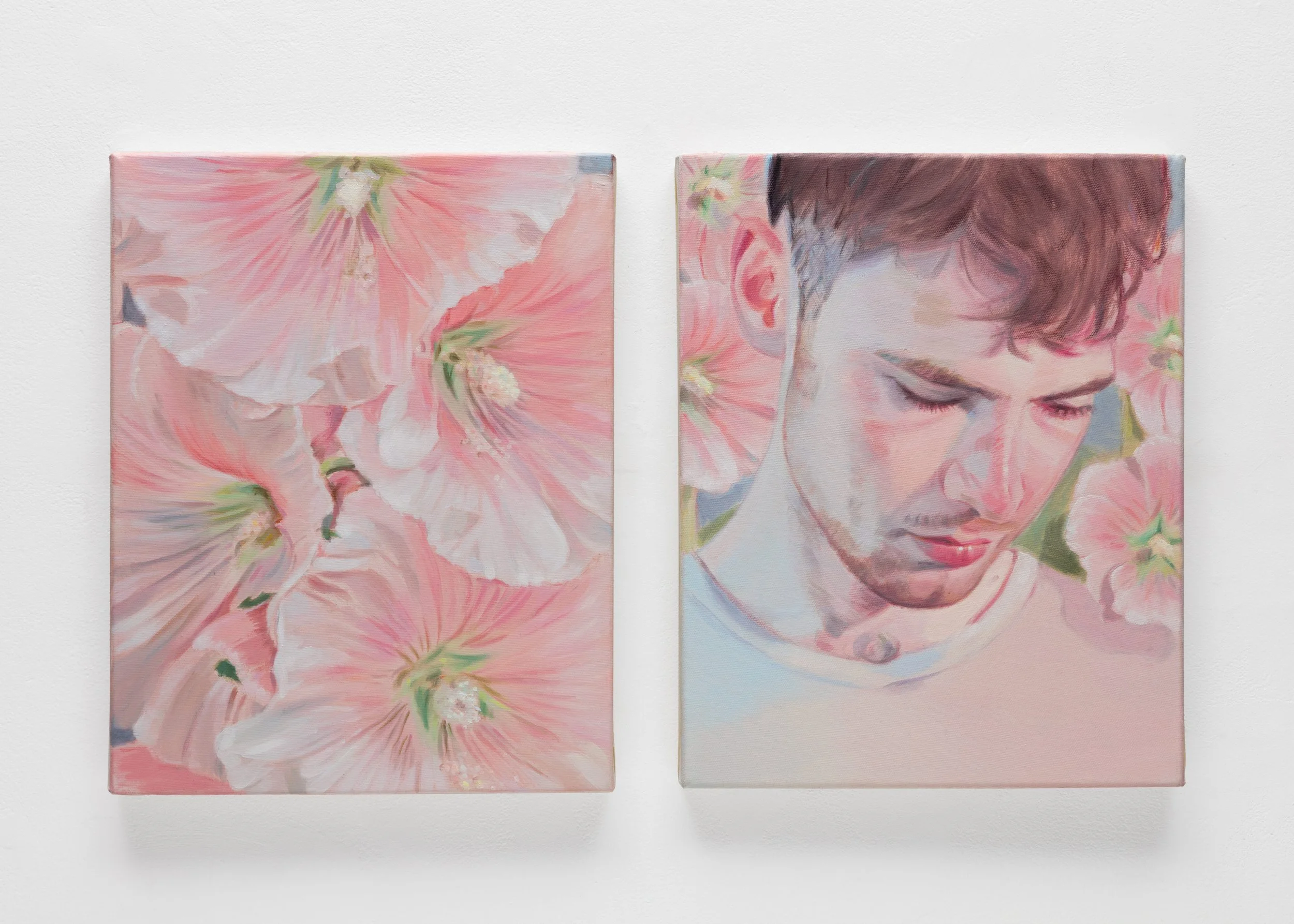
Kris Knight Standing In the Sun (Hollyhocks & Mingus), 2025 Oil on canvas,14 x 11 in35.6 x 27.9 cm (each panel)
U: Rather than “changing the narrative” around queerness, your exhibition seems to operate within ambiguity, symbolism, and intimacy. How do you understand the relationship between visibility and opacity in queer representation today? Is resistance always explicit?
K: I have the freedom to express my queerness when it comes to art making, which is something I don’t take for granted. I’m aware of my privilege and the freedom I have because of the fight and sacrifice that the LGBTQIA2S+ community and allies made before me so that I can have this space. All queer people have to disrupt the norm at some point in their lives in order to live an authentic life. I’m delighted when I meet young queer people who didn’t have to go through the same shit that I went through growing up, just as older queer friends of mine are relieved when they find out that I didn’t go through the shit that they went through. Each generation’s resistance carves more space for the next, so representation and visibility are still vital. My freedom is that I live in a time when I have the permissiveness and pride to make work that is quiet, gentle, domestic, and sensitive as a way to humanize and give weight to my own queer experience. I think there’s a lot of power in subtlety.
U: Your practice engages coded language, historical symbolism, and aesthetic pleasure. In a political climate that often demands directness, what is the role of obliqueness, metaphor, or beauty as forms of resistance?
K: Someone once wrote on my Instagram that I am “a master of softness”. I didn’t take it as a compliment at first (queue the acidic bubbling of buried shame and internalized homophobia), but now I see it with positive regard. I’m a really quiet person who lives a really quiet life. I’m an observer, a listener, who’d rather make things with my hands than speak out loud. For most of my life, I was ashamed of being a wallflower, but now I own it. I make intimate, quiet, chalky paintings that don’t scream at you across the room; they whisper, or in my case, they mumble to you to come closer. My paintings aren’t bold or overtly political or overtly sexual; they are tender, they are sensitive, everything is slow-burning. I think our society has a tendency to dismiss men who are vulnerable, but I want to celebrate them in my work. I get a lot of kind messages from men who relate to my work, so it’s important to remember that queer experience is a broad experience, boldness is not always the definition of defiance, and resistance can be humming in the background in quiet moments as well.
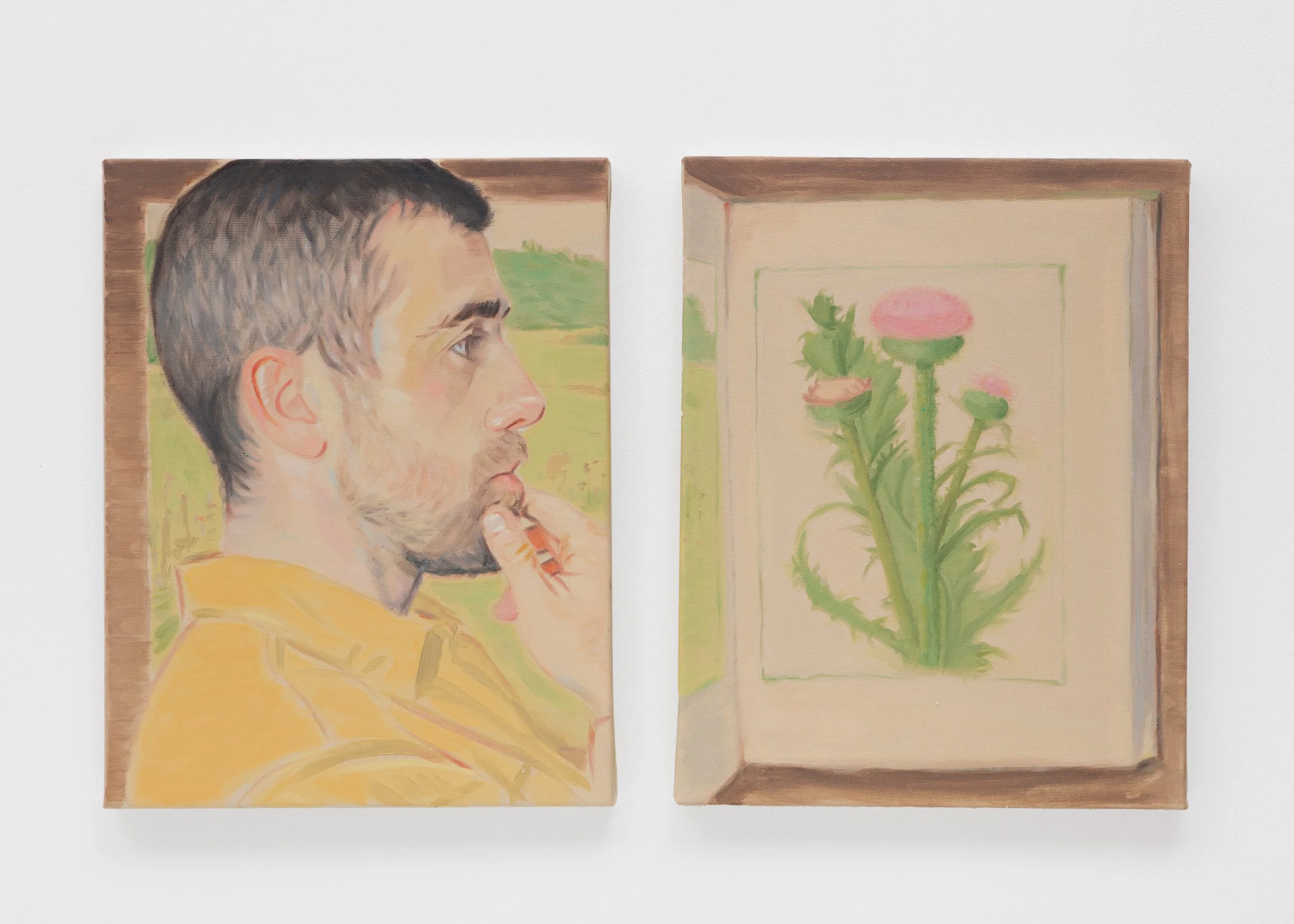
Kris Knight Always Looking out (Sam & Thistle), 2025 Oil on canvas 14 x 11 in35.6 x 27.9 cm (each panel)
U: Many of your portraits are rooted in lived relationships and personal proximity. How do you negotiate the ethics of intimacy in representation? When private experience becomes aesthetic material, what transformations occur?
K: I am interested in narratives that revolve around representation, queerness, and intimacy, as well as depicting different modes of masculinity that include tenderness, vulnerability, and ambiguity
For the past two decades, I have often painted the men around me, mostly queer creatives, as both celebration and documentation. Part of me wants to chronicle their existence because they inspire me so much (and also Canadians have a hard time celebrating their own), but the other part of me sees them as surrogates for my own storytelling from a narcissistic scopophilia angle. I often paint my friends and acquaintances as models for my work, but also see them as actors, staging them in ways that subtly reveal fragments of my own life. Before I invite someone to pose for me in my studio, I often have the composition already worked out, usually based on a memory, and I physically pose my models and stage them in a theatrical way, rather than a voyeuristic approach.
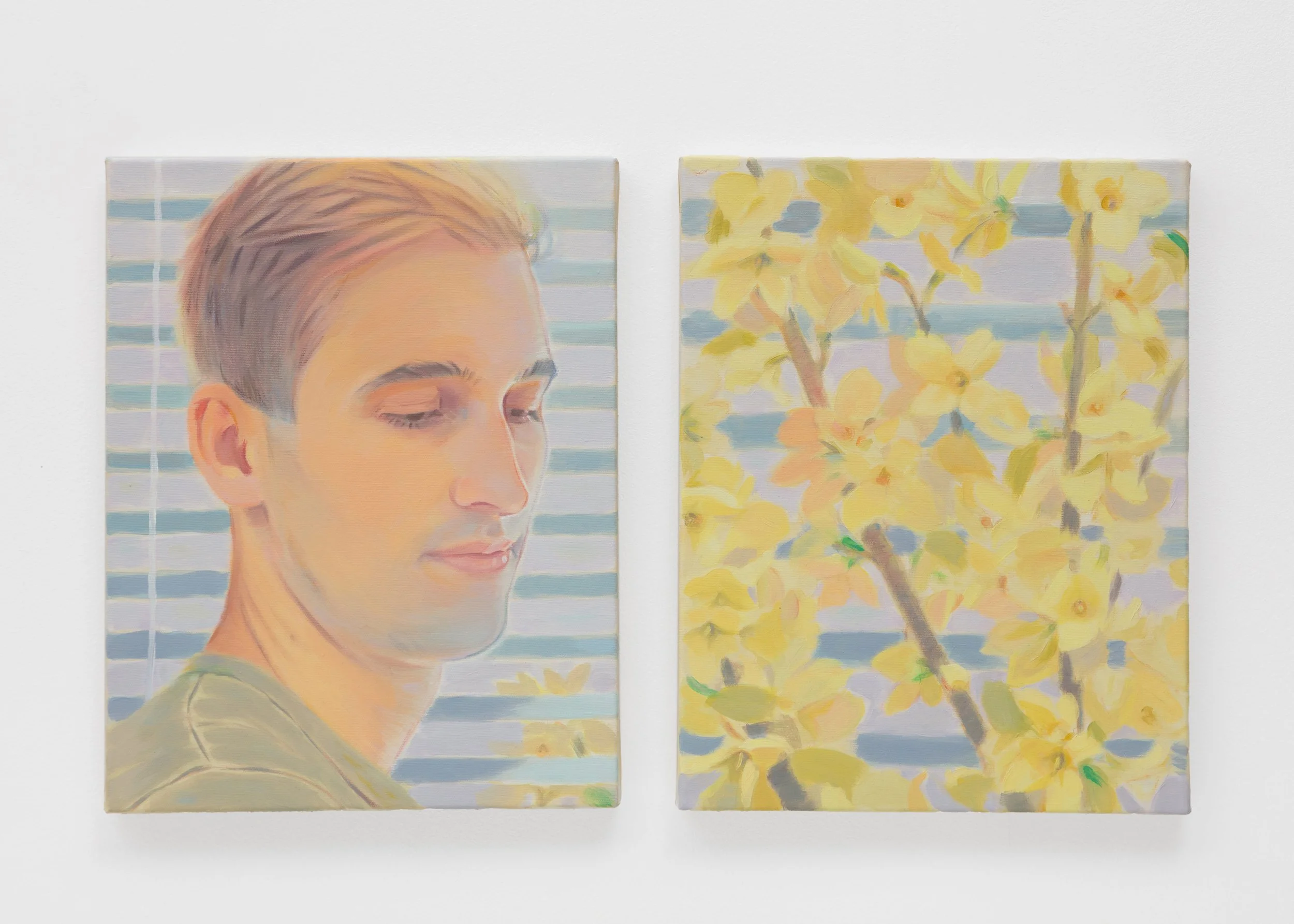
Kris Knight Gold Turns To Green (Sean & Forsythia) ,2025 Oil on canvas 14 x 11 in 35.6 x 27.9 cm (each panel)
U: Your paintings often balance vulnerability with formal control. How do you conceive of vulnerability, not only as subject matter, but as a structural condition within painting itself?
K: There’s a freedom to not having to yell at the top of your lungs – I’m trying to find ecstasy in quietness and celebrating tranquility in solitude. I grew up gay in small-town Canada in the ‘90s, when being queer and out was still an open invitation for blatant homophobia, so I treaded lightly and tried not to be perceived too much. I remained quiet and observing. There’s a freedom of invisibility and a freedom to observe how others perform when you’re a wallflower. I bring this aspect of observation into my work, but now I can invite people into my world. When I invite someone to my studio to pose for me, I ask a lot of questions. I am a nervous person, and I find interviewing my sitters is my defense mechanism - a way to calm the starkness of modeling for a painting – especially if this is their first time posing for me or posing for a portrait in general. I ask them a lot of interview questions, but also try to ask them some universal queer questions, like – when did you know you were queer? How did you come out? How did your family take it? How do you transcend shame? Do you have internalized homophobia? Questions like these bring out the vulnerability in my sitters. There’s a privilege to have access to their softness, and I think of their stories during the process of painting, long after they leave my studio. There’s a quiet sense of melancholy to my work that I find hard to shake, but my work is more about longing than it is about sadness.
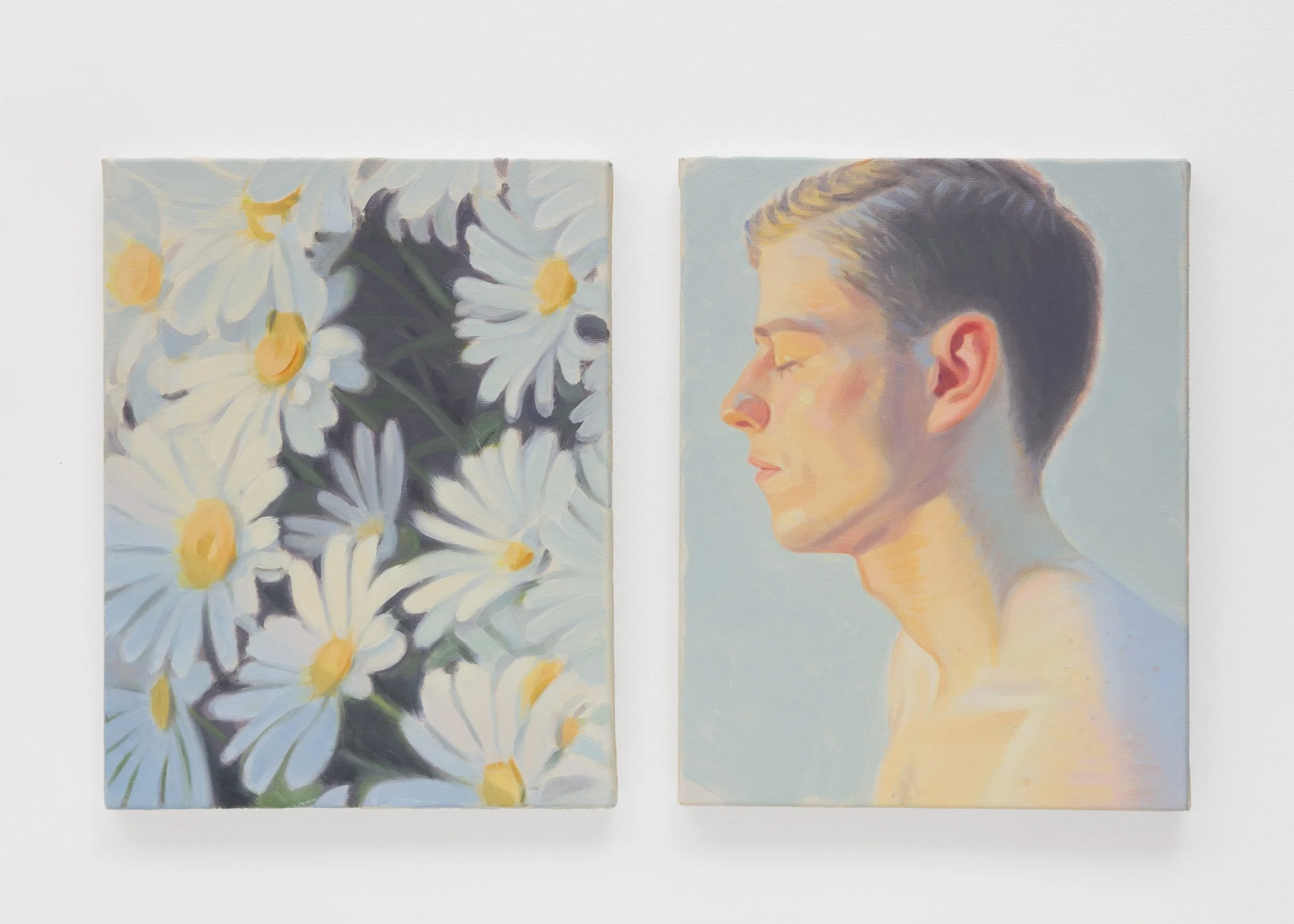
Kris Knight Heliotropism (Daisies & Justin), 2025 Oil on canvas 14 x 11 in 35.6 x 27.9 cm (each panel)
U: Can you speak about your process in terms of construction and concealment? At what point does a work reveal its meaning to you, and at what point do you deliberately withhold it?
K: A lot of work is autobiographical in a sense, even though I paint other people. I love portraits, but not in the historical sense, where pleasing the sitter or client was paramount. I am more interested in how I can depict my subject as a surrogate for my own storytelling. I hope to paint my models at different ages in their lives until they die, chronicling their existence but also my own. I like the fact that I can look back at all of my different series of paintings, and I know exactly what I was going through at that part of my life. I document moments and memories, then I move on. Memory plays such a big part in my work, and, in a way, I paint to remember who I am and who I was.
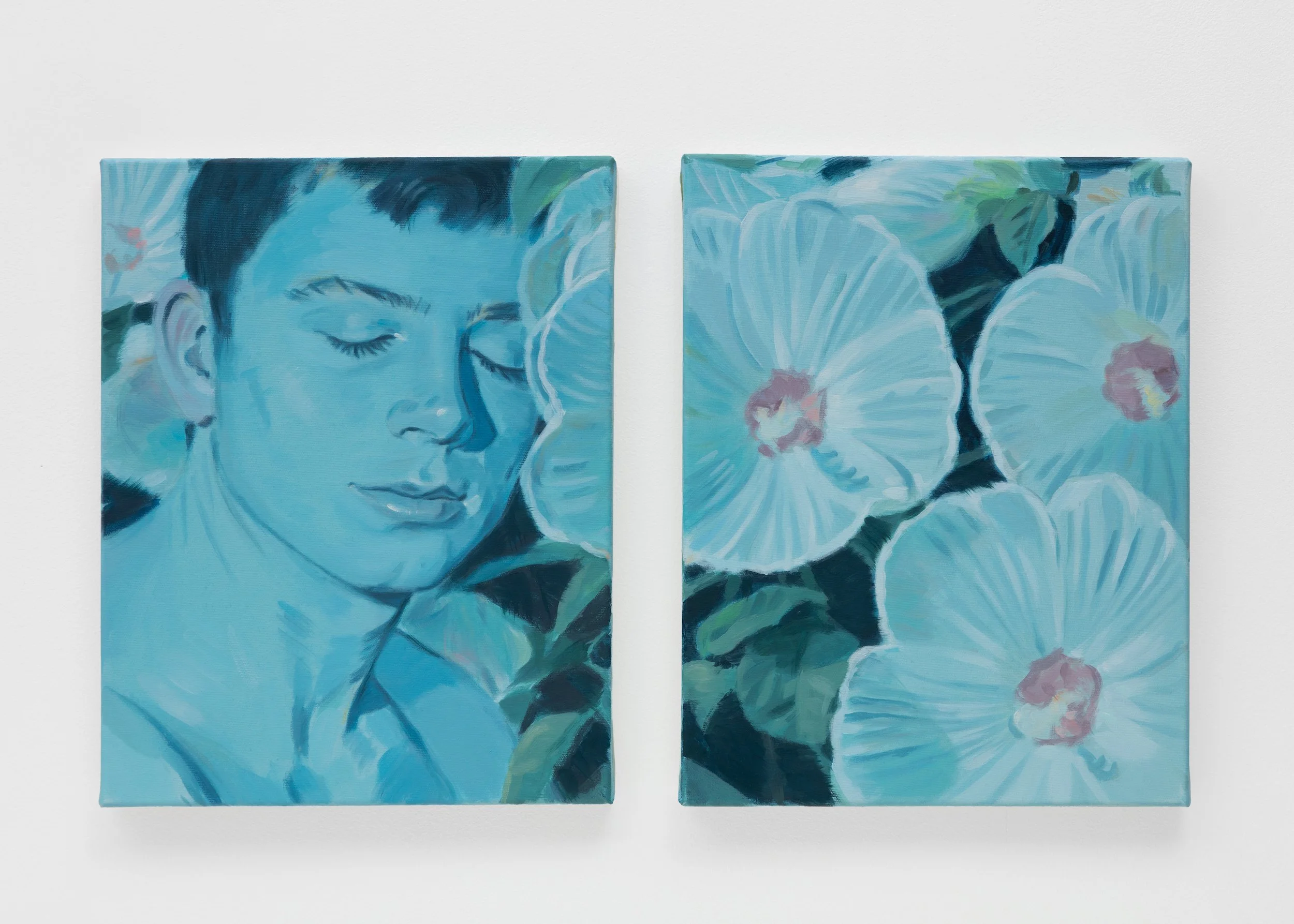
Kris Knight Nyctinasty In Reverse (James & Hibiscus), 2025 Oil on canvas 14 x 11 in 35.6 x 27.9 cm (each panel)
U: The exhibition engages floriography and cryptological systems of communication. What draws you to historical systems of coded meaning, and how do they resonate with contemporary queer experience?
K: I’ve utilized flowers and floral still life in my work for years. I’m drawn to their delicate, fleeting beauty, coded meanings, but also see a lot of connections to the short-lived beauty of youth and fleeting moments of the human experience.
I’m a history nerd, and ever since the pandemic, I’ve gone down this rabbit hole researching the Victorians. My last two exhibitions referenced Victorian garden portraiture that was in fashion during the height of Tuberculosis. A second exhibition referenced the Victorian notion of “blue mind” and how doctors believed one could cure illness by getting out of the city and visiting the sea. There are a lot of parallels between Victorian and contemporary wellness and self-care. For this suite of paintings, I focused on Floriography, which is the Victorian language of flowers. Floriography was a fad, where flowers were assigned secretive double meanings based on published floriography books. This fad became really popular amongst young Victorians, who were socially repressed but starting to explore sexuality in the shadows. This act of giving flowers, cut flowers, or dried flowers in letters was a way to express secret desires and sentiments to someone without saying a word.
I’ve always been interested in queer codes, especially historical queer codes, and can imagine how floriography could be an early way of gays signaling to other gays (i.e., Wilde’s green carnation), similar to how I made mixtapes of coded language songs for the guys I had crushes on when I was young.
U: If painting is a form of translation—of memory, desire, or identity—what is lost and what is gained in that translation?
K: I do think painting is a form of translation. It’s hard not to try to dissect what the artist is trying to say, their historic and contemporary references, and what inspired them to make a painting in the first place. I find the act of explaining my paintings a little hit or miss. In one way, it’s a great way to contextualize the work; revealing little tidbits of your life can add more weight or understanding to your work, but in another way, maybe people don’t really want to know the meaning of your work because they won’t be able to unsee it afterward. For example, I had a collector ask me about a painting in my new suite of floriography portraits, one that is based on my first boyfriend. As I was telling him the story of us, the thrill of early love, his early depression, the humiliating way it ended, and the shame that followed, as well as his early death, I could tell from the collector’s face that maybe I said too much.
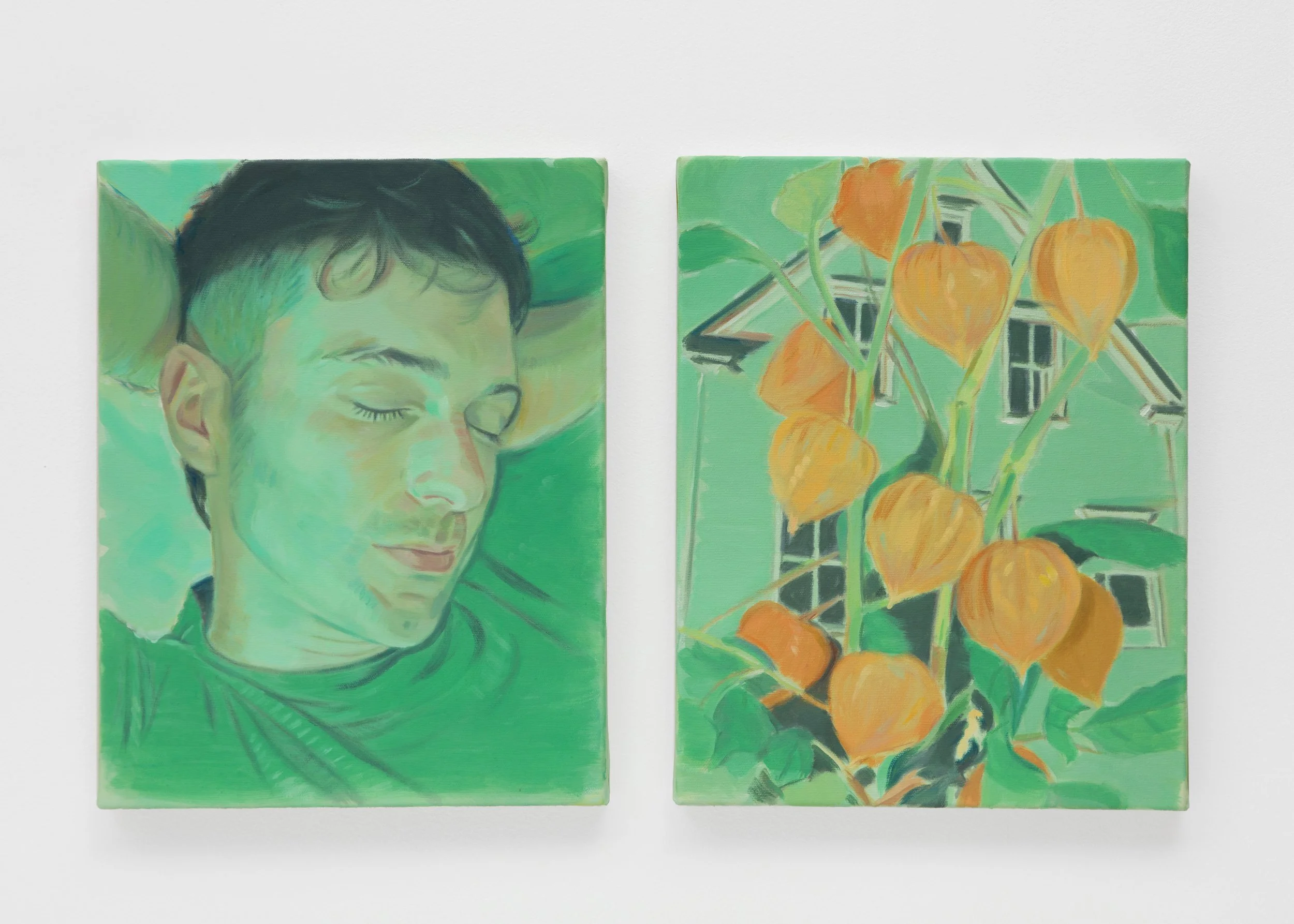
Kris Knight Kent County House (Jordan & Alkekengi), 2025 Oil on canvas 14 x 11 in 35.6 x 27.9 cm (each panel)
U: Your work frequently moves between literary and visual registers. How do you understand the porous boundary between image and text? Do you think painting can function as a form of writing?
K: I often write about a new series of work before I start painting. I find it’s the best way for me to corral my ideas, as I am often planning multiple exhibitions at one time. Making images for me is just another tool for storytelling, documenting personal folklore, recording and processing memory and emotions, but through the act of painting.
U: If you were to describe the ethical responsibility of the artist today, what would it entail? Is it to witness, to provoke, to archive, to seduce—or something else entirely?
K: I find it odd to be making paintings right now when the world seems so chaotic and images of injustice, corruption, and pain are everywhere. I have a feeling of heaviness that is hard to shake. I don’t know what the ethical responsibility of artists today is other than keeping community, making space for underrepresented voices, helping each other out, and just surviving. Being an artist for the long haul is a Sisyphean task, but I can’t imagine doing anything else. My resilience is because I have a skill that is also an emotional escape or conduit. Being in front of a canvas feels sensible to me; painting makes me feel safe, centered, and in control. I like the fact that my inboxes are full of messages from artists from all around the world, so many of them I haven’t met and probably will never meet in real life. We send praise, we send opportunities, we send recommendations, we send warnings, we send compassion and thoughtful generosity. Even when life feels like an endless shitshow, I still feel very lucky to be an artist right now.
Kris’s past exhibitions included Green Carnation, held at Gavlak this year; Drawing Now Paris with Galerie Alain Gutharc at Carreau du Temple; and Paris Art Paris 2026 with Galerie Alain Gutharc at the Grand Palais, Paris. For more information about his artwork, please visit his site here.