In Conversation with Hanz Roland
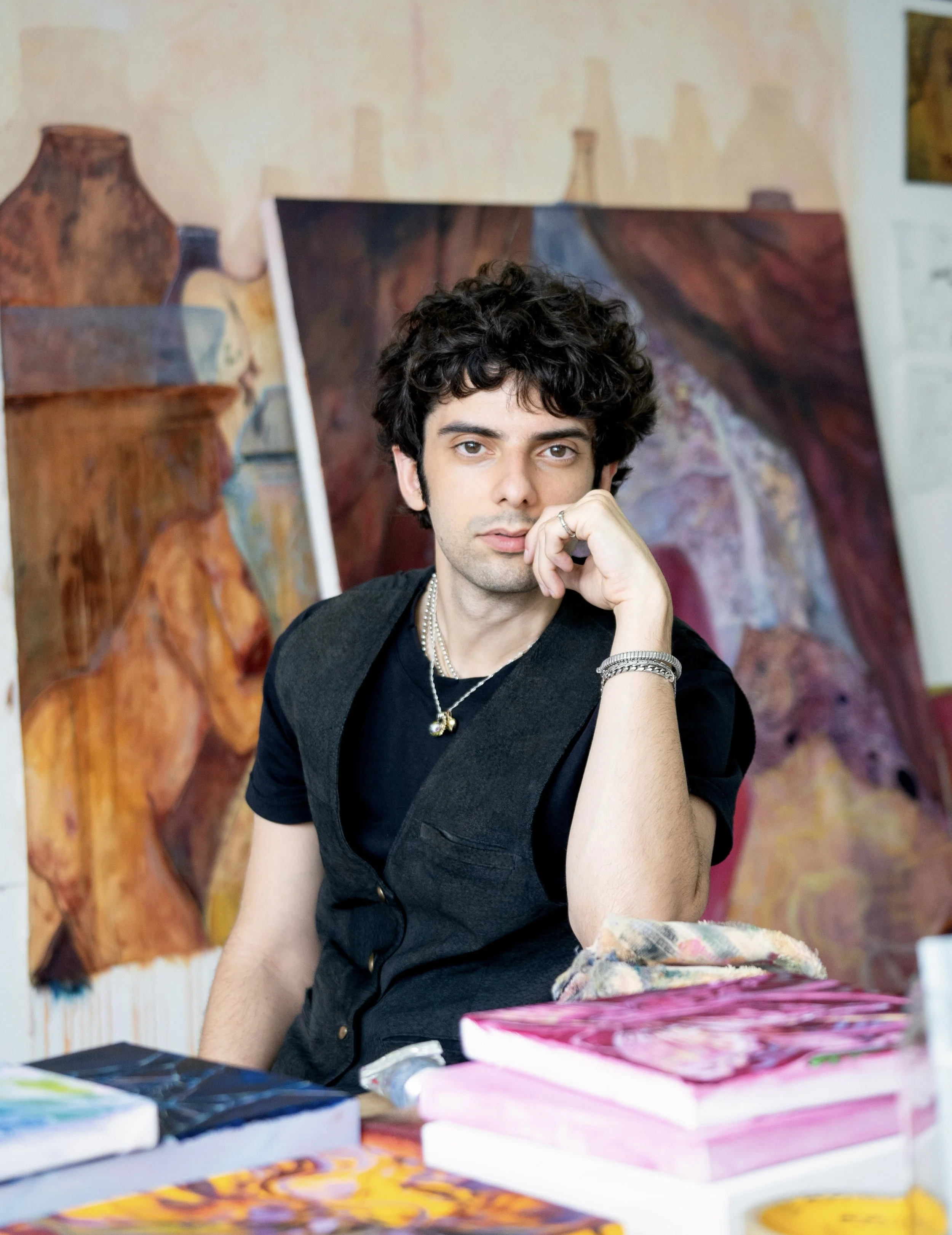
Portrait by Pamela Lahaud
Hanz Ronald (b. Catanduva, Brazil, 1996) received a Bachelor of Fine Arts in Visual Arts from Belas Artes University Center, São Paulo (2021). He has had recent solo exhibitions at Retina Galeria, São Paulo, Brazil (2025) and Plexi Galeria, São Paulo, Brazil (2023). Ronald’s work has been included in recent group exhibitions at Galeria Fasam, São Paulo, Brazil (2025); Centro Cultural BNP, São Paulo, Brazil (2024); Canteiro Contemporâneo, São Paulo, Brazil (2024); 25M – Galeria Metrópole, São Paulo, Brazil (2024); Centro Cultural Correios, Rio de Janeiro, Brazil (2023); Casa Pirâmide, São Paulo, Brazil (2023); Centro Cultural da Diversidade, São Paulo, Brazil (2022); Vórtice Cultural, São Paulo, Brazil (2022); Edifício Vera, São Paulo, Brazil (2022); and Galeria Benedito Nunes, Belém, Brazil (2022). Ronald lives and works in São Paulo, Brazil.
UZOMAH: How has working with curator Stavroula Coulianidis shaped your approach to A Charmed Hour? What did this collaboration bring to your understanding of your own work?
HANZ: Working with Stavroula Coulianidis has been a very important part of A Charmed Hour. She gave me the freedom to bring together different works and references while also helping me see connections between them that I wasn’t always conscious of. Through our conversations, she encouraged me to trust some of the more intuitive and unusual connections in my work, rather than trying to explain everything. Having the perspective of someone who lives in a different place and comes from a different cultural context also changed the way I see the connections within my work. I think the exhibition and the curatorial process reached another stage through this exchange. Her perspective brings a different cultural and personal context to the paintings, creating an interesting tension between our two points of view. For me, this is very interesting because it allows the work to move beyond where it started and creates new possibilities for how the paintings can be seen and connected.
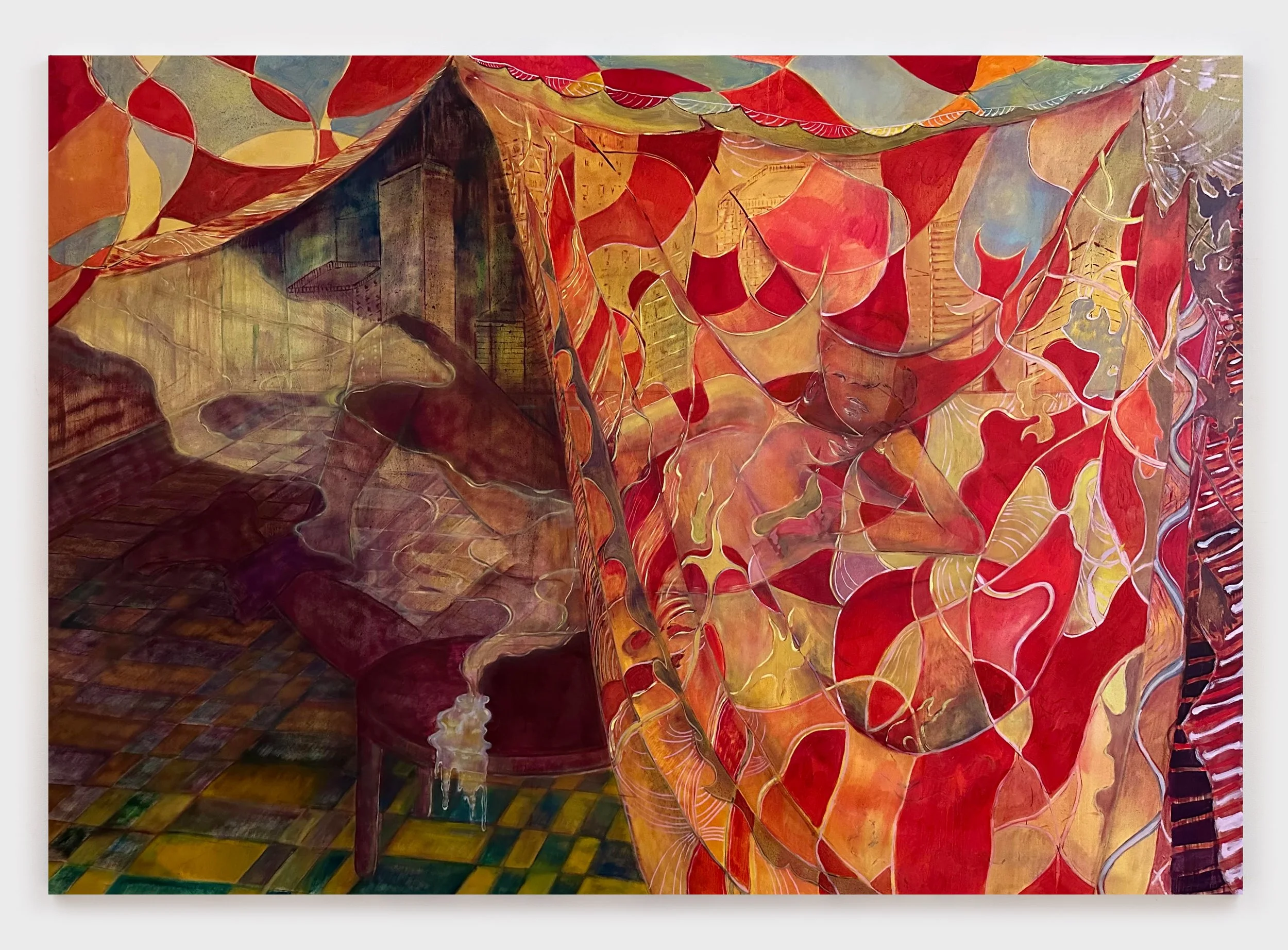
Hanz Ronald, Venice nights, 2026 oil on canvas 61 x 87⅜in. (155.00 x 222.00 cm)
U: What draws you to a particular image, object or moment? How does your perspective as an artist influence the way you experience and engage with the work of others?
H: I’m often drawn to images, objects, or moments that carry a sense of mystery, symbolism, or emotional memory. Sometimes it’s something very ordinary that suddenly feels strange or meaningful to me. I’m interested in the stories, histories, and associations that an image or object can hold, and in how different references can come together and create new meanings.
I think being an artist changes the way I look at other people’s work because I’m always aware of the space between what we see and what we feel. I pay attention to small details, materials, composition, and the choices that might not be immediately visible. But I also try not to over-explain the work to myself. I like allowing a work to affect me before I try to understand it. Sometimes that feeling, rather than an intellectual understanding, is what stays with me and becomes part of my own practice.
U: Are there any artists whose work has recently inspired you or challenged the way you think about your own practice?
H: Anna Boghiguian and Ney Matogrosso. Both have challenged the way I think about what art can be in our world, and about the connections between history, objects, culture, and the body.
Anna’s work has a strong impact on me because it shows how painting can reach other dimensions and open up different ways of seeing. I’ve also been drawing inspiration from music and performance for quite some time. For me, Ney Matogrosso is a beautiful and sensitive artist who has challenged the conventions of his time. His work is a source of inspiration for me, from his compositions and sounds to his energy and the whole atmosphere he creates.
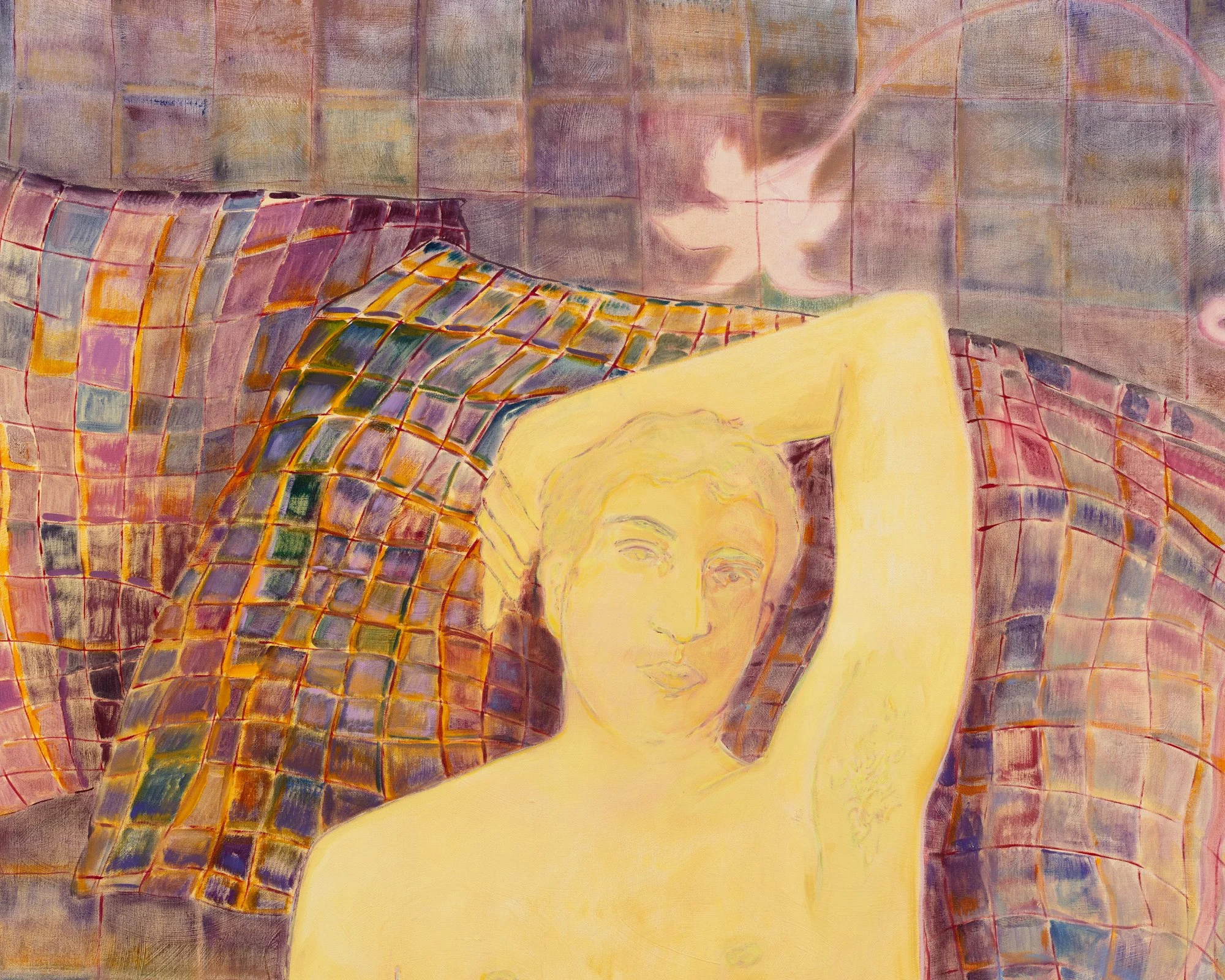
Hanz Ronald, Something Greater, 2026 oil on canvas 53⅛ x 49¼ in. (135.00 x 125.00 cm)
U: Your paintings often blur the boundaries between memory, imagination and reality. If you could describe your practice in one word, what would it be and why?
H: Connections. I think my practice is very much surrounded by the idea of creating unusual connections between shapes, colors, and images. I spend quite a lot of time creating these connections, blending and merging different elements, subjects, times, and forms to build the images. I’m interested in what happens when things that don’t necessarily belong together start to find a relationship within the painting.
U: Does the time of day influence your creative process? Is there a particular moment when you feel most connected to your work?
H: I like to work with the sun, so I usually prefer the morning or late afternoon. There’s a special moment in my studio around 4 pm, when the sun comes in at a certain angle and fills the space with a very specific light. Everything becomes brighter, and the rays of light almost transform the studio into a different space. When this happens, I feel more excited to work. I find myself looking at the light, the colors, and the way everything changes, and wanting to somehow capture that feeling.
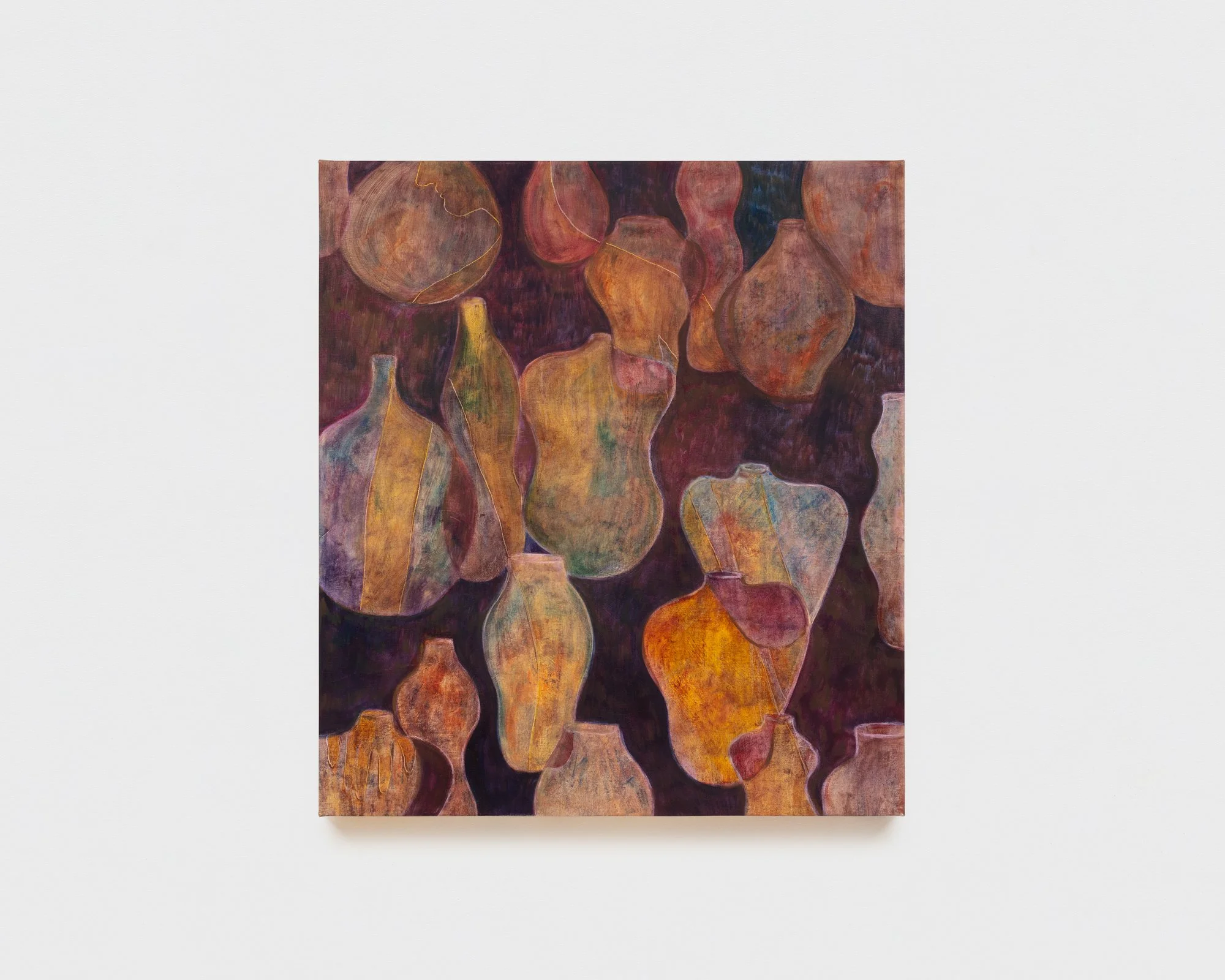
Hanz Ronald, I know I'm not wrong, 2026 oil on canvas 39⅜ x 35 in. (100.00 x 89.00 cm)
U: What are you reading at the moment? Has literature played a role in shaping the imagery, atmosphere or narratives within your paintings?
H: I'm reading “When God Was a Woman” by Merlin Stone and “In Praise of Hands” by Henri Focillon. My reading isn’t always directly connected to my practice. I like to move between different subjects and themes: things from the past, theories, fiction, poetry, and other kinds of writing. I often find sources for my work through reading, but not necessarily in a direct way. Books give me images, ideas, stories, and ways of thinking that slowly become part of my imagination. They help me explore how I see the world, and sometimes something I read will return much later in a painting, transformed into something completely different.
Jewelry and personal objects appear throughout A Charmed Hour, often carrying a sense of intimacy and memory. What interests you about adornment as a form of artistic expression, and how do these objects take on new meaning within your paintings?
I’m interested in adornment because it can be very personal, but at the same time it can carry a lot of cultural and symbolic meaning. Jewelry, clothes, ornaments, and personal objects can tell us something about a person without necessarily saying anything directly. They can speak about identity, desire, memory, status, protection, or simply the way someone wants to present themselves.
There is a tension in the world between objects and the body. Sometimes we give a body to an object, and sometimes we objectify the body. I’m interested in this tension and in how it can change our relationship with things, giving them different meanings and turning them into symbols. In my paintings, these objects often come from memories, photographs, things I have seen, or images I have collected over time. Once they enter the painting, they become something slightly different. I like taking an object that has its own history and placing it in an imagined space, where it can connect with other symbols, figures, colors, and references. In this way, the object can transform its context and become part of a different story.
U: Your work draws from a range of cultural histories and visual traditions, often bringing seemingly disparate references together. How has your Brazilian background informed your visual language, and what interests you about creating connections across different cultures and histories?
H: My Brazilian background has definitely influenced the way I look at color, ornament, movement, textures, and the relationship between different visual languages and narratives. Growing up in Brazil, I was surrounded by a very diverse mix of cultural references, images, traditions, stories, and influences, and I think this openness became part of the way I see and build images. I’m interested in how different histories and visual traditions can meet and create something new. I think a lot about stories, too. In Brazil, there is a strong culture of talking and telling stories- personal stories, family stories, stories from the past- and I think this way of sharing and imagining things is also part of how I see the world. Brazil has also been shaped by a very complex mix of cultures with different people and traditions living and developing in the same space. In my work, I like bringing together references that might seem very distant from each other: ancient objects and patterns, contemporary images, memories, symbols, and personal experiences. I’m interested in what these different cultures have in common, the questions they ask about the world, and the different ways they try to understand or imagine it. For me, these connections don’t need to have a direct historical relationship. They are often intuitive. I like discovering similarities in symbols, forms, stories, and feelings, and imagining how something can be understood or imagined in completely different ways by different people and cultures. Painting becomes a way for me to bring these things together and see what new connections can appear.
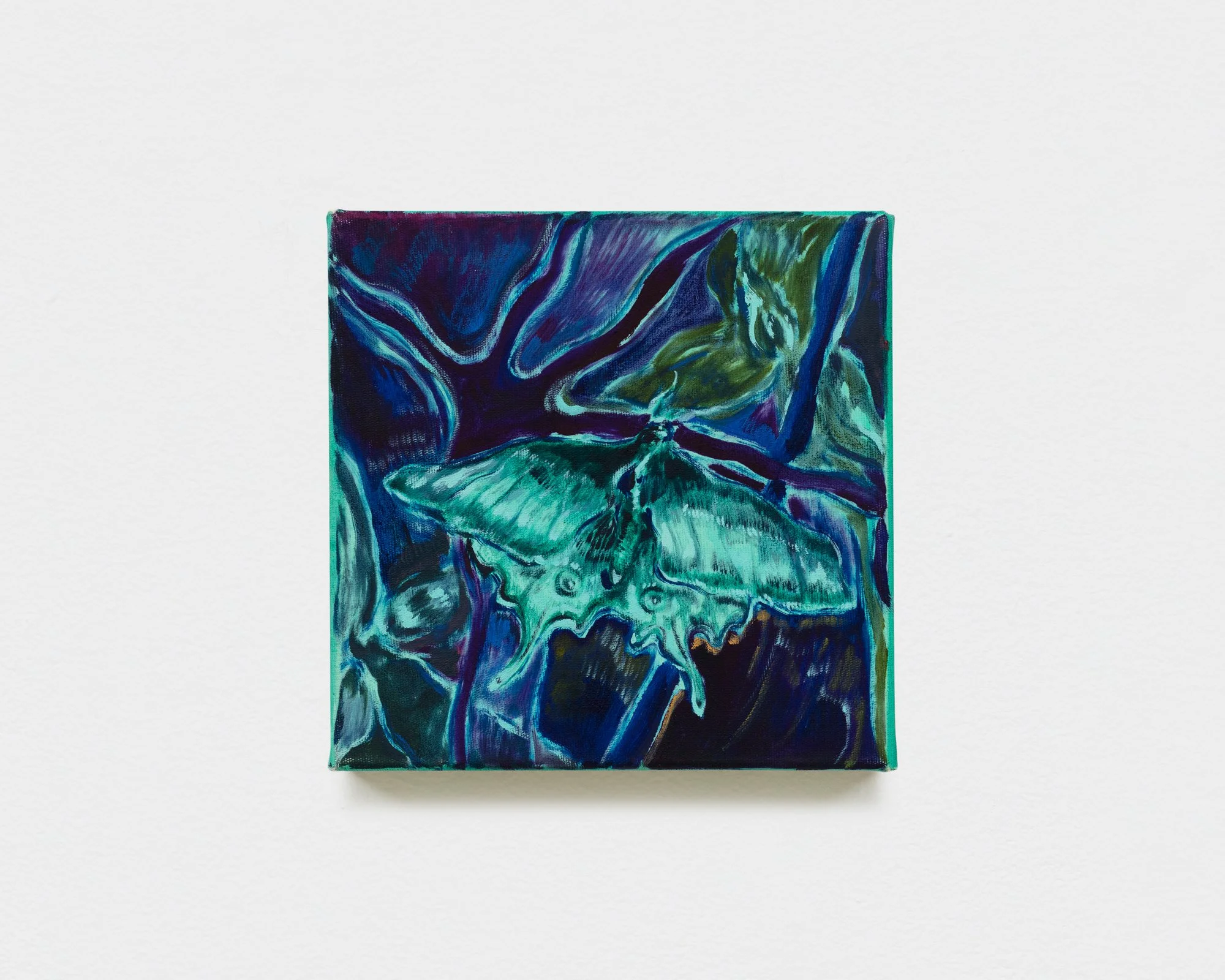
Hanz Ronald Mysterious I, 2025 oil on canvas 7⅞x 7⅞ in. (20.00 x 20.00 cm)
U: Is there a medium, subject or direction you haven't yet explored that you're eager to pursue? What do you hope to discover in the next chapter of your practice?
H: I would like to explore installation more and find other possibilities within painting. I’m interested in thinking about how the paintings can relate to the space around them, and how I can bring some of the elements that already exist in my paintings into the physical space. I’ve already made an installation with a 6-meter-long painting, so I think it could be very exciting to continue exploring these dimensions and see how painting can transform a space.
I’m interested in finding new connections and ways of expanding my practice while staying close to what already feels true to me. I hope the next chapter brings new possibilities, but also allows me to go deeper into the things that are already part of my work.
The magazine did a feature on Hanz’s most recent exhibition which can be found here. For information about Hanz’s artwork and his recent exhibtion at Uffner & Liu gallery please visit thier site here.