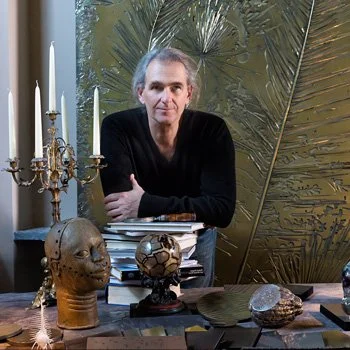
Courtesy of artist
Born in Milan 1966. After graduating in economics and business studies from the Bocconi university in Milan, Gianluca Pacchioni moved to Paris. There, during the Nineties, he was plunged into the Paris art world and was overcome with a passion for sculpting metals which he experimented, self-taught, in the studio shared with other artists at the Quai de la Gare. The experiments then found their place, with the first collection of sculpture furniture in iron shown by the Vivendi gallery in Place des Vosges. The return to Milan was dictated by the need to work in tandem with the flexibility, experience and creativity of Italian artisans. This relationship with the material and with artisans led to his leap from designer to homo faber. He opened his Milan atelier in an eye drops factory from the 1930s, with the final location for the forge and workshops set up in 1998. Since then the atelier has constantly forged sculptures and limited editions of furniture, produced for an international clientele. Exploration is ongoing and there has been a move from iron to stainless steel, bronze, brass and aluminum, to patinas and experimental techniques with liquid metals. The workshop only produces works with experimental and innovative working and techniques. In 2014, following an exhibition, one of his works was permanently exhibited as a symbol of Italian savoir-faire, at the entrance hall of the Italian Embassy in Paris. In 2016 he was awarded with the title of " Master of Arts and Crafts " by the prestigious Fondazione Cologni.. Forging steel himself in his workshop, he began working with bronze, brass and aluminum to create limited edition sculptures and furniture. Constantly experimenting, his innovations involve liquid metals and patinas. The pieces he creates show the contrast between raw materials – metal of course, but also stone or concrete – and the resulting beauty that is born from the artist’s skill and sensitivity. Likewise, light plays a fundamental role in his works. It amplifies the forms of expression, making them both visible and uncertain. The sculpture reveals the inner self.
I had the pleasure of asking Gianluca what is the most vital trait an artist should possess, how he hopes his legacy will be remembered, and how art and literature intersect and so much more.
UZOMAH: How important is the role of the curator when you work on your exhibitions? Can you give specific examples of how a curator can help you present your artistic statement authentically?
GIANLUCA: The role of the curator is fundamental, but only when it doesn’t overlap with the work itself. My practice is deeply rooted in a physical relationship with materials, stone and metal, so there is always a risk of imposing a narrative that becomes stronger than the presence of the work. A good curator works by subtraction, creating the conditions for the work to speak in its own voice, without over-explaining it. When this balance works, the curator becomes a deeply attentive presence, someone who doesn’t interpret for the artist, but makes visible what is already there, sometimes even what is still implicit.
U: In your opinion, what is the most vital trait every artist should possess? Can you provide an example?
G: In my opinion, the most vital trait an artist can possess is intensity. Not in the sense of excess, but as a form of inner necessity, an uncompromising commitment to what one is doing. It’s the ability to stay within a process long enough for something real to emerge, beyond intention or control. I’ve always been drawn to artists whose work carries this kind of density. You can feel when a piece has been pushed to a point where it could not be otherwise. In my own practice, working with stone and metal, intensity means resisting the temptation to resolve too quickly, allowing the material, and the resistance it offers, to shape the outcome. It’s not about style or recognition. It’s about how deeply the work is lived.
Courtesy of artist
U: Can you describe your typical day in the studio? If you have a set routine, what does it look like?
G: My day usually begins very early, around five or six in the morning, with a sense of anticipation that is almost childlike, like waking up on Christmas day. There is an immediate desire to start, to enter the work. The first part of the day is dedicated to visiting the workshops I collaborate with: stone ateliers, foundries, mechanical labs. It’s a moment of exchange, very concrete, where ideas take shape through dialogue and process. We often share lunch together, it’s an important part of the rhythm, a human continuity within the work. In the afternoon, I return to my own studio and work alone. That is a more introspective time, where everything slows down and becomes more focused, more silent. I don’t like working at night. I prefer to follow the rhythm of natural light. When the day ends, I shift to what I call the “backstage”: emails, administrative work, all the invisible structure that supports the visible part of the practice.
U: Is there anything in the visual arts that you struggle to express through your work but still strive to communicate? Can you give a specific example?
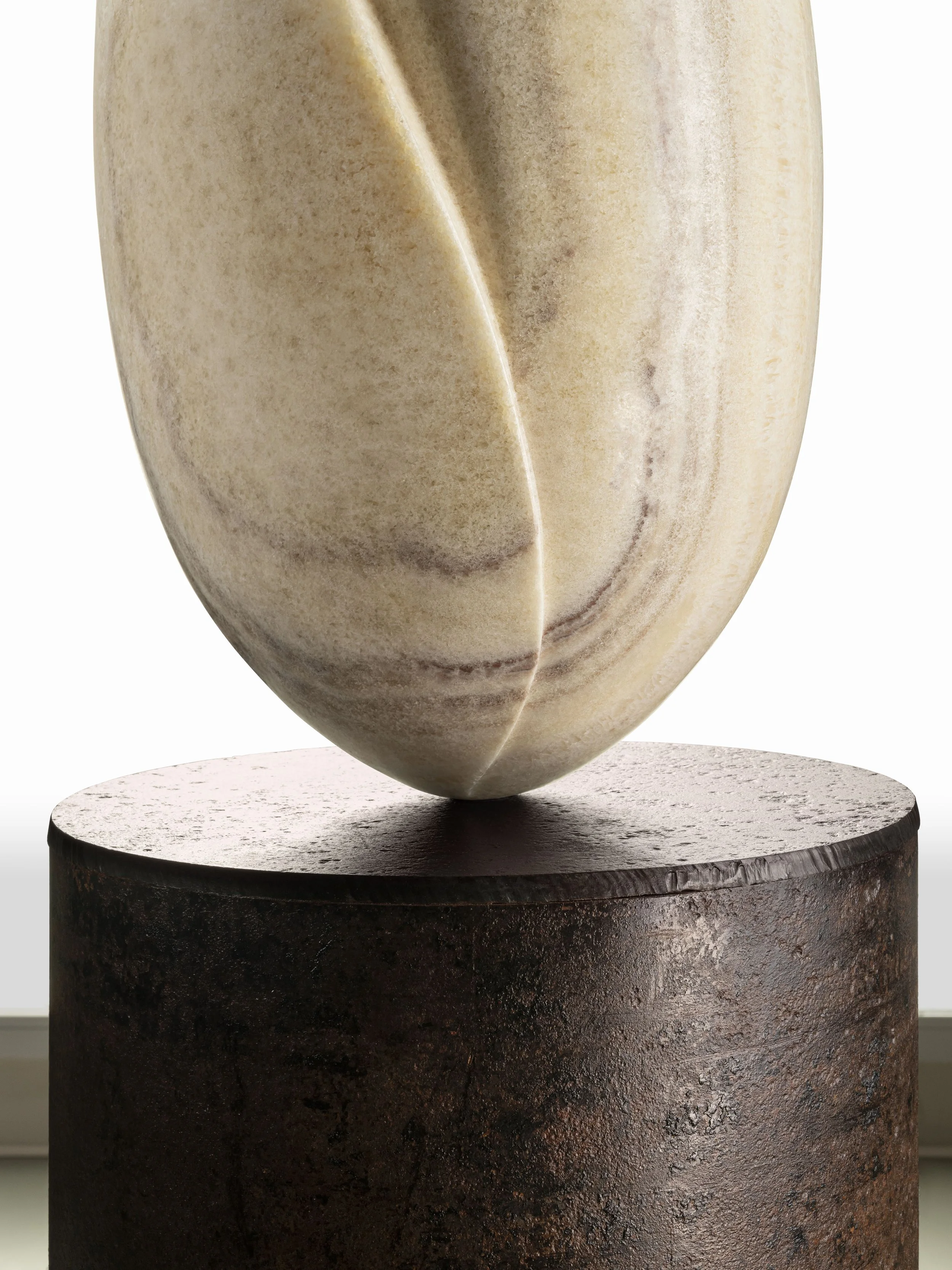
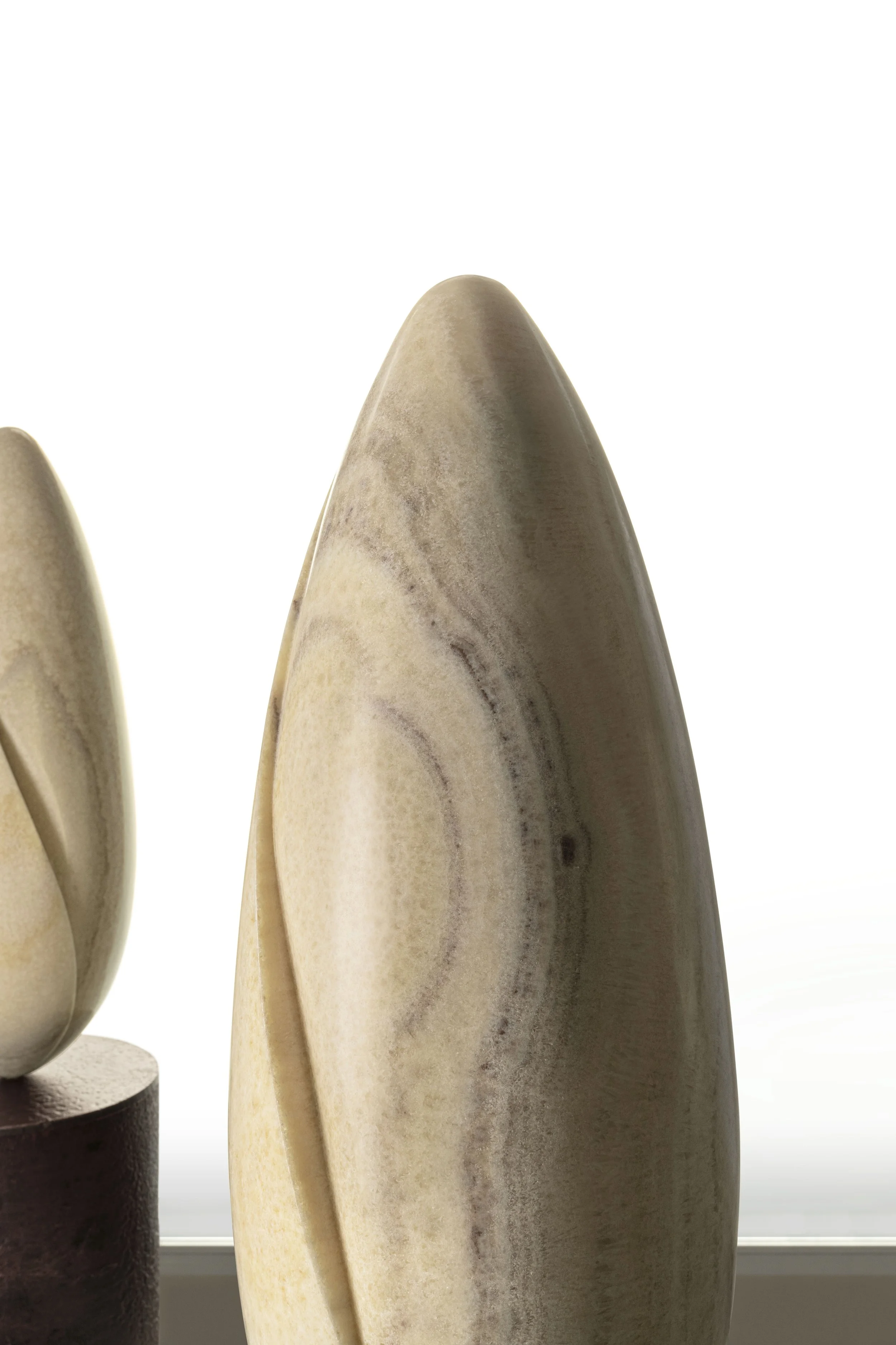
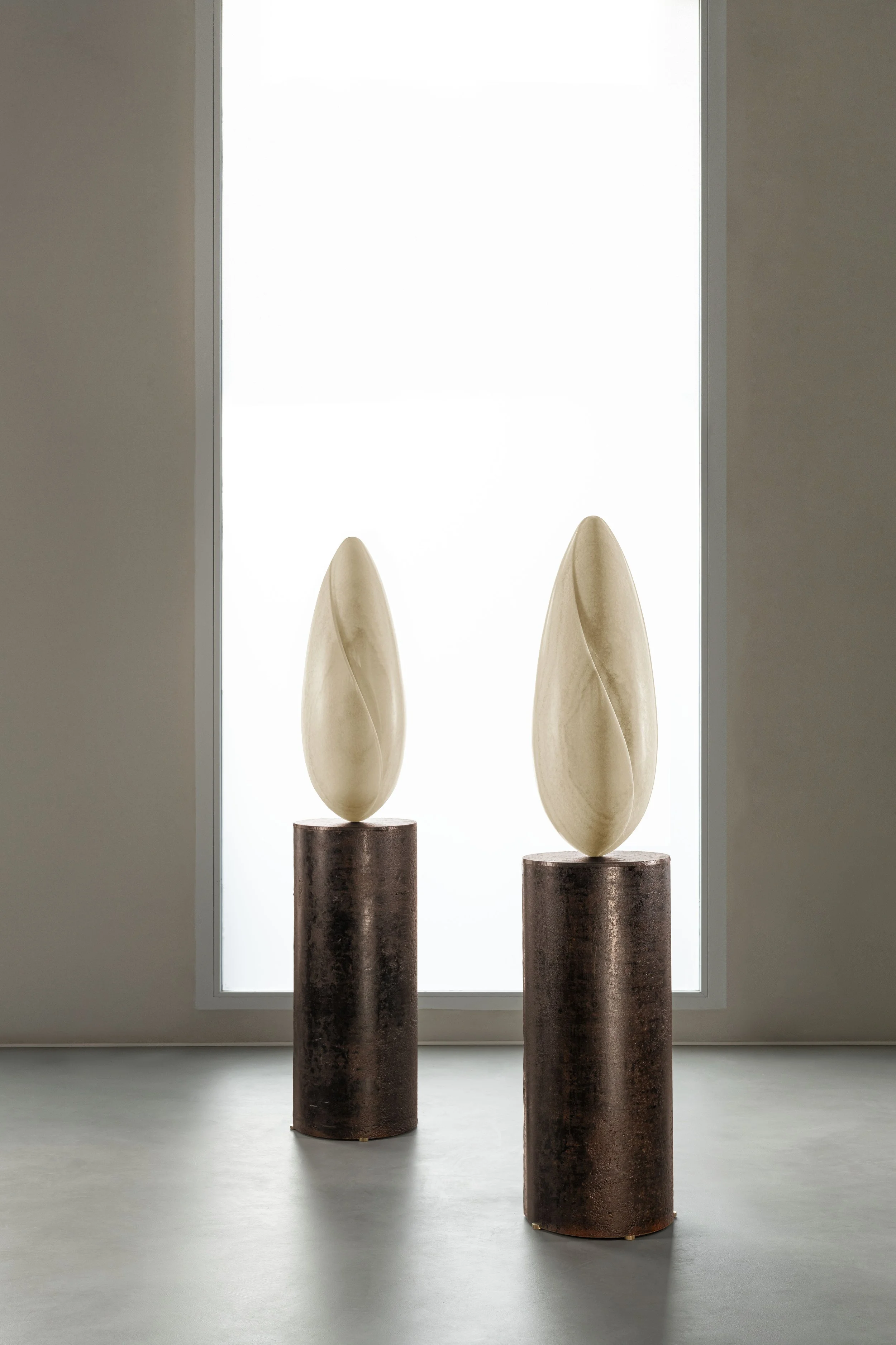
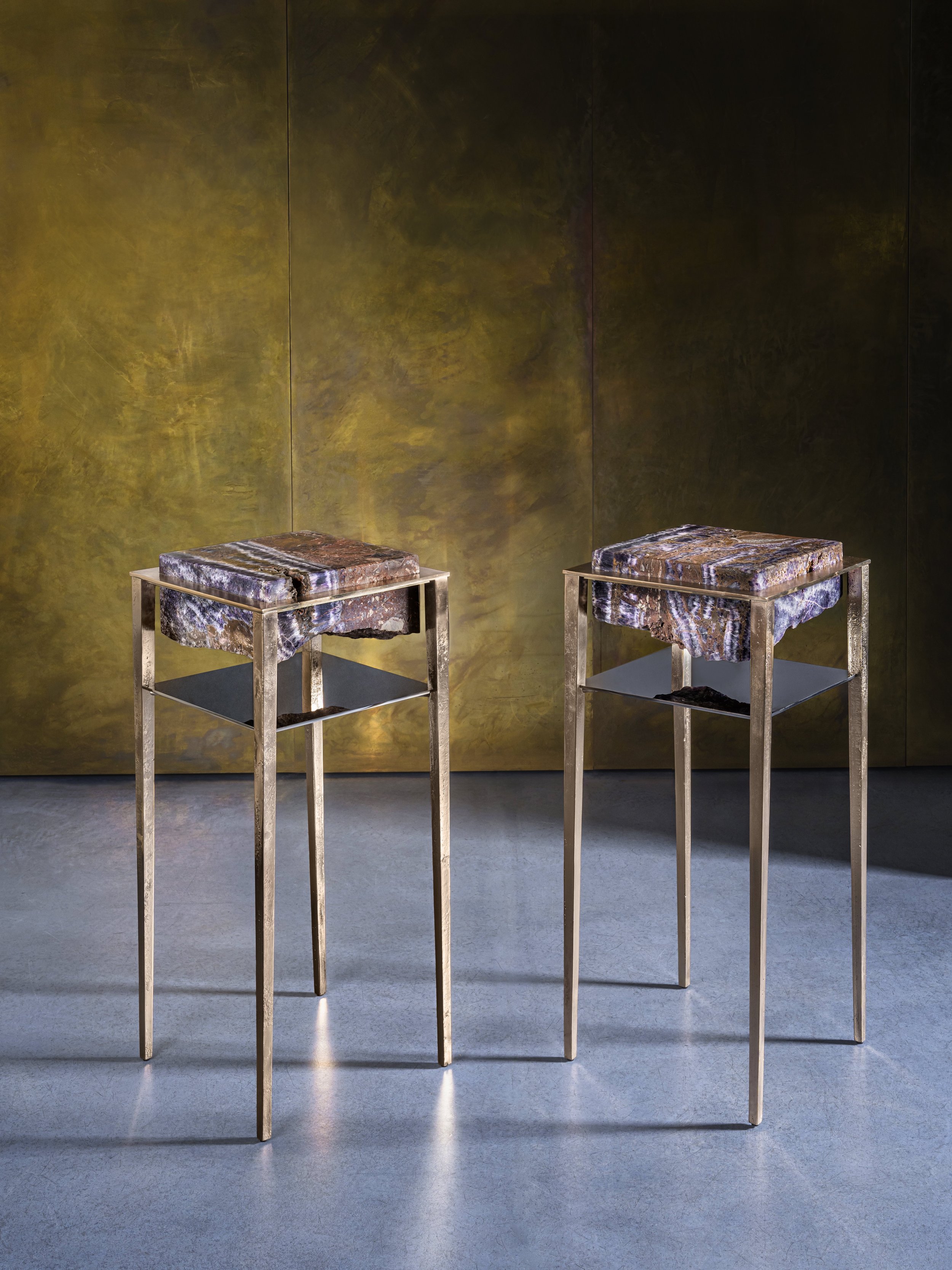
G: I think the question of limits is intrinsic to sculpture itself. As a sculptor, you are asked to resolve emotions, thoughts, and tensions through a single gesture, a three-dimensional gesture that is, by nature, finite. But this is also the beauty of the work: the possibility of condensing one of the many mysteries of life into a single form. Recently, I’ve been focusing on a very fragile and intense moment, the condition of equilibrium. In this recent exhibition, I presented two works titled Ecstatic, which attempt to hold, in one gesture, that unstable balance: the moment in which a person feels both absolute strength and extreme fragility at the same time. This is what I strive for. There is always a difficulty in the work but that difficulty is precisely where the challenge lies, and with it, the motivation and the reason to continue.
Courtesy of artist
U: Are you currently reading anything? If so, could you name some authors or poets you enjoy and describe what draws you to their work?
G: At the moment, I’m reading two very different kinds of books. On one side, something more technical but beautifully done: The Art Lover’s Guide to Japanese Museums by Sophie Richard. It’s a guide to what can be discovered in Japan for someone deeply interested in art, especially open-air museums, extraordinary collections, and access to contemporary, modern, and ancient works. It’s also part of a personal project, as I’m planning a second trip to Japan, which remains one of the most inspiring journeys I’ve experienced in recent years. On the other side, I’m rereading, for the third or fourth time, Memoirs of Hadrian by Marguerite Yourcenar. It is, to me, one of the most extraordinary books ever written, marked by a level of clarity, depth, and control that I rarely encounter in contemporary literature.
U: Can you name a painting that left you in awe? What specifically about that artist or the painting appeals to you?
G: One painting that left me in awe is Crowned by Nicola Samorì. What strikes me is the tension it holds within a single image. There is a sense of classical perfection, almost heroic, and at the same time a violent disruption of that form. The surface is not just painted, it is worked, pushed, almost wounded. What I find compelling is precisely this threshold: the moment in which the image is still standing, but already collapsing. It’s not about representation, but about resistance, how much a form can endure before it gives way. That balance between control and loss, between beauty and destruction, is something I feel very close to in my own work.
U: How and when do the visual arts and the literary arts intersect? Do you see any differences between the media and how they are expressed through their chosen formats? Any similarities?
G: Visual and literary arts intersect when they both move beyond description and enter a space of necessity. At a certain level, they are not so different: both attempt to give form to something that is not yet fully clear, something that resists being fixed. Whether through words or through matter, the process is similar, a continuous negotiation between intention and what emerges along the way. The difference lies in the nature of the medium. Literature unfolds in time; it is sequential, it guides you through a path. Visual art, on the other hand, exists all at once. It is immediate, physical, and often silent. You don’t follow it, you confront it. And yet, they meet in a very precise point: when form is able to carry more than what is explicitly said or shown. A sentence, like a sculpture or a painting, can hold tension, ambiguity, even contradiction. In both cases, what matters is not the language itself, but the intensity with which it is used.
Courtesy of artist
U: What makes this exhibition different from your previous exhibitions? Can you give a specific example of how this one stands out?
G: This exhibition is very different from my previous one, both in its nature and in its point of departure. The last exhibition was a site-specific solo show, deeply rooted in the history of Palazzina Masieri in Venice, and in the well-known dialogue, and tension, between Carlo Scarpa and Frank Lloyd Wright. The work was conceived in direct relation to the space, almost as a response to its architectural and historical layers. This exhibition, on the other hand, moves in a different direction. It is a group show, and as the title suggests, it is built around a series of reflections on Constantin Brancusi. The works engage with a more distant, yet deeply embedded source of inspiration. one that exists almost beneath the skin of sculpture itself. For me, what makes it stand out is precisely this shift: from a dialogue with a specific place to a dialogue with a lineage. It becomes less about responding to a context, and more about entering a conversation that spans time, one that inevitably touches something very personal, but also something shared among sculptors.
Courtesy of artist
U: How do you hope your artistic legacy will be remembered? Can you describe a specific legacy you hope to leave?
G: I came to sculpture as a self-taught artist, and for me it was never a choice in the conventional sense, it was a necessity, almost an urgency. If I think about legacy, I don’t imagine it in terms of having resolved great questions or mysteries. What I hope remains is something more essential: the intensity and the quality of the work, and the sense of a life entirely committed to it. What matters to me is having pursued this path with consistency, seriousness, and devotion, allowing the work to permeate every aspect of my life. Not as a statement, but as a continuous process of growth, shaped over time. At the same time, I feel that my work is gradually moving toward one of the deepest and most elusive territories we face: the mystery of time. Not time as a concept, but as something that can be felt, resisted, perhaps even held for a moment. If there is something I would like to be remembered for, it is this: not for having explained anything, but for having remained within the work long enough, with enough intensity, to touch something that cannot be fully grasped and to have tried, through form, to hold what ultimately escapes it.
For more information about Gianluca’s artwork please visit his site here. He can also be found on Instagram here.