In Conversation with Aglaé Bassens
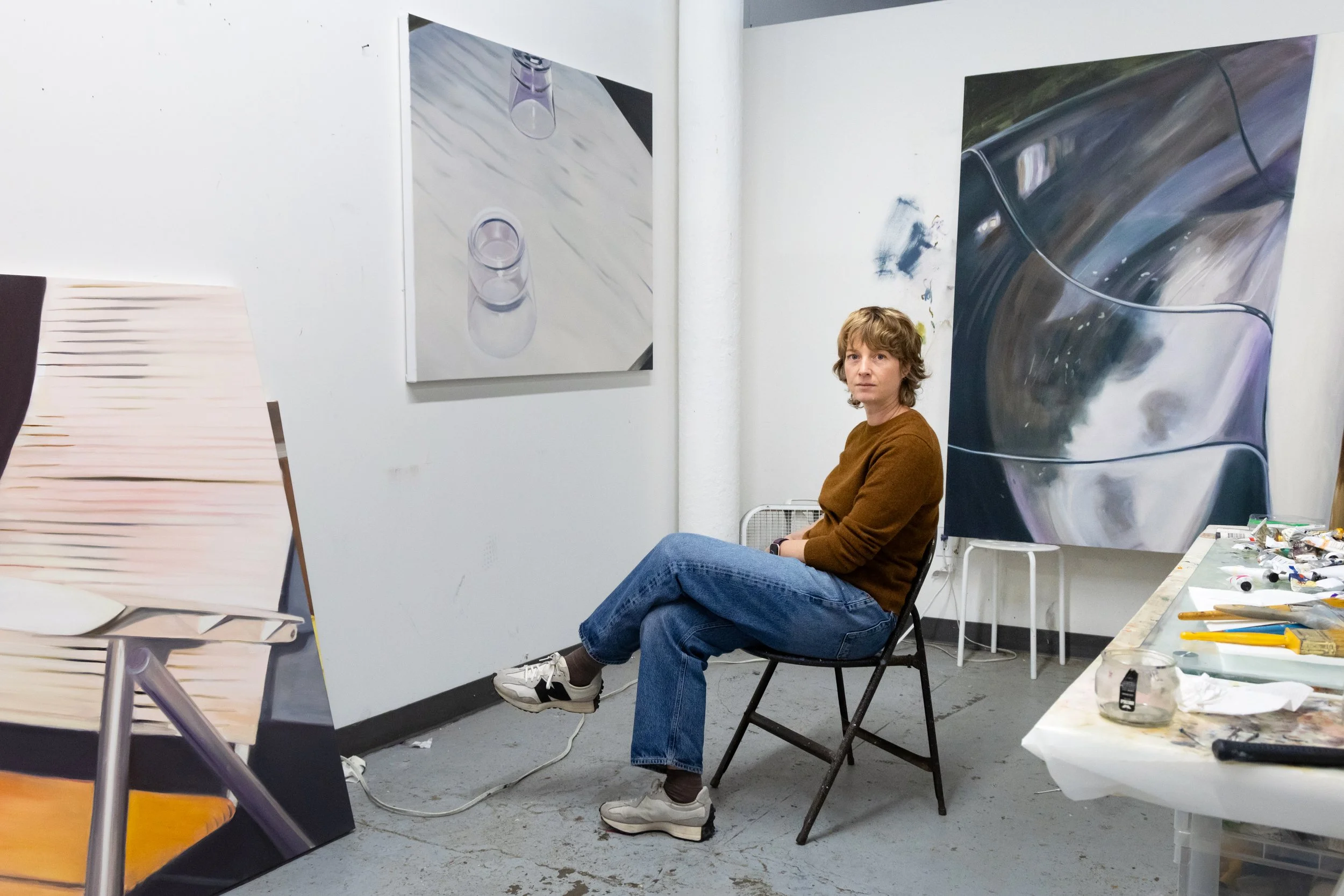
Algaé Bassens, 2025. Courtesy of HESSE FLATOW © Jenny Gorman
Aglaé Bassens is a painter interested in the overlap of the private experience with the communal one. While her paintings stem from her own memories, the imagery feels approximate enough to belong to anyone else’s recollections. Calling attention to the overlooked and the everyday, each work begins with a photograph, either her own or found. Bassens siphons her personal memories, loading each image with feeling. At the same time, she edits and omits from each image, allowing it to be broad enough for anyone to identify with. Through her signature asymmetrical cropping and atmospheric treatment, she invites viewers to recognize something of their own in each painting.
Aglaé Bassens (b. 1986, Belgium) has a BA in Fine Art from the Ruskin School of Drawing and Fine Art, Oxford University (2007) and an MFA in Fine Art Painting from the Slade School of Fine Art, London (2011). Her work has been exhibited internationally, with solo presentations at the Institute of Contemporary Art, Miami; HESSE FLATOW, New York, NY; 12.26, Dallas, TX; Nars Foundation, Brooklyn, NY; CRUSH Curatorial, New York, NY; and Cabin Gallery, London; as well as group exhibitions at Gowen Contemporary, Geneva; STEMS Gallery, Paris; The Valley, Taos, NM; and Workplace Gallery, London. Her work is featured in New American Paintings No. 134 Northeast Issue and in 100 Painters of Tomorrow published by Thames and Hudson. Bassens’s works can be found in the permanent collections of the Institute of Contemporary Art, Miami and Colección SOLO, Madrid, Spain. She lives and works in Brooklyn, NY.
UZOMAH: This exhibition marks a new development in your practice with the use of a Polaroid camera and images as a starting point for your paintings. Did you know when preparing for this show that you would switch to a Polaroid camera, or were the digital images and found photographs no longer sparking the same response they had before?
AGLAE: I think it’s important to be able to visualize how your current practice could improve or begin to identify the ways it might develop and transform. I had been thinking about ways to shift something in the way I was making paintings when I got the Polaroid camera. I had been considering bigger changes involving subject matter or medium or painting support. But then I purchased a polaroid camera without articulating any distinct plan other than using the flash feature as I love exaggerated lighting and shadows in my paintings. When I looked at the prints I was worried about how little information there is compared to a high definition digital image. It was when I painted the first work from a Polaroid print (Idling) that something clicked: the lack of information allowed me to delve more in the texture of those ‘empty areas’, making the painting more tactile and atmospheric, somehow fuller while still depicting emptiness. I also love the reduced palette that made the new body of work really cohesive despite varied imagery.
U: In your earlier exhibitions at HESSE FLATOW, the human presence has appeared in some of the works either directly and indirectly, through shadows or cropped fragments. In VACANT, the human subject disappears entirely. What does removing the figure allow you to see more clearly, and what does it prevent? The only work featuring a living form is What was that (2025), in which a small group of fish swim across the canvas. What made you decide to include this moment when the emphasis of the exhibition is on vacancy?
A: When I was young, a teacher of mine once told me that you can’t force figures; they kind of just creep up on you. I often think of that because I think it’s very true for me. My practice has primarily been still life, with elements of presence as you mentioned. When I include a figure, it is also absent or unavailable, by being literally cropped or figuratively by being turned away, asleep, or absorbed by a phone screen. Even in the empty scenes, the figure is still felt through its absence. Ideally, I want the figures I paint to have come to me the way the other images do: a fleeting encounter, an ordinary moment noticed and chosen to paint. I think there is a danger of staging figures, of chasing for something you imagined instead of being receptive to chance and inspiration. I try to paint figures only when they creep up on me to maintain my approach to sourcing and creating images. That said, I have found that an element of life provides a strong counterpoint to the emptiness of other paintings in the context of an exhibition. This has brought my attention to animals: they are so interesting to me as paintings, because they have personality and presence but a different consciousness than people have. They also speak to domesticity, which relates to the mundane nature of my motifs, and to instinct, which relates to the way I paint. In VACANT, I debated painting an empty fish tank, but was attracted by the presence of the fish swimming silently, and the emptiness in their eyes. The title What Was That refers to the saying about goldfish having no memory; it seems like the perfect living vessel for emptiness.

Aglaé Bassens (b. 1986) Tablescape, 2025 Oil on canvas 39 3/8 x 51 1/8 inches 100 x 130 cm
U: In the press release, you are quoted as saying, “Contemplating mortality can be unsettling, yet there is poetic beauty to the indifference of time to our milestones, achievements, and losses.” Considering the themes of impermanence, memory, and mortality, and the fact that time is not guaranteed for any of us, do you think getting older and the passing of time give meaning to an individual? Not necessarily through what one does or the legacy one leaves, but simply through the time lived.
A: Absolutely. The passing of time is like the stuff, the material of life. As a young artist, you have so much time ahead of you, which means you have so little life, memories, and experiences under your belt. Then you’re turning 40, and you find yourself with never enough time but lots more life experience behind you. The magic is that as you age and your practice evolves, the time of painting remains direct, always in the present.

Aglaé Bassens (b. 1986) Idling , 2025 Oil on canvas 51⅛ x 66⅞ inches 130 x 170 cm
U: I read that your process starts with the photograph and that you paint each work in one sitting. How long does it typically take to complete a painting? Have there been scenes that you photographed and painted but ultimately chose not to include in the final exhibition?
A: Typically, it takes me between 1 to 6 hours, depending on the scale. Sometimes the bigger ones can take less time than a tricky small painting. I have painted many things that ended up in the bin. The painting of the images is like a performance for me; it is conceptually important that it happens in one go, like a long act of staring or concentration, a surge of energy. This means I have to commit to an idea and hope it works out! As I get older, I am better at triaging images and at anticipating difficult areas so they don’t slow me down and disrupt the flow. Typical mistakes I have made include too many things in a scene - I don’t do well with busy paintings, they don’t feel quiet enough - or overworking a painting until it feels tight and technical. It works, or it doesn’t, and you start again. I try not to be precious about the work; it's important to be able to throw something out if it doesn’t work.

Aglaé Bassens (b. 1986) What was that, 2025 Oil on canvas 39 3/8 x 51 1/8 inches 100 x 130 cm
U: When viewing the works, there is an overwhelming feeling of nostalgia, an empty car, a playground slide, and deflating balloons. They are simplistic but feel universally familiar. When you come across these moments while collecting imagery for your paintings, are you thinking about your own past?
A: Yes, sometimes it is related to a specific anecdote or memory. For example, the deflated balloon in the show is from my son’s third birthday last summer. I chose to paint it because balloons are a favorite motif, but also because it symbolized a realization that he is growing up fast. Most of the time, the things I paint are not inherently nostalgic; they don’t make you stop in the street. The process of painting slows down the experience of looking long enough for the viewer to project their own memories and associations onto the motif. It is simply a universal way to look at the world on pause and take notice of time ebbing away. The familiarity of the images helps that human connection.

Aglaé Bassens (b. 1986) Happy Anniversary, 2025 Oil on canvas 10.5 x 13.75 inches 26 x 34 cm
U: Have you ever orchestrated a still life before photographing it, or do you wait for moments to present themselves to you? Have you ever had a vision of a scene, such as an empty dinner table, and made a mental note to photograph it the next time you encounter it?
A: No, I never staged a picture. When I was younger, I tried it and it immediately felt wrong. It’s important to me that it’s accidental, an encounter that triggers something in me to stop and take a picture. Sometimes I can’t articulate at the time why I need to photograph it, and that unconscious desire is exactly what I am looking for. If I imagine what I want to paint in the context of a theme, it inevitably becomes very literal, just an illustration. When I encounter a scene that moves me, I don’t question it; I photograph it at once, then unravel its meaning in the studio. It has led me to much more interesting results, and it also feels more like collaboration with the world at large. I don’t invent anything, I just upcycle.

Aglaé Bassens (b. 1986) Stone Tiles, 2025 Oil on canvas 51 1/8 x 39 3/8 inches 130 x 100 cm
U: With this exhibition marking your fourth solo presentation at HESSE FLATOW, the first dating back to 2018, and with time being such a central theme in the work, how has the time between these four shows shifted your practice (aside from the use of a Polaroid camera)? How have you changed as an artist?
A: The main thing is that I have more life behind me. Since 2018, I have gotten married, given birth, and experienced loss. The sights that speak to me have become more varied, the associations more complicated. Despite their ongoing emptiness, the paintings have become warmer, softer. I have learned not to make decisions based on a need to justify myself as an artist. I have acquired a better understanding of which photographs make good paintings and why, and of when a painting is finished. I have become more comfortable not needing to overexplain everything in my work. My drive remains the desire to draw out emotion by casting light on the mundane, the discarded.
For more information about Aglaé’s artwork updates, please visit their website here, follow them on Instagram here, and see their current exhibition featured in the magazine here.