Highlights from NADA Miami
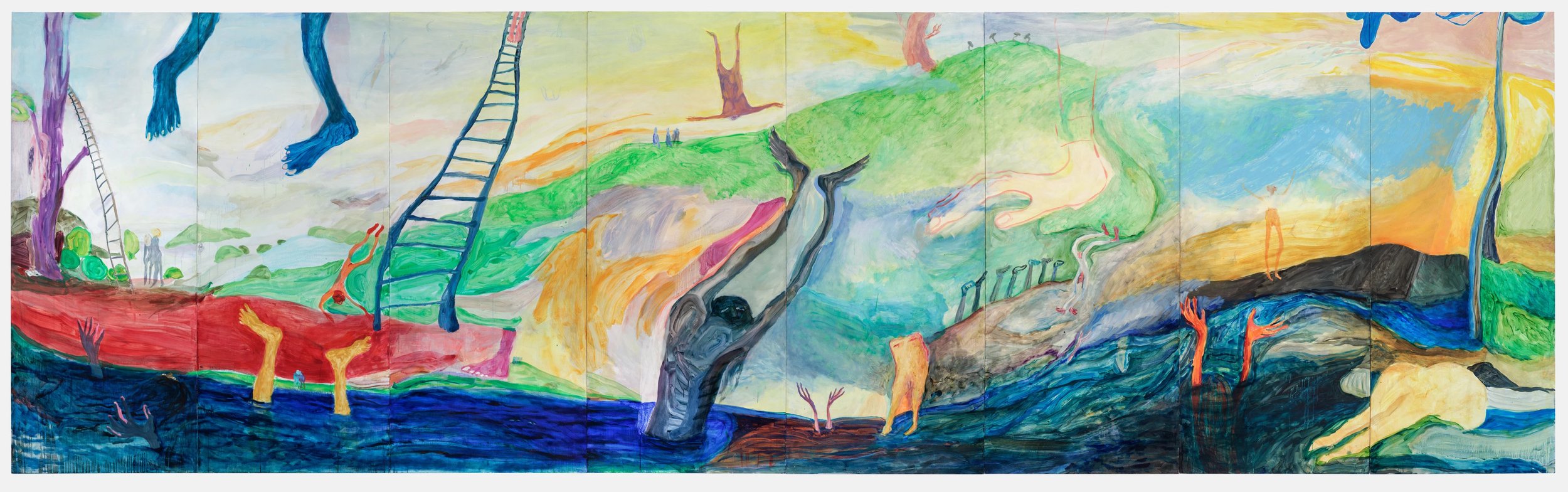
Lucía Vidales: Courtesy of the artist and PROXYCO, New York.
NADA Miami opened its doors this week for the 23rd edition of the fair, closing out 2025 with unapologetic energy amidst a challenging market. At Ice Palace Studios, the fair hosts nearly 140 galleries, art spaces, and nonprofit organizations from across the world, once again positioning itself as a ground for discovery. As one of the New Art Dealers Alliance’s two annual fairs, Miami continues to exude a spirit of collaboration and welcomes an exciting roster of newcomers such as Paris-based Brigitte Mulholland.
Below is a list of artworks at the fair that you can’t miss!
PROXYCO presents a solo booth centered on one of Lucía Vidales’ most ambitious large-scale works: a 30-foot-long painting composed of eight panels titled “Viendo el Monte Calvario (Looking at Mount Calvary),” 2020. Originally commissioned by Murales para un cubo blanco (Murals for a White Cube) at the Sala de Arte Público Siqueiros in Mexico City, once the studio of the seminal Mexican muralist David Alfaro Siqueiros, it stages a contemporary dialogue with his legacy. Vidales engages with Siqueiros with both resonance and distance, articulating the perspective of a younger generation, increasingly skeptical of organized religion and more outspoken in its interrogation of institutional power and violence.
During his imprisonment at Lecumberri prison, Siqueiros conceived of this work, imagining Jesus Christ as a political prisoner persecuted for his convictions and his challenge to institutional power. Vidales’ painting reframes critiques of systemic violence through visual references of Mexican viceregal paintings from the 16th to 18th centuries, establishing a fantastical arena for a re-evaluation of religious dogma.
The work’s sweeping 30-foot span envelops the viewer, subjecting them to a full-body encounter with its imagery. Vidales renders the crucifixion site with bright colors; limbs are fragmented, pushing against and slipping beyond the boundaries of the canvas, dissolving into the surrounding terrain, while Christ himself is conspicuously absent. By withholding the figure of Christ, Vidales disrupts expectations, allowing the scene to unfold in a surrealist register and inviting an alternative reading of the crucifixion site.
Lizzie Gill at HESSE FLATOW
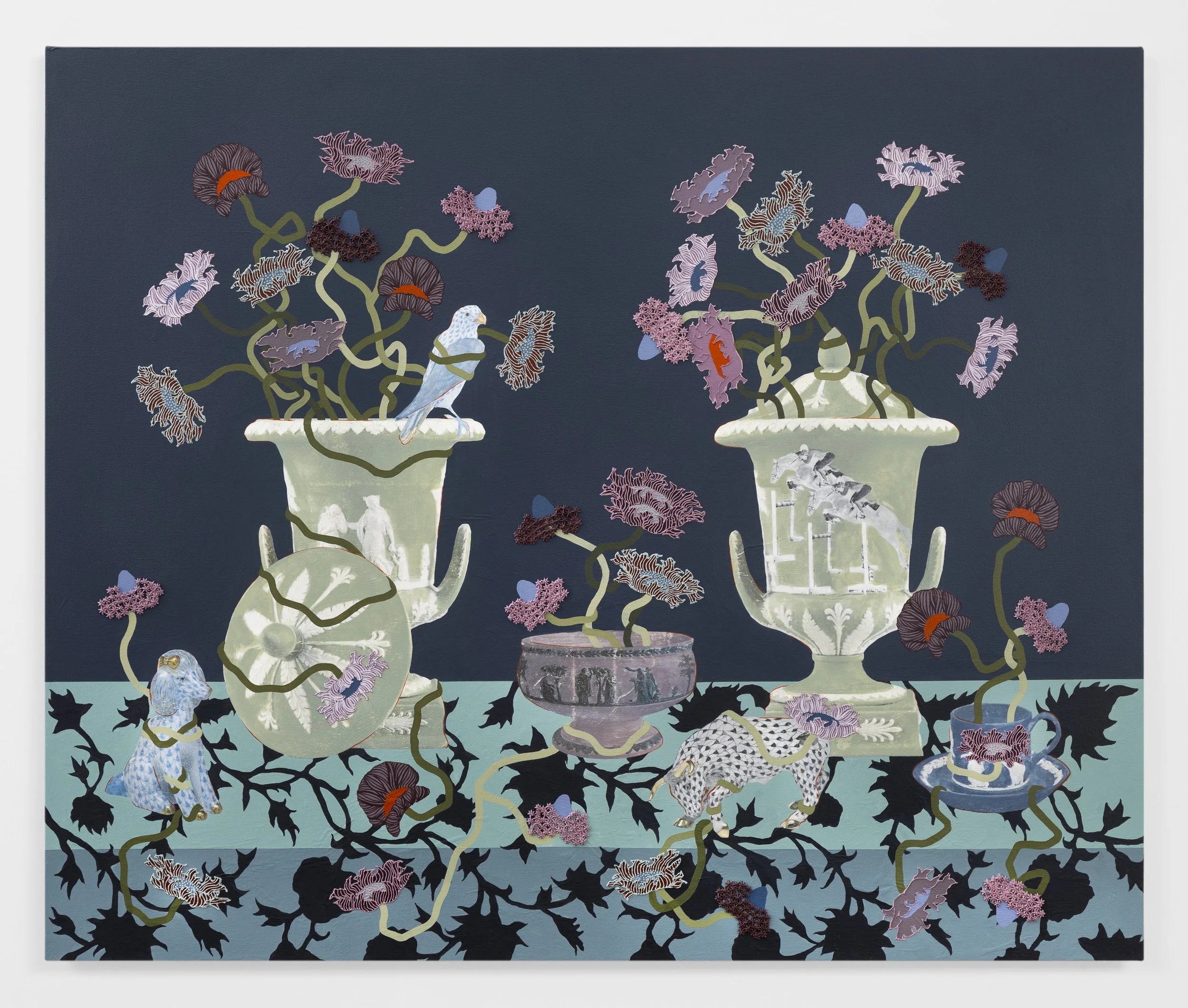
Lizzie Gill: Courtesy of the artist and HESSE FLATOW, New York. Photo: Walker Esner
Lizzie Gill’s exploration of domesticity unfolds through carefully composed still-life paintings centered on meticulously staged tablescapes. Her body of work investigates material culture through generational knowledge and allegorical symbolism; porcelain animals and antique ceramic ware serve as synecdoches for family structures and for the ways inanimate objects inform social rituals. Employing an image-transfer process to display her mother’s porcelain collection, Gill removes these objects from their original context, prompting a reflection on the capriciousness of ownership and authorship.
In “Still Life with Two Green Vessels (Avec Le Faucon)”, Gill pipes marble-dust emulsion onto the canvas surface. This technique traces her earlier works that were more textured, mimicking the gesture of decorating a cake to embellish the floral arrangement. She heightens its sculptural presence against an otherwise flat and monochromatic background. The meandering, heavy, rare flowers suggest an imperative toward nurturing and cultivating growth, alluding to the preservation of heirloom inheritance passed through the maternal line.
Her solo exhibition at HESSE FLATOW earlier this year frames this inquiry through the Greek term paráphernal—“beyond the dowry”—used to describe property legally protected as a woman’s own, outside of her marital contract. Across these works, Gill advocates for responsible practices of preservation, stewardship, and accessibility, positioning her observations on domesticity within a socio-political framework of feminine autonomy.
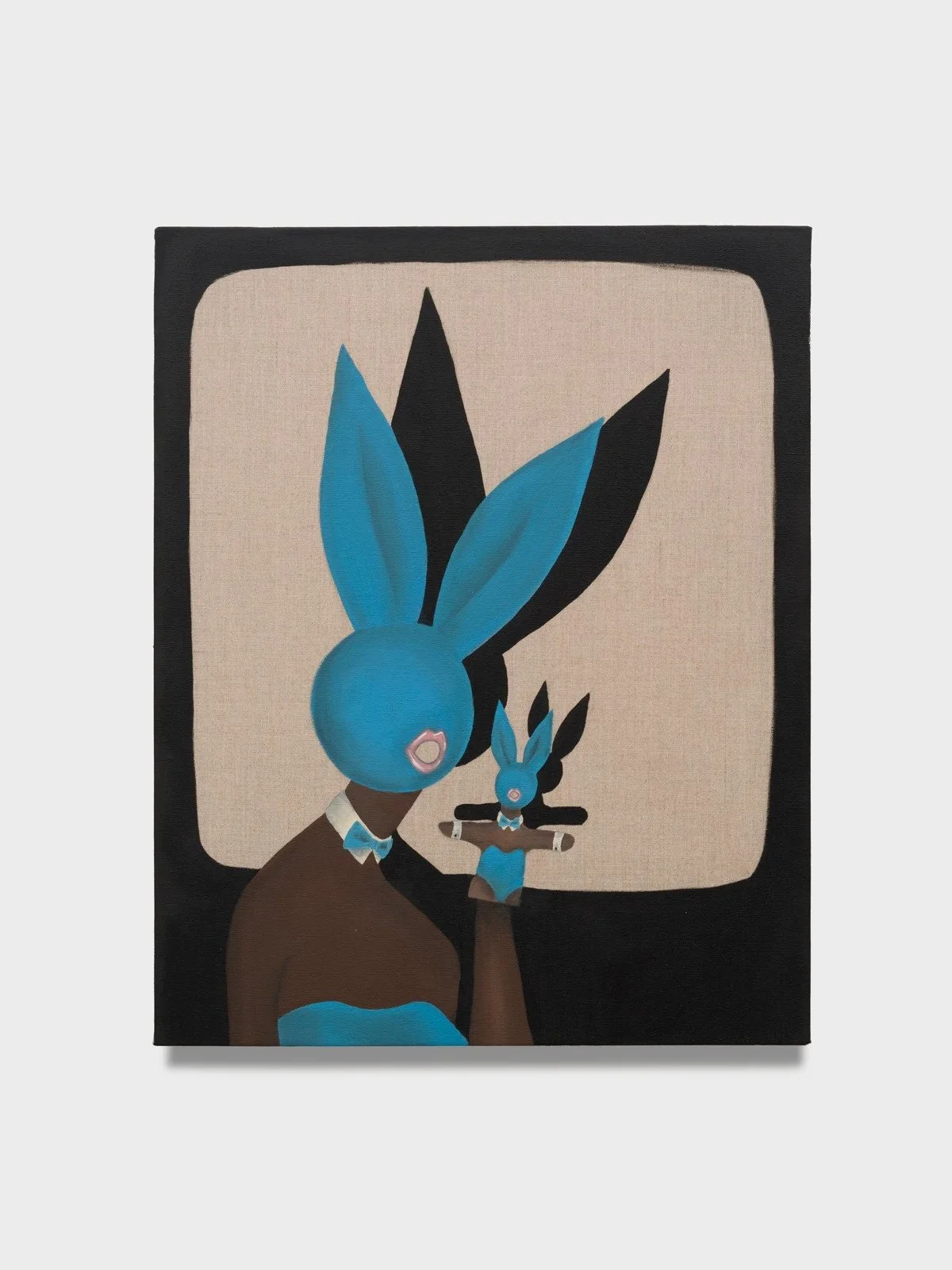
Ryan Wilde: Courtesy of the artist and Brigitte Mulholland, Paris
Ryan Wilde at Brigitte Mulholland
Ryan Wilde's presentation invites a pointed examination of gender performance and the social inscription of feminine identity through sartorial cues. Her painting exposes the objectification and the fetishization of garments, translating appearance to a gendered site through which desire and selfhood are revealed. Drawing on her formative experience as a milliner, Wilde translates the process of hat-making into a method of tracing social and historical codes. She underscores how clothing has historically been weaponized against women to impose otherness, fuel accusations of witchcraft, and spark recurring waves of female hysteria.
“The Puppeteer” offers a contemporary reading of clothing as a non-verbal language, foregrounding fashion as a poignant visual lexicon that mirrors broader cultural shifts in self-expression. The figure’s anonymity gestures to modern women’s inclination to dress intuitively and enigmatically. At the same time, this work reflects how identity is performed, projected, and ultimately consumed—here embodied in the curious guise of a bunny suit. Wilde recasts the Playboy bunny as an autonomous subject, transforming a historically objectifying symbol into a knowing, self-directed mask that signals a woman’s mastery over her own image.
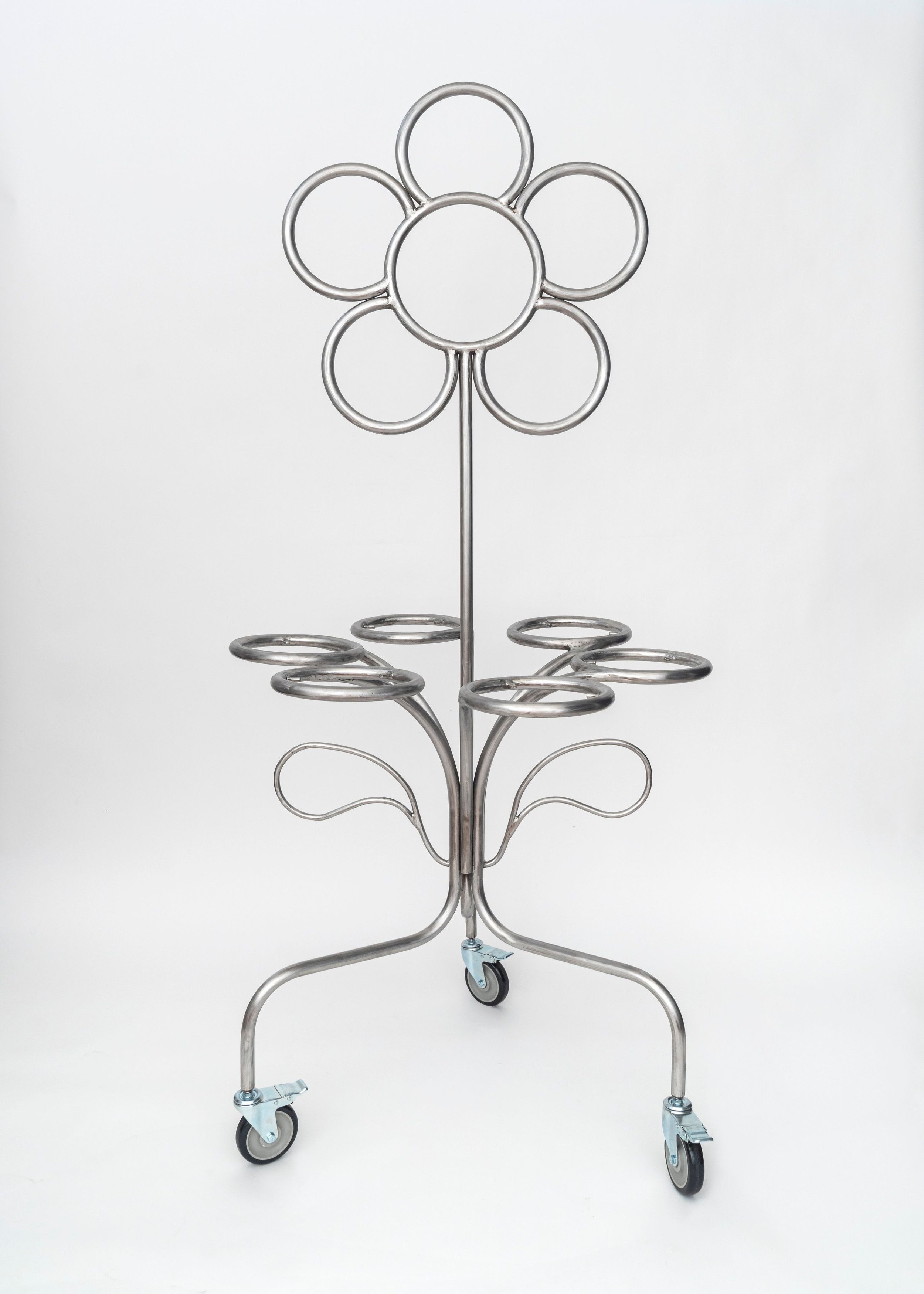
Andrea Bergart: Courtesy of the artist and Chozick Family Art Gallery, New York.
Andrea Bergart at Chozick Family Art Gallery
At NADA Miami, Andrea Bergart presents a series of new paintings, drawings, and sculpture. The installation foregrounds one of her most overt motifs, basketball, considering it as an emblem of everyday life to examine shared cultural experience—play, ritual, and communal identity. The basketball series articulates the symmetry and spatial logic of a basketball court through geometric abstractions.
The sculpture “Sprouting Flower” functions as the show’s centerpiece. The reimagined basketball rack, engineered from polished stainless-steel tubing, is a flower. It operates as both a functional apparatus and a sculpture, reframing athletic equipment as an object of aesthetic intervention. The delicacy of the flower underscores the balance between confidence and vulnerability central to pre-game rituals, team dynamics, and the communal spirit of a sport. Bergart’s presentation also brings up the current moment in women’s sports in the United States. While celebrating WNBA’s record-breaking growth and visibility, the series subtly interrogates systemicdisparity that female athletes still face in stark comparison to their male counterparts.
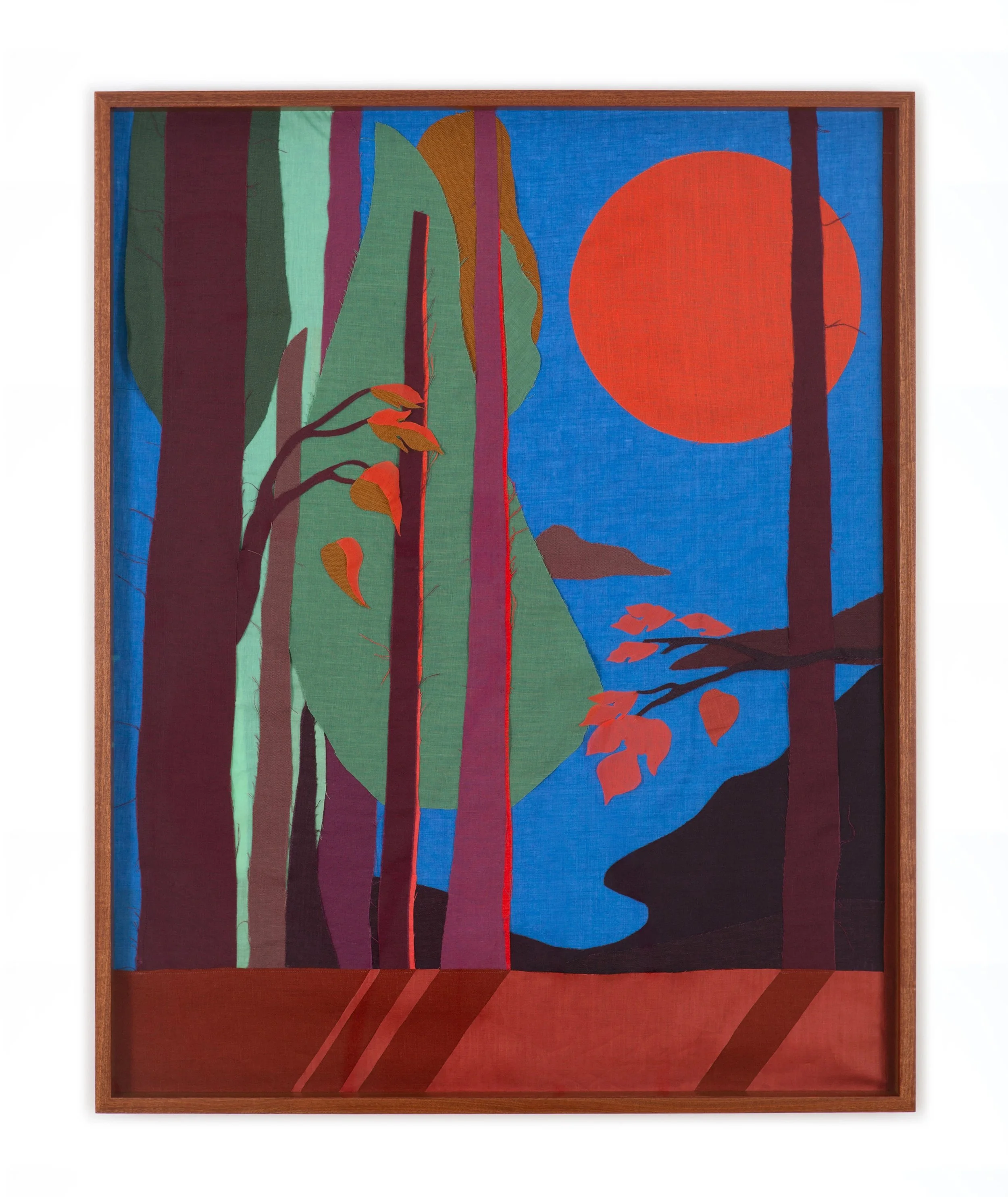
Lisha Bai: Courtesy of the artist and Deanna Evans Project, New York.
Lisha Bai at Deanna Evans Projects
Lisha Bai synthesizes visual metaphors through fiber art, drawing inspiration from two culturally distant textile traditions yet intimately her own: bojagi, the traditional Korean wrapping cloths constructed from various fabric remnants, and the improvisational compositions of quiltmakers of Gee’s Bend, Alabama. “Forest Fragments II” distills these influences into a composition of bright, carefully assembled textiles that frame a windowscape. The work reads as a quiet meditation, a pared-down yet evocative glimpse of nature seen through a softened, almost romantic gaze.
Bai’s practice is shaped by the fascination of illusionism and materiality within the modern canon. Her work pays homage to makers whose primary concerns probed light, color, and material constraints, namely Josef Albers, and the impromptu spirit embedded in the Gee’s Bend tradition. Working within the language of minimalism, she uses geometric shapes to compress expansive emotional experiences into the mundane human moments. Warm tones foster an atmosphere of comfort, familiarity, and introspection, referencing the intertwined cultural inheritance as a Korean American raised in Alabama.
For more information about NADA Miami, please visit their site here.