9 Must-See Works at Art Basel Miami Beach
As the international art calendar draws to a close, Art Basel Miami Beach once again asserts itself as the definitive anchor event of the year — a vital convergence point where artistic, commercial, and curatorial currents from across the Americas meet in concentrated dialogue. Far more than a seasonal spectacle, the fair functions as a barometer for the present moment, revealing how artists and galleries are responding to shifting social, political, and material conditions with renewed urgency, nuance, and imagination.
What distinguishes Art Basel Miami Beach is not only its scale, but its carefully articulated structure. Through sectors such as Meridians, Nova, Statements, and Galleries, the fair facilitates a layered engagement with contemporary practice — one that moves seamlessly from monumental ambition to intimate material inquiry. These divisions encourage a slower, more considered navigation of the fairground, prompting visitors to encounter artworks not as isolated commodities, but as part of broader conversations around form, labor, historiography, identity, and collective memory.
This year’s presentation is marked by an especially compelling cross-section of voices, spanning intergenerational practices, global geographies, and rigorously diverse material languages — from hand-blown mirrored environments and bead-based tapestries to immersive figurative painting and feminist reconfigurations of the body. In response, we have assembled a curated selection of seven standout works that exemplify the intellectual and aesthetic breadth of the fair. Each offers a distinctive entry point into the pressing questions animating contemporary art today, and together they provide a revealing lens through which to experience Art Basel Miami Beach at its most resonant.
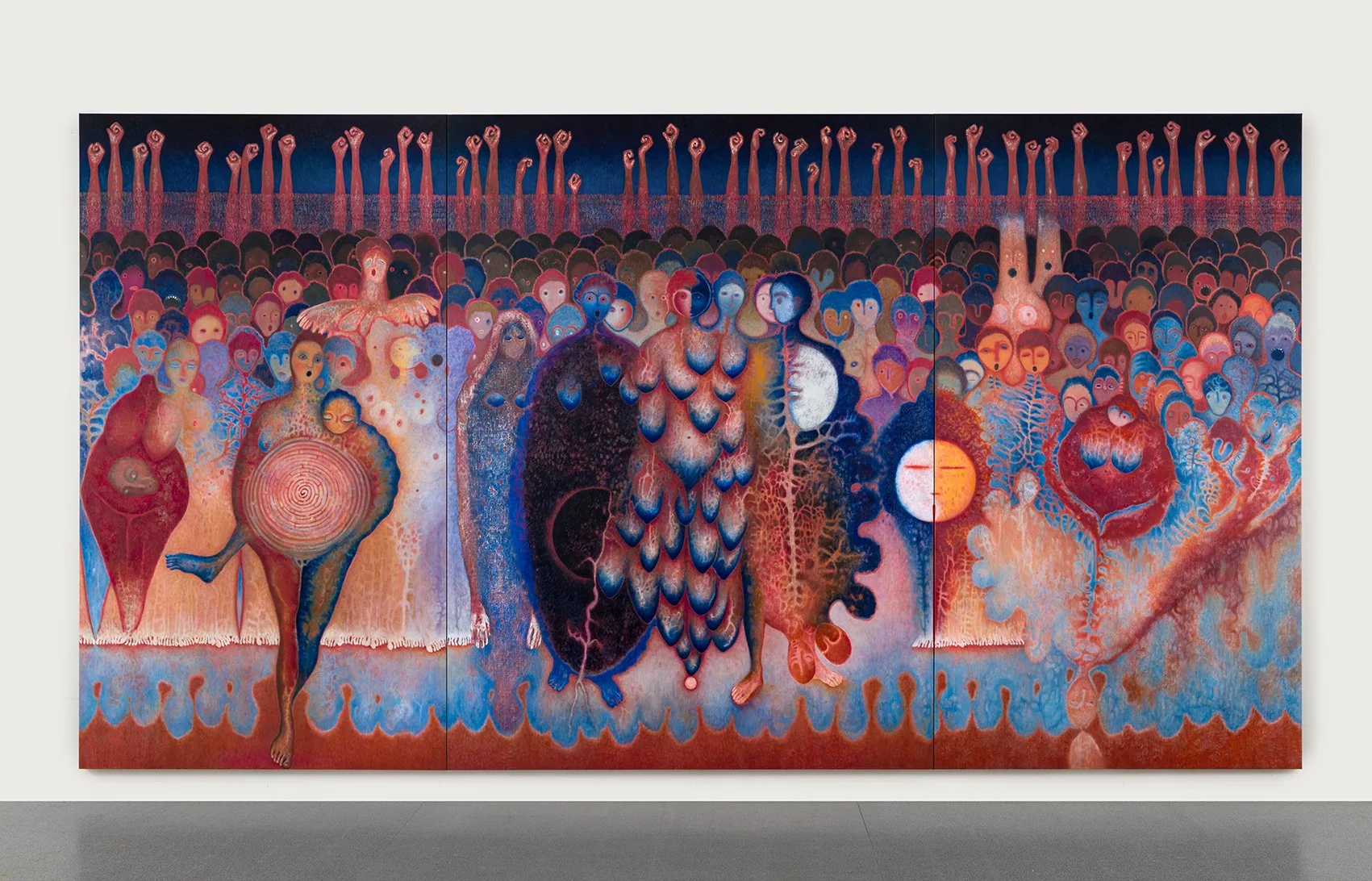
Luisa Rabbia The Network, 2024-25 Oil on linen 115 3/8 x 214 1/2 inches (293 x 545 cm)
Luisa Rabbia’s The Network (2025)
Peter Blum Gallery
Presented in the Meridians sector, Luisa Rabbia’s “The Network” stands as a visceral and urgent meditation on collective resistance and embodied solidarity. Spanning nearly eighteen feet, the monumental painting reimagines Giuseppe Pellizza da Volpedo’s Il quarto stato (1901), transforming the historic proletarian march into a procession of women advancing in unison — not as a singular mass, but as a pulsating organism shaped by shared vulnerability and strength.
Rabbia’s painterly language dissolves the boundaries between the human body and the natural world, offering a vision that oscillates between figuration and the cosmic. Layered anatomical forms overlap and disperse within incandescent fields of color, suggesting both protest and transcendence. Up close, the surface reveals delicately scraped pigments, ghosted fingerprints, and pencil tracings that dramatize the intimacy of touch as much as the monumentality of scale. These traces transform the painting into a record of lived time — a reminder that each mark carries the weight of individual presence within an interconnected whole.
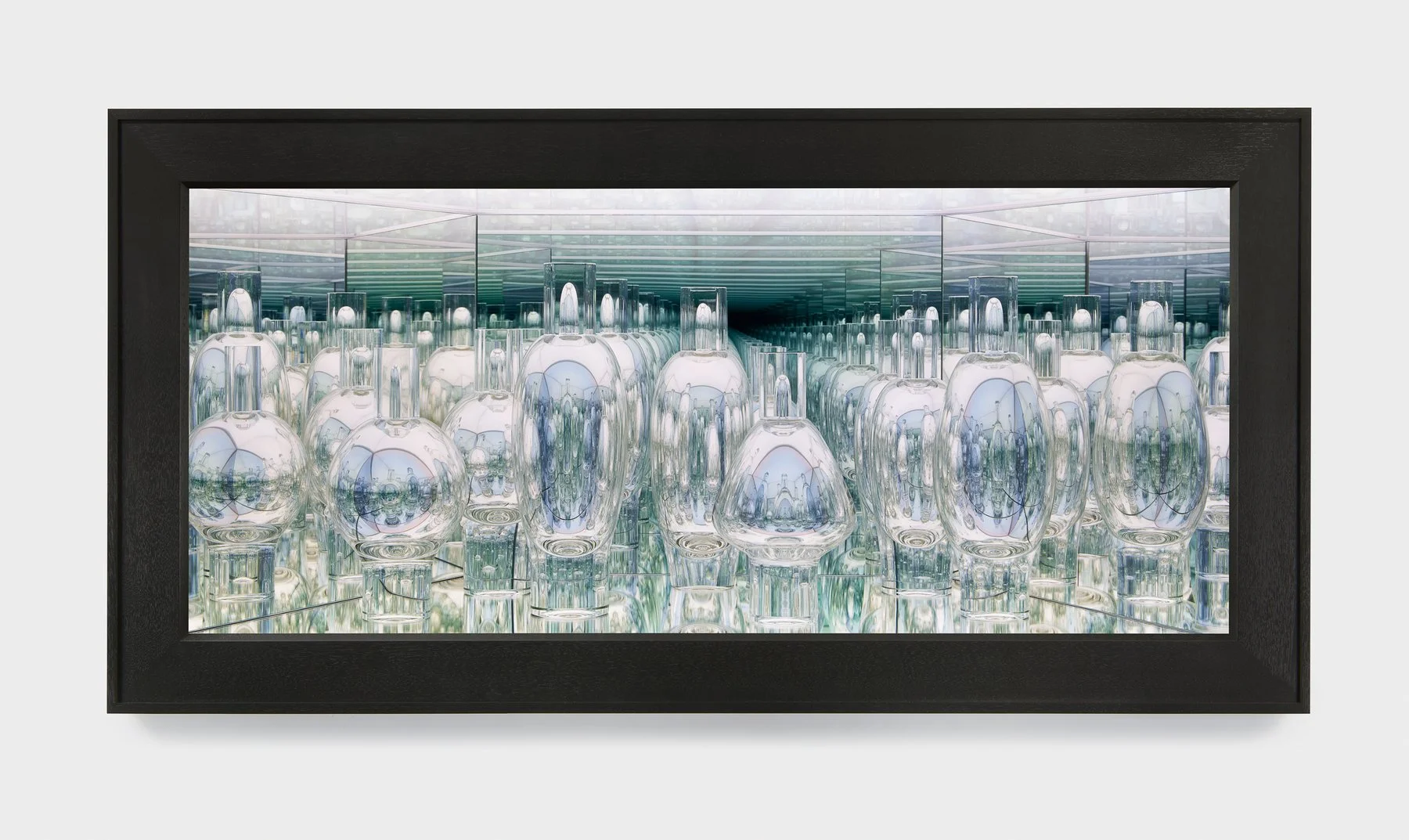
Josiah McElheny From the Library of Atmospheres II, 2025 Hand-blown, cut, polished, and mirrored glass; low-iron mirror and two-way mirror; electric light; walnut frame 26 3/4 x 53 1/4 x 19 3/8 in 67.9 x 135.3 x 49.2 cm
Josiah McElheny’s From the Library of Atmospheres III (2025)
James Cohan
Josiah McElheny’s mirrored glass tableau operates as both sculptural environment and philosophical inquiry, foregrounding the viewer’s encounter with infinity as a lived perceptual experience. Drawing from Jorge Luis Borges’s legendary short story The Library of Babel, McElheny constructs a mesmerizing universe of endlessly reflected forms — light bulbs, glass orbs, and mirrored planes — that multiply into a seemingly infinite continuum.
The work complicates the idea of truth as fixed, proposing instead a vision of knowledge as ever-expanding. Through meticulous craft and precision engineering, McElheny fuses historical modernist aesthetics with contemporary conceptual rigor. The reflected repetition becomes a metaphor for pluralism itself: knowledge as layered, non-linear, and contingent upon perspective. In this hypnotic enclosure, infinity ceases to be abstract and becomes tactile — a luminous environment in which viewers confront both their scale and their agency within the system.
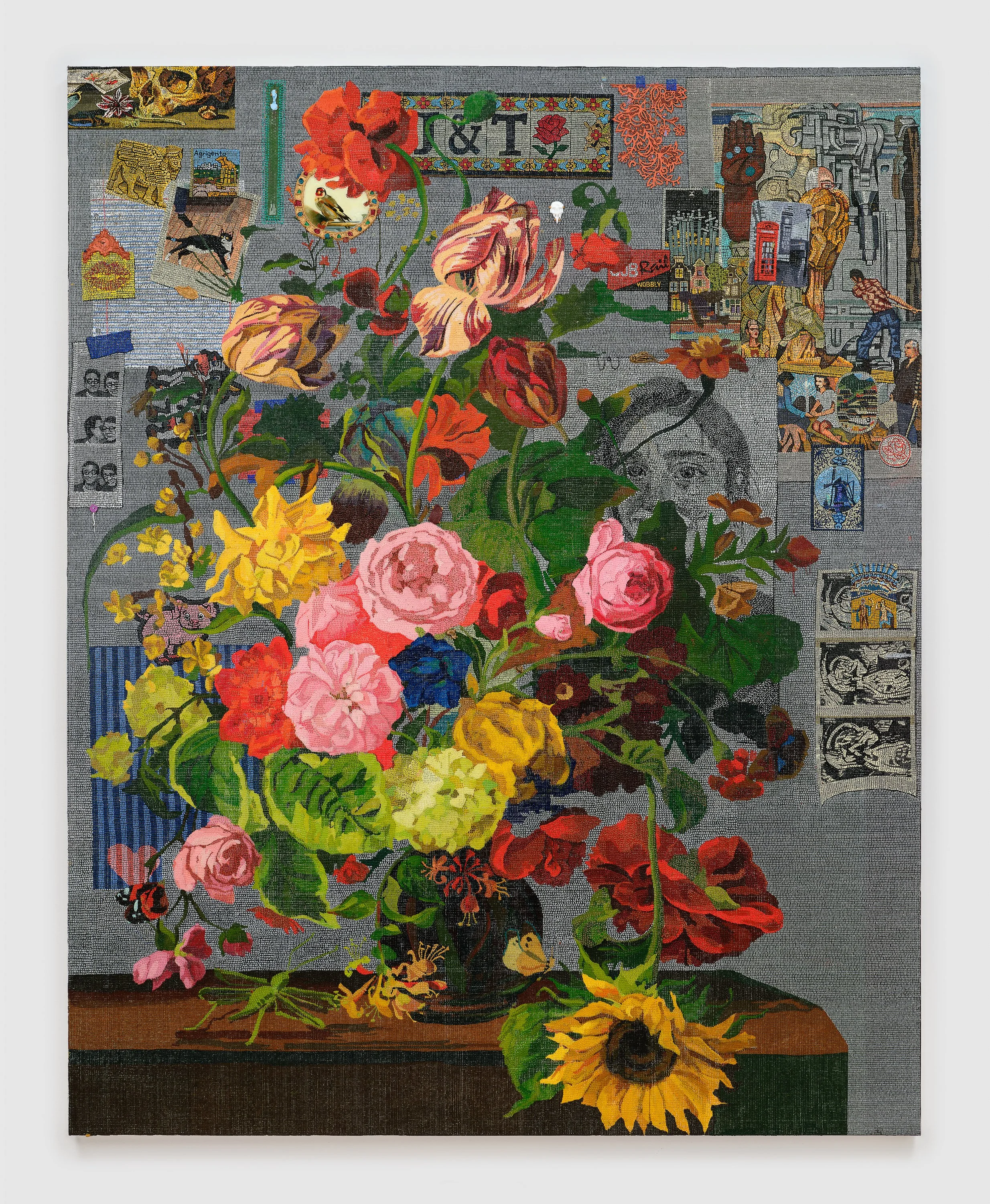
Talia Levitt Momentos, 2025 acrylic on canvas 60 x 48 in (152.4 x 121.9 cm)
Talia Levitt’s Momentos (2025)
Uffner & Liu
Talia Levitt’s Momentos unfolds as an intricate meditation on memory, domestic labor, and the enduring legacies of women’s work. Referencing the tactile warmth of heirloom quilts and the intimacy of the “schmatta,” Levitt constructs a richly layered surface that simulates fabric, stitching, and embroidery through paint alone. Her painterly illusion collapses distinctions between foreground and background, as bodies and textile environments blur into one another.
The work draws deeply from her familial history of garment labor and personal narrative, weaving together gestures of care, mourning, and resilience. Evocations of generational lineage and maternal presence softly emerge within the composition, affirming the domestic as a site of profound cultural history. Through faux-stitching and trompe l’oeil techniques, Levitt reinscribes women’s labor into the canon of painting — elevating the handmade as both political and poetic gesture.
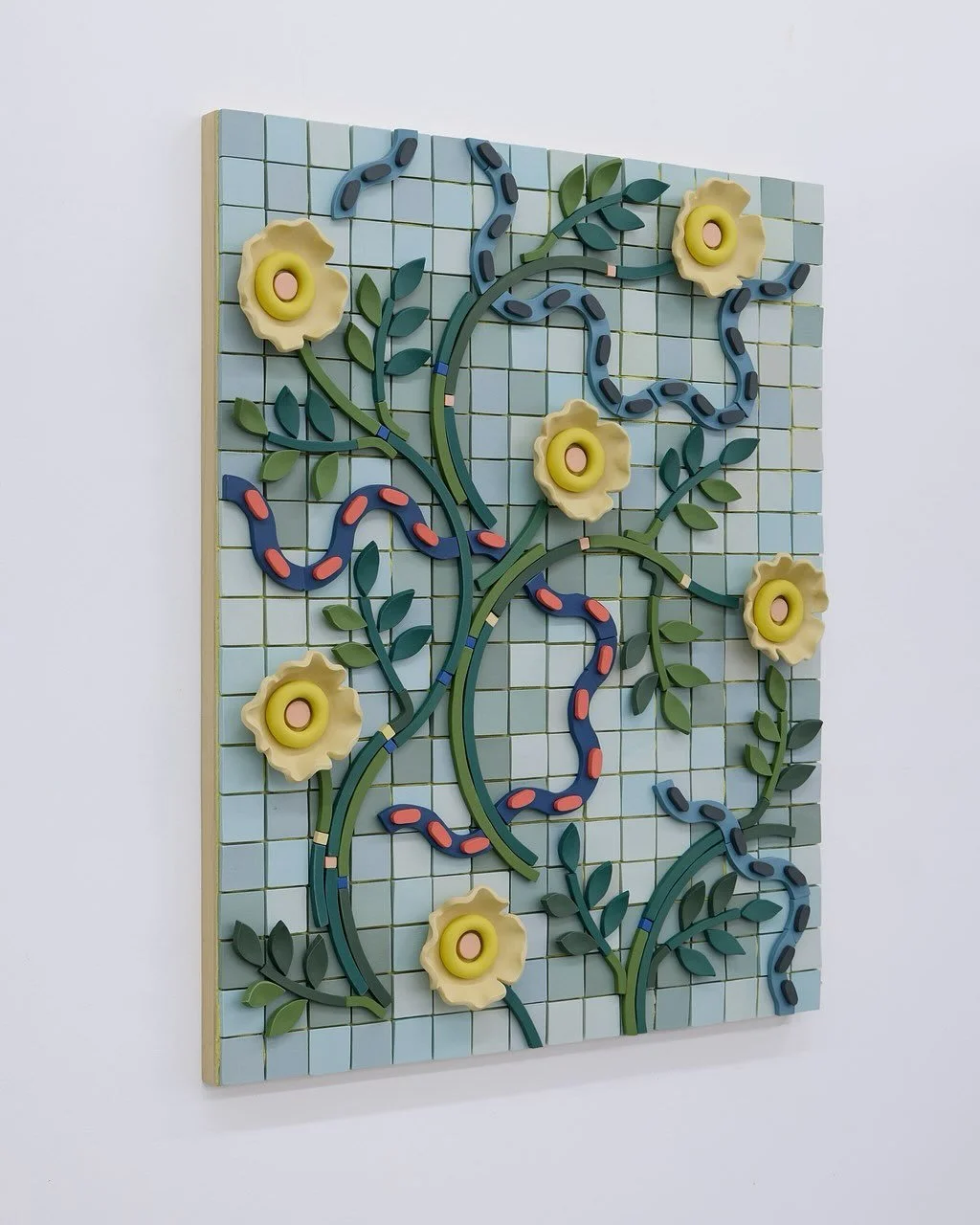
Genesis Belanger, Self Optimization, 2025 Porcelain, aluminum reinforced plywood panel, mortar, and structural epoxy 37 × 30 × 4 1/2 in | 94 × 76.2 × 11.4 cm
Genesis Belanger’s Self Optimization (2025)
Perrotin
Genesis Belanger’s porcelain relief synthesizes mosaic tradition, Pop sensibility, and feminist critique into a meticulously constructed visual language. In Self Optimization, debuting with Perrotin at the fair, Belanger trades the domestic bouquet for a more psychologically charged still life—one that stages the rituals of self-improvement as both aspiration and burden.
Across its gridded porcelain surface, polished objects, stylized tools, and fragmented gestures appear suspended in a state of perfect arrangement. The composition evokes the aesthetics of lifestyle optimization and digital culture, where care, beauty, and productivity become endlessly curated images. Here, Belanger renders those pressures with a seductive deadpan: immaculate, orderly, and faintly absurd.
Hand-mixed pigments embedded directly into the clay give the work its distinctive tactility, underscoring the tension between handcrafted labor and the sleek sheen of self-betterment culture. Belanger’s sculptural language examines how desire is manufactured and maintained—exposing the emotional infrastructure behind contemporary ideals of perfection. In Self Optimization, the decorative becomes a site of ambivalence, where intimacy, performance, and cultural expectation quietly collide.
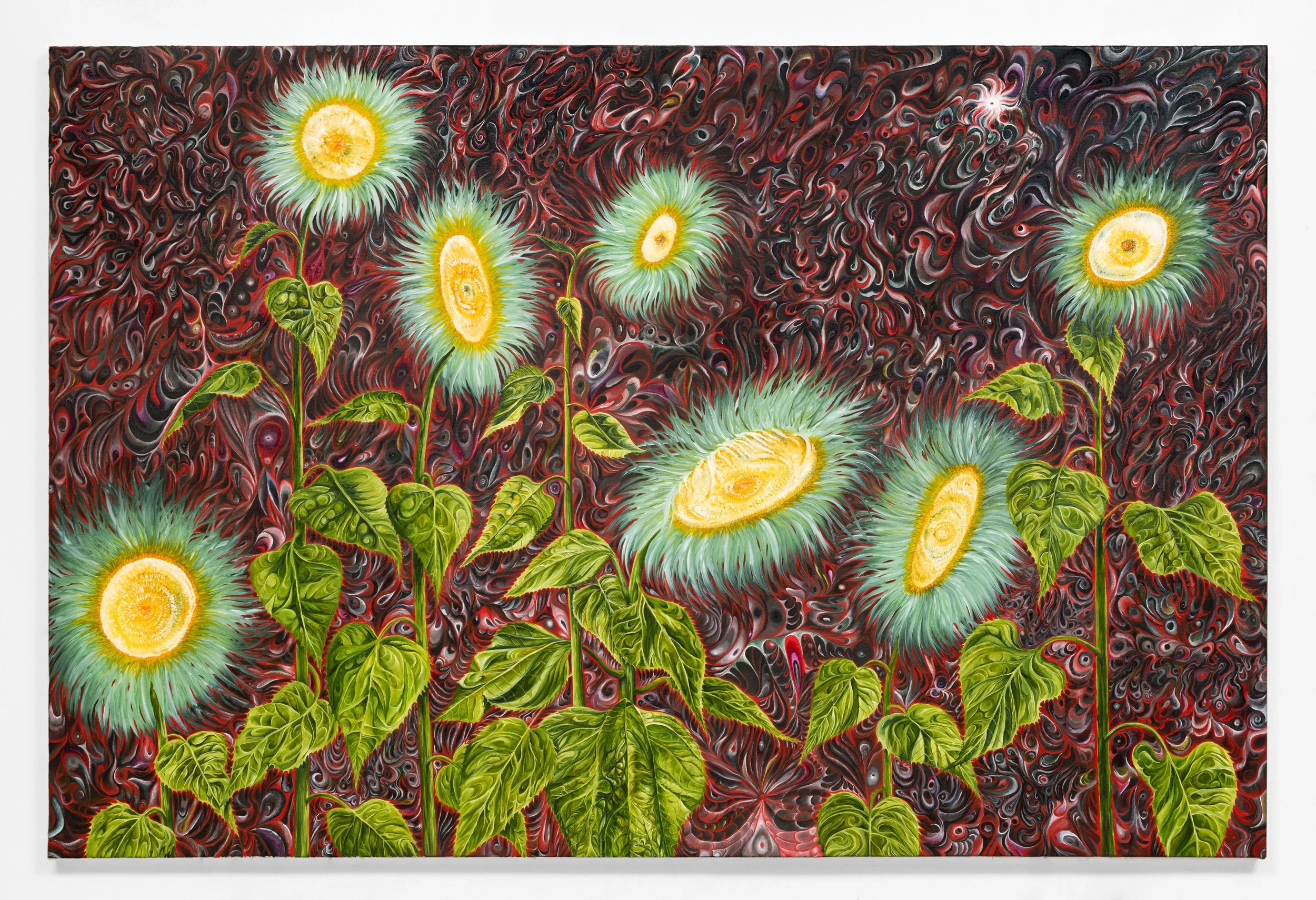
Seven Sunflowers and the Sun, 2025 oil on linen 48 x 72 ins. 121.9 x 182.9 cm
Srijon Chowdhury’s Seven Sunflowers and the Sun (2025)
PPOW
Srijon Chowdhury’s richly saturated paintings occupy a liminal terrain between the personal and the mythological, merging quotidian imagery with metaphysical symbolism. His compositions, often dense and dreamlike, stage surreal ecosystems where bodies, flora, and spectral presences coexist in hallucinatory proximity. Drawing from ecological, theological, and philosophical frameworks, Chowdhury constructs immersive visual worlds that hover between narrative and abstraction.
Through his hyper-detailed technique, Chowdhury transforms intimacy into monument — collapsing the ordinary into the uncanny. The work’s visual rhythm oscillates between spellbinding beauty and quiet unease, capturing cycles of growth, decay, and transcendence. In doing so, his practice articulates a deeply contemporary longing: to reconcile the sacred and the mundane in a fractured world.
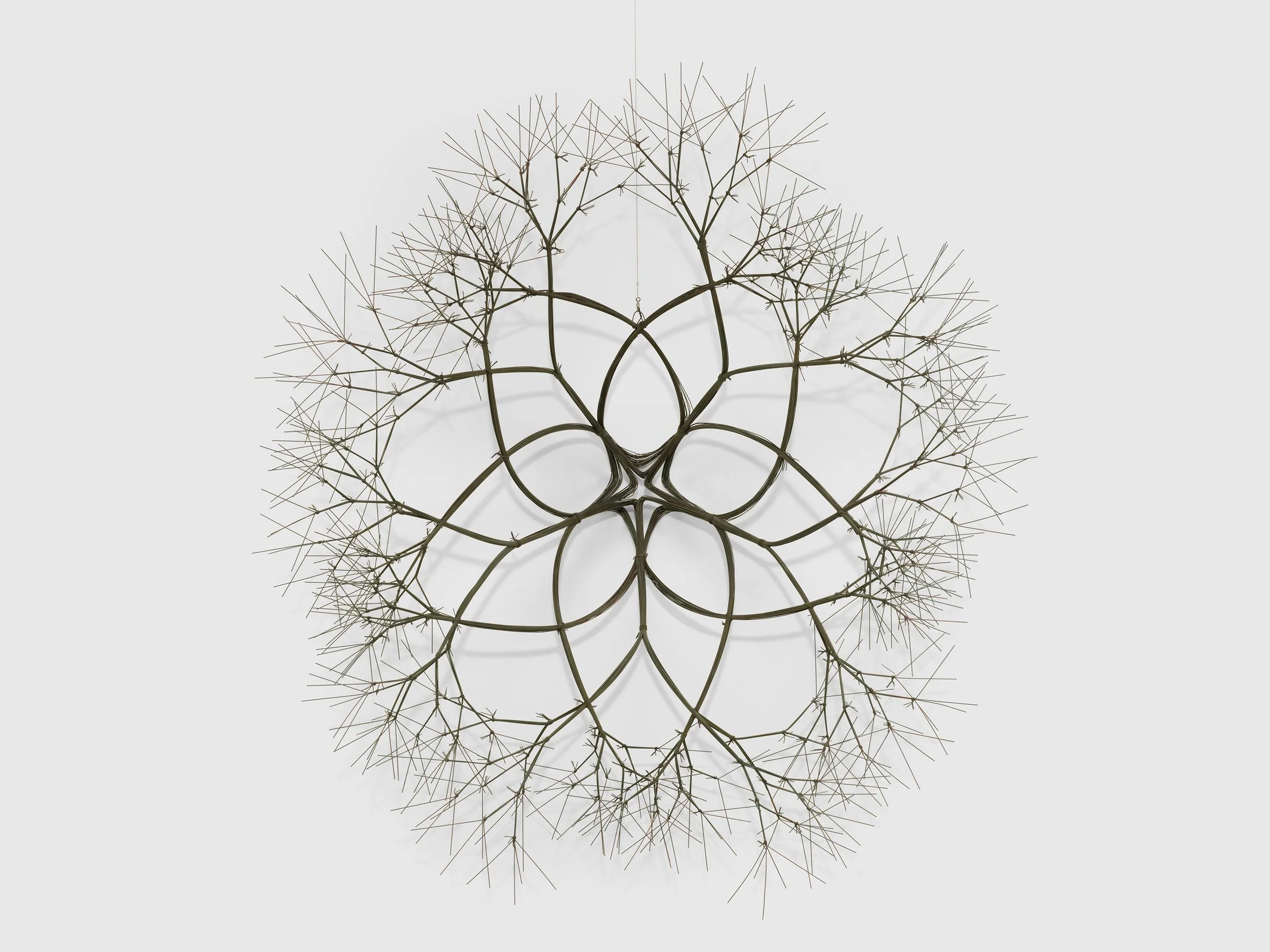
Ruth Asawa Untitled (S.212, Wall-Mounted Tied-Wire, Open-Center, Five-Branched Form Based on Nature), 1977 Wall-mounted sculpture—bronze wire, naturally patinated green 54 x 54 x 15 inches (137.2 x 137.2 x 38.1 cm)
Ruth Asawa’s Untitled (S.212, Wall-Mounted Tied-Wire…) (1977)
David Zwirner
Ruth Asawa’s iconic sculptural forms exemplify an elegance born of repetition, intuition, and resilience. Forged through a looping process she likened to “a string of e’s,” Asawa’s tied-wire sculptures retain the gestural immediacy of handcraft while achieving structural sophistication. The five-branched, open-centered form on view reflects her lifelong engagement with space, volume, and natural growth patterns.
Asawa’s biography — shaped by wartime internment, cross-cultural influence, and institutional marginalization — deepens the poetic gravity of her work. By transforming a humble craft technique into a refined sculptural language, she challenged hierarchies between high art and labor. The resulting form appears to hover between architecture and organism, embodying both delicacy and resilience.
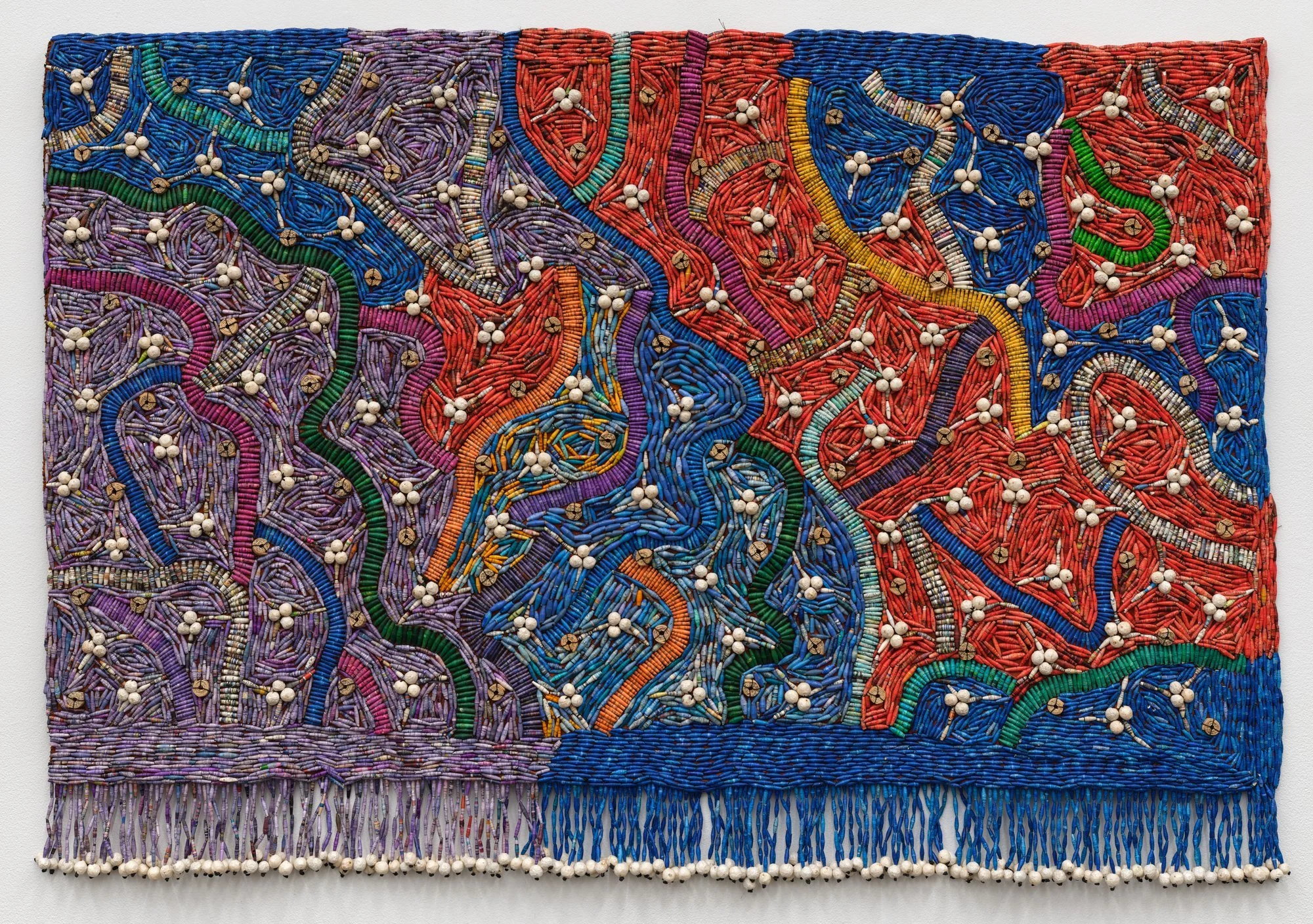
Sanaa Gateja Tributaries, 2024 Paper beads on barkcloth 37¾ x 55 in. 95.89 x 139.70 cm Courtesy the artist and KARMA, Los Angeles
Sanaa Gateja’s Tributaries (2024)
KARMA
Sanaa Gateja’s Tributaries series weave together the vibrancy of communal craftsmanship merged with contemporary abstraction. The work on view in Miami is composed of meticulously arranged paper beads affixed to barkcloth. It glows with rhythmic color and pattern, echoing both riverine flow and genealogical lineage. Gateja’s pioneering bead-making process, developed from recycled paper, elevates discarded material into a language of cultural affirmation.
The work reflects Gateja’s commitment to sustainability and social engagement, having provided livelihoods for thousands of women in Uganda. Formal beauty and ethical structure converge here — each bead a unit of care and labor, woven into a larger field of shared memory. Tributaries thus becomes both visual meditation and socio-political gesture, mapping the interdependence of people, process, and place.
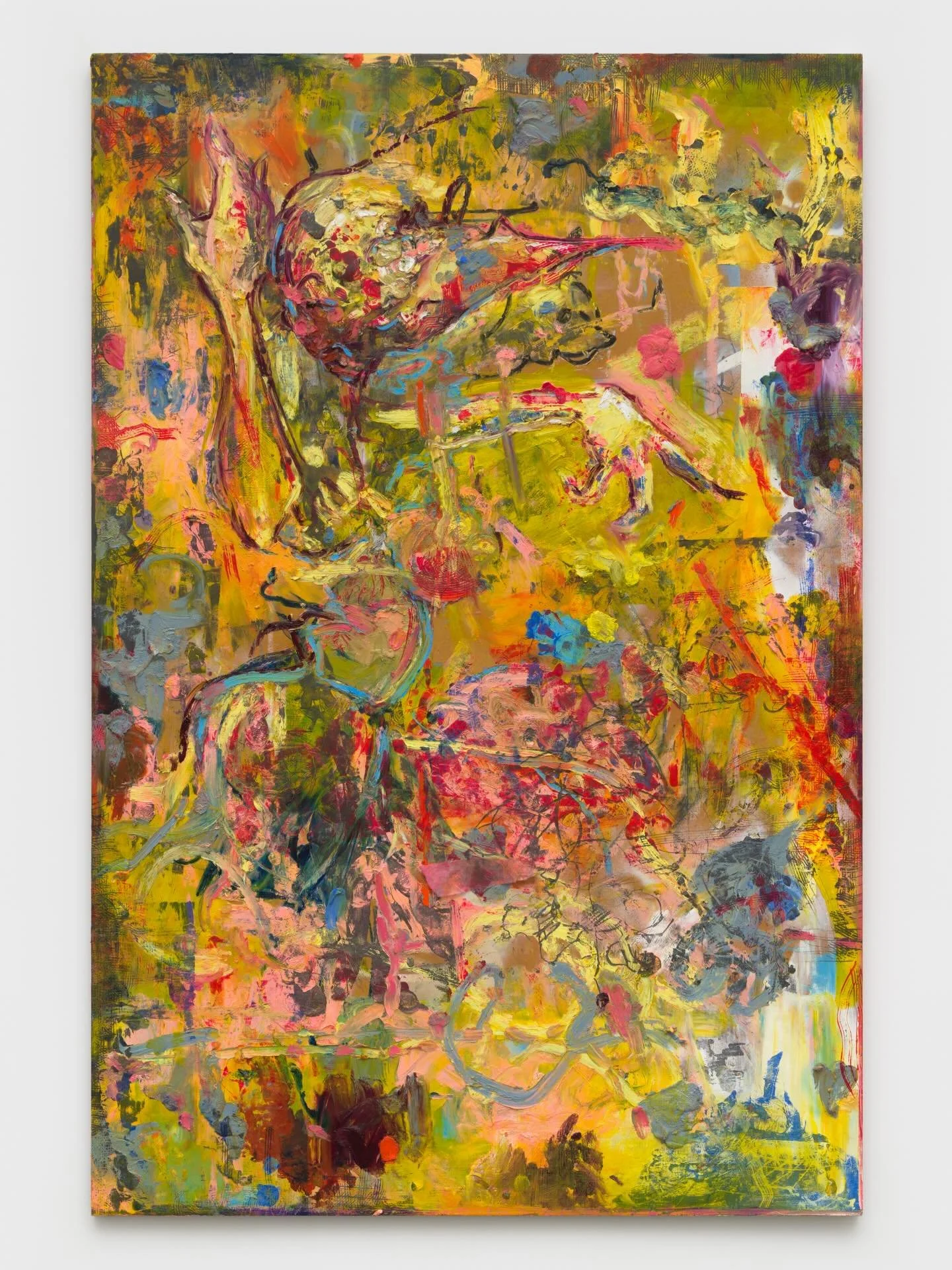
Uri Aran Lemondrop, 2025 Oil, acrylic, oil pastel, graphite, polyurethane and mixed media on HDO 48 x 31 7/8 in
Uri Aran’s Lemondrop (2025)
Matthew Brown
In Lemondrop, Uri Aran channels his signature language of accumulation into a charged, painterly field where gesture, texture, and fragmented figuration collide. Layers of oil, acrylic, pastel, graphite, and polyurethane build into an almost topographical surface — a site where forms appear to emerge and dissolve in the same breath. The composition feels diaristic yet elusive, drawing from Aran’s long-standing interest in how meaning is constructed through proximity, repetition, and the quiet logic of everyday materials.
While Aran is widely known for his sculptural and table-based assemblages, Lemondrop extends that sensibility into painting: a restless system in which symbols, marks, and intuitive gestures coexist without hierarchy. Scribbles, smears, and attenuated figures tangle into a visual syntax that resists linear narrative, suggesting instead the blurry circuitry of memory and associative thought. The result is a work that feels both intimate and unresolved — a compelling record of perception in motion, shaped by Aran’s instinctive negotiation between the ordinary and the enigmatic.
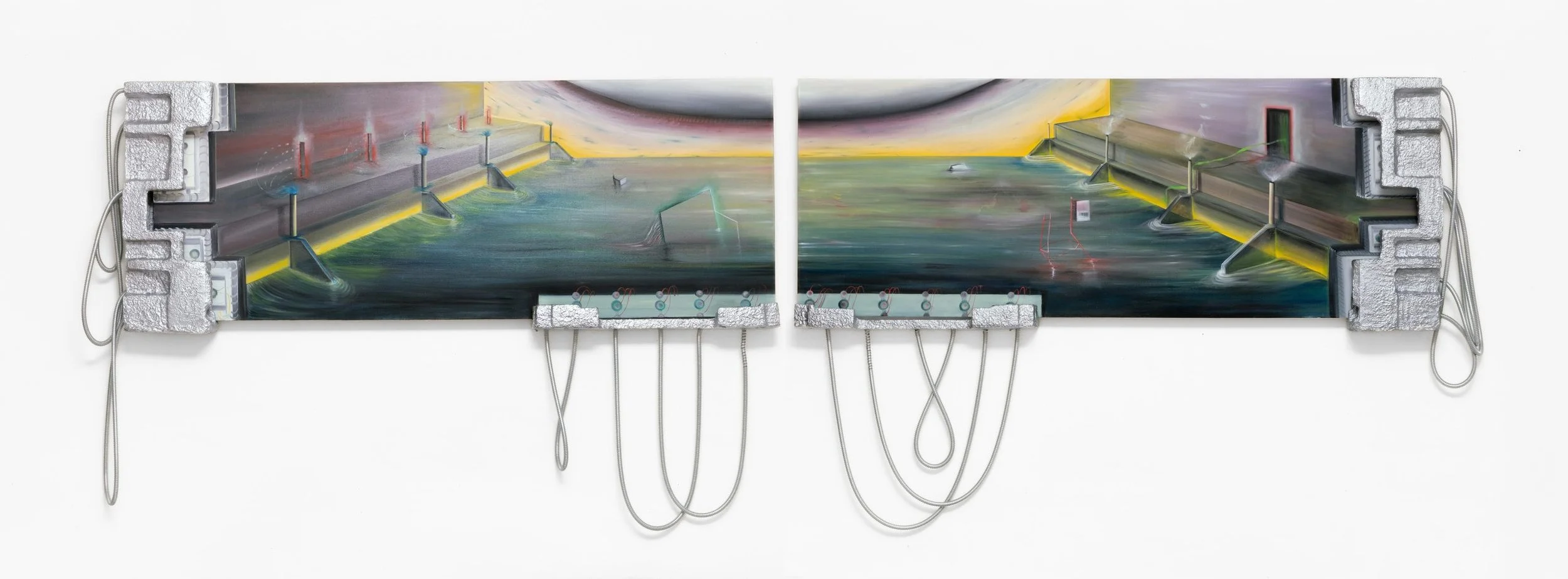
Carolina Fusilier, Flux field, 2025 Oil on canvas embedded in styrofoam and paper mache structures, aluminum cable intervention 75 x 390 x 3.5 cm
Carolina Fusilier’s Flux field (2025)
Margot Samel
Carolina Fusilier’s Flux field transforms the logic of infrastructure into a haunting, panoramic vision of technological afterlife. Painted across a sweeping diptych and embedded within sculptural housings of recycled styrofoam, papier-mâché, and aluminum cabling, the work unfolds like a submerged industrial landscape — part machinery, part ecosystem. Liquid surfaces, flickering signals, and fragmented architectural forms suggest a world in transition, where technological ruins absorb the rhythms of natural environments.
By incorporating industrial packaging and looping cables into the physical structure of the piece, Fusilier collapses the boundary between image and mechanism. The painting becomes an exposed circuit, revealing the hidden conduits, flows, and residual energies that undergird daily life. In Flux field, the artist’s techno-animist sensibility comes to the fore: machines seem to breathe, landscapes compute, and discarded materials take on new vitality. The result is a speculative ecology — a system where the visible and invisible infrastructures that shape contemporary existence briefly come into focus.
Art Basel took place at the Miami Beach from December 2nd to 7th, 2025. For more information about Art Basel, please visit their website, Instagram, X, Facebook, and YouTube.