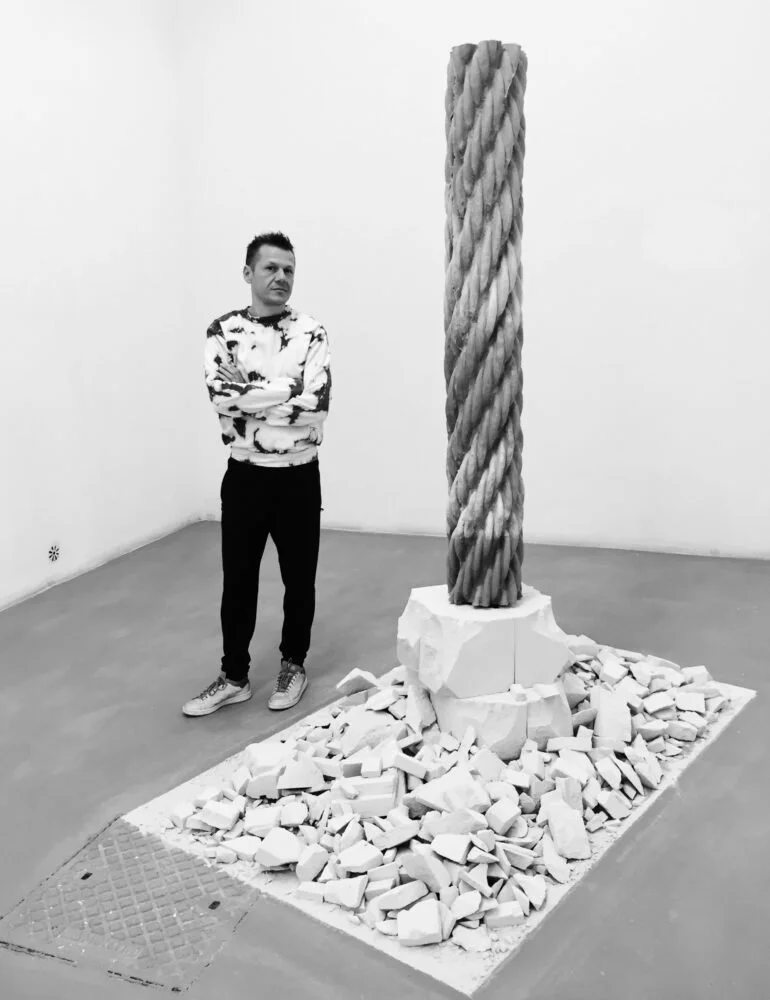
Courtesy of Galerie Negropontes and artist
Mircea Cantor was born in 1977 in Oradea, Romania. He is an artist who, in his own words, “lives and works on Earth”. His polymorphous practice draws inspiration from everyday life, ingeniously using repetition, rhythm and symmetry to create powerful poetic images that leave an indelible mark on the mind. His works encourage us to meditate on our own freedom of movement, on the concepts of boundaries and limits, and on courageous but often audacious attempts to sublimate and subvert the world.
He came to prominence in the early 2000s with the film The Landscape Is Changing (2003), in which demonstrators hold up large mirrors as slogans. Two years later, he made the video Deeparture (2005), which shows the encounter between a wolf and a doe in the empty space of the Yvon Lambert gallery in Paris. However, his means of expression are more diverse than film. He has experimented with sculpture, installations, photography, drawing and most recently set design for Alexandru Dabija’s production of The Little Prince at the Teatrul de Comedie in Bucharest (2017).
For the Paris Opera’s 350th anniversary season in 2019, he was invited to illustrate the season’s various programmes with drawings made in situ during rehearsals. Drawing is becoming an increasingly important part of his practice. Since 2011 he has been interested in nineteenth-century Chinese and Japanese Zen painters, particularly the speed with which they give form to ideas and subject matter. It is this search for the prima linea, the vivid, concise line imposed by circumstances, that Mircea Cantor affections. He is the winner of the Prix Marcel Duchamp (2011) and the Prix de la Fondation d’Entreprise Paul Ricard (2004). His works are included in major international collections such as the MoMA (New York), the Walker Art Center (Minneapolis), the Philadelphia Museum of Art (Philadelphia), the Musée national d’Art moderne – Centre Pompidou (Paris), Museum Abteiberg (Mönchengladbach), Museo Nacional Centro de Arte Reina Sofia (Madrid), Kunsthaus (Zurich), Collection Pinault (Paris), Fondation Louis Vuitton (Paris), Rennie Collection (Vancouver), Castello di Rivoli (Turin).
Recent solo exhibitions include the Villa Medici (Rome 2021); the performance “The Sound of my Body is the Memory of my Presence” at the Greek Theatre of Syracuse (INDA season, Syracuse, 2020), as well as at the Musée de la Chasse et de la Nature for the France-Romania season (Paris, 2019), the Musée d’arts de Nantes (Nantes, 2019), the Fondation d’entreprise Hermès (Tokyo, 2018), the Fondazione Giuliani (Rome, 2017), the Fondation Francès (Senlis, 2016), the Rennie Museum (Vancouver, 2014).
Mircea Cantor has been awarded the Ordre d’Officier des Arts et Lettres, France (2019) and the Ordre National du Mérite au rang de Chevalier, Romania (2019).
The latest extensive monograph on his work was published in 2020 by Dilecta, Paris, what topics and subjects he hopes to explore after the exhibition and so much more.
I had the pleasure of asking Mireca about his residency at Cité internationale des arts in Paris,
UZOMAH: Building on your use of readymade materials, can you discuss a typical day in the studio for you?
MIRECA: -I believe in the continuity of the Art, therefore the readymade is just a station in the long journey that Art does. Everything has to be subordinated to an inner necessity and when doing so, the question is not whether we use or not ready made, rather that what kind of knowledge is transmitting through our piece of art, what message and what emotion. My studio is the whole world: is my garden, is my kitchen , is the museum, is the airplane is the train, is the beach, and even my gallery can be the my studio.

Courtesy of Galerie Negropontes and artist
U: In 2004, you attended an artist residency at Cité internationale des arts in Paris before winning the Marcel-Duchamp Prize. How did that experience shape your artistic process and help you further develop your craft? After such a significant achievement, what about art makes you keep doing it?
M: -The artist has many hills to climb; I don’t have the idea of conquest in mind. I have just the desire to find out more. But the most important is to do it serene and confident. As the latin adagio says: “Nosce te ipsum” - Know thyself.
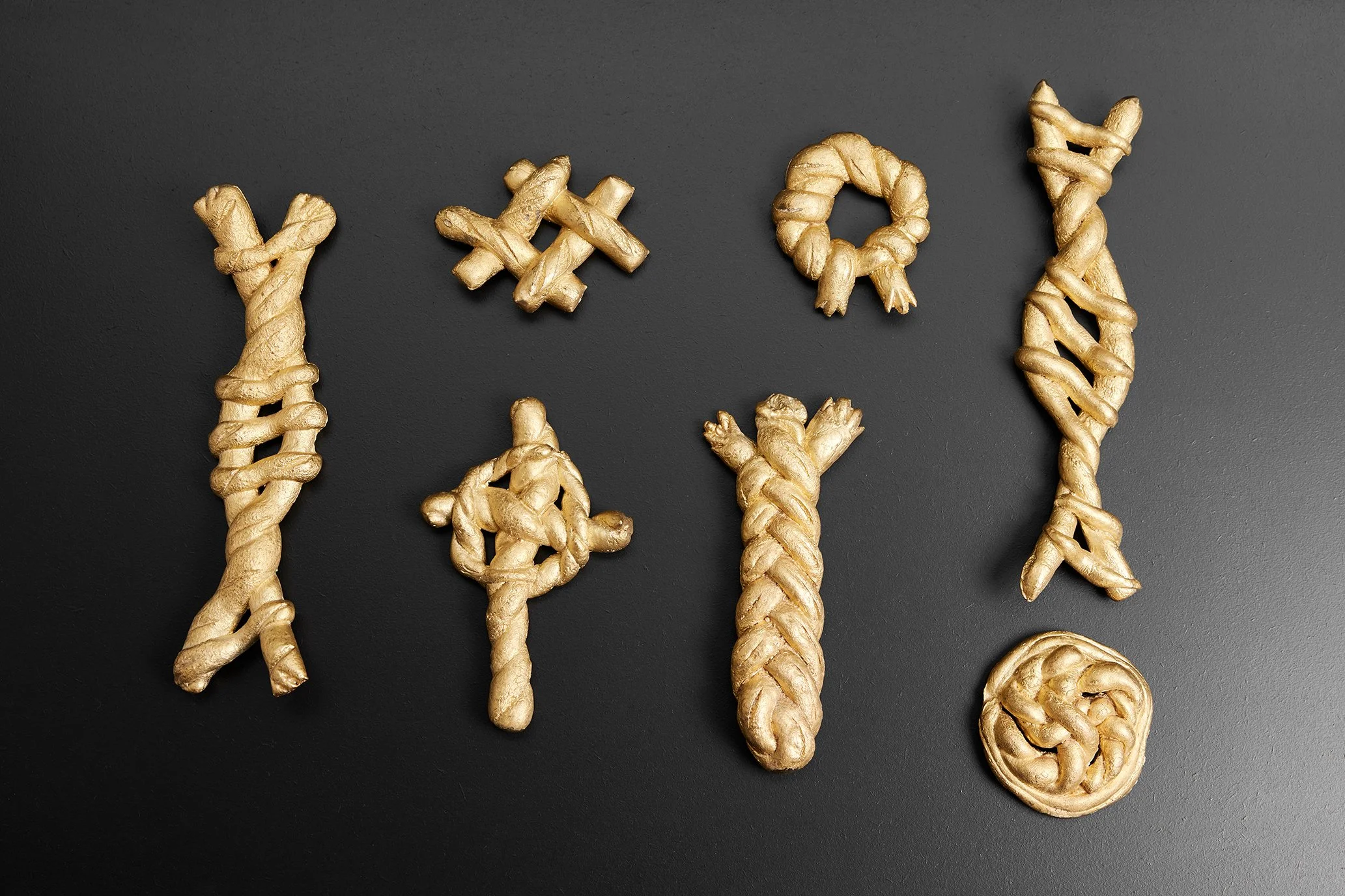
Courtesy of Galerie Negropontes and artist
U: Are there topics or subjects you want to explore through art that you haven't yet, looking ahead in your creative journey?
M: -Oh yes! I can’t count and enumerate them! I think artist should be or is like a spounge. It absorbs and intergate evrything on his path. Tell me something that can’t be or called Art!
U: If art reveals so much about the world, in your opinion, what is the artist to the world?
M: -An antenna.
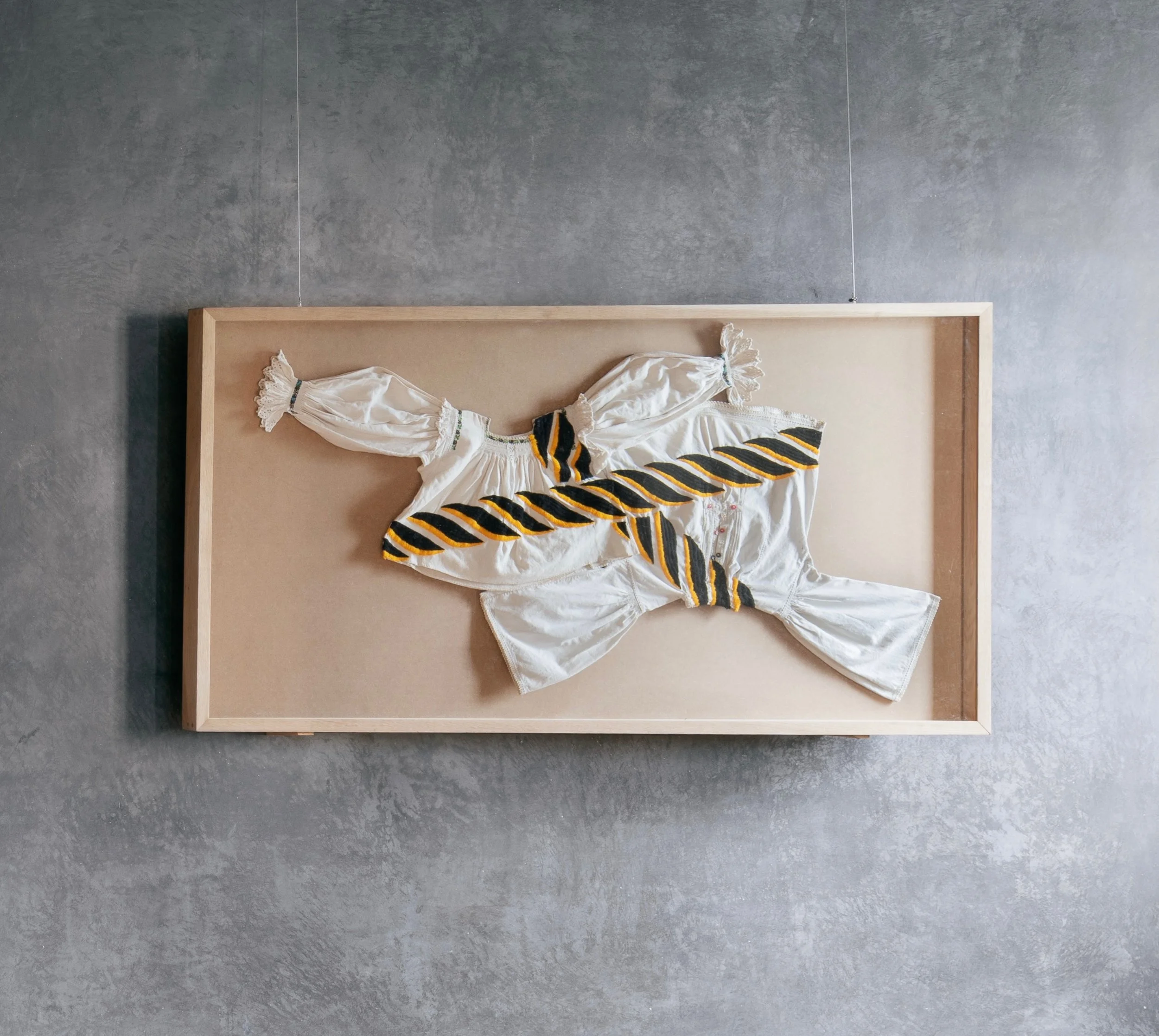
Courtesy of Galerie Negropontes and artist
U: In your art, you use various media, like video. How do you find a medium where each element intersects into a display that shows your theme to your liking?
M: -The elements are like magnets to your ideas.
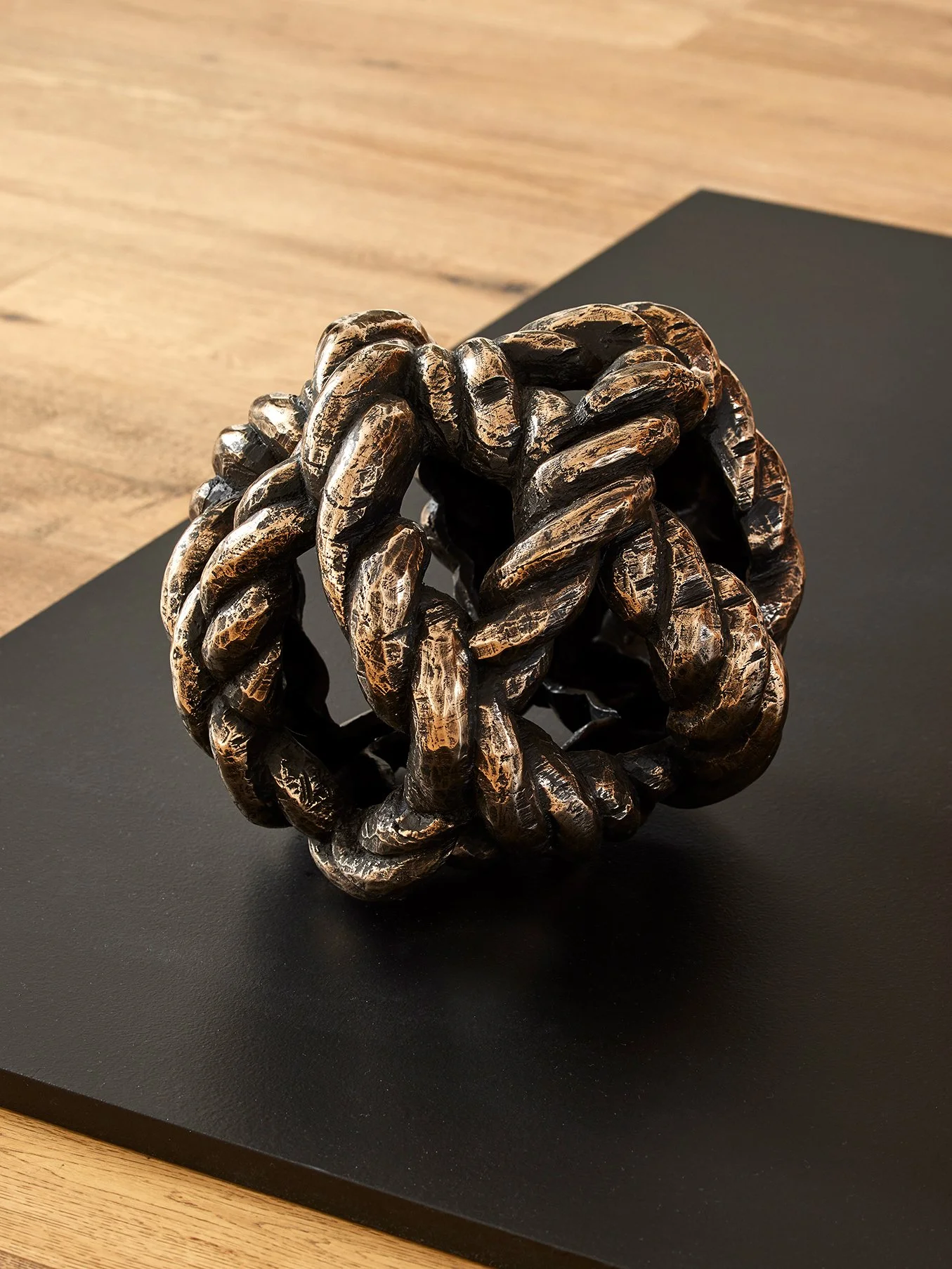
Courtesy of Galerie Negropontes and artist
U: As you reflect on these creative choices, after this exhibition, what is next for you?
M: -The artist never sleeps, and if he does, he dreams of Art.
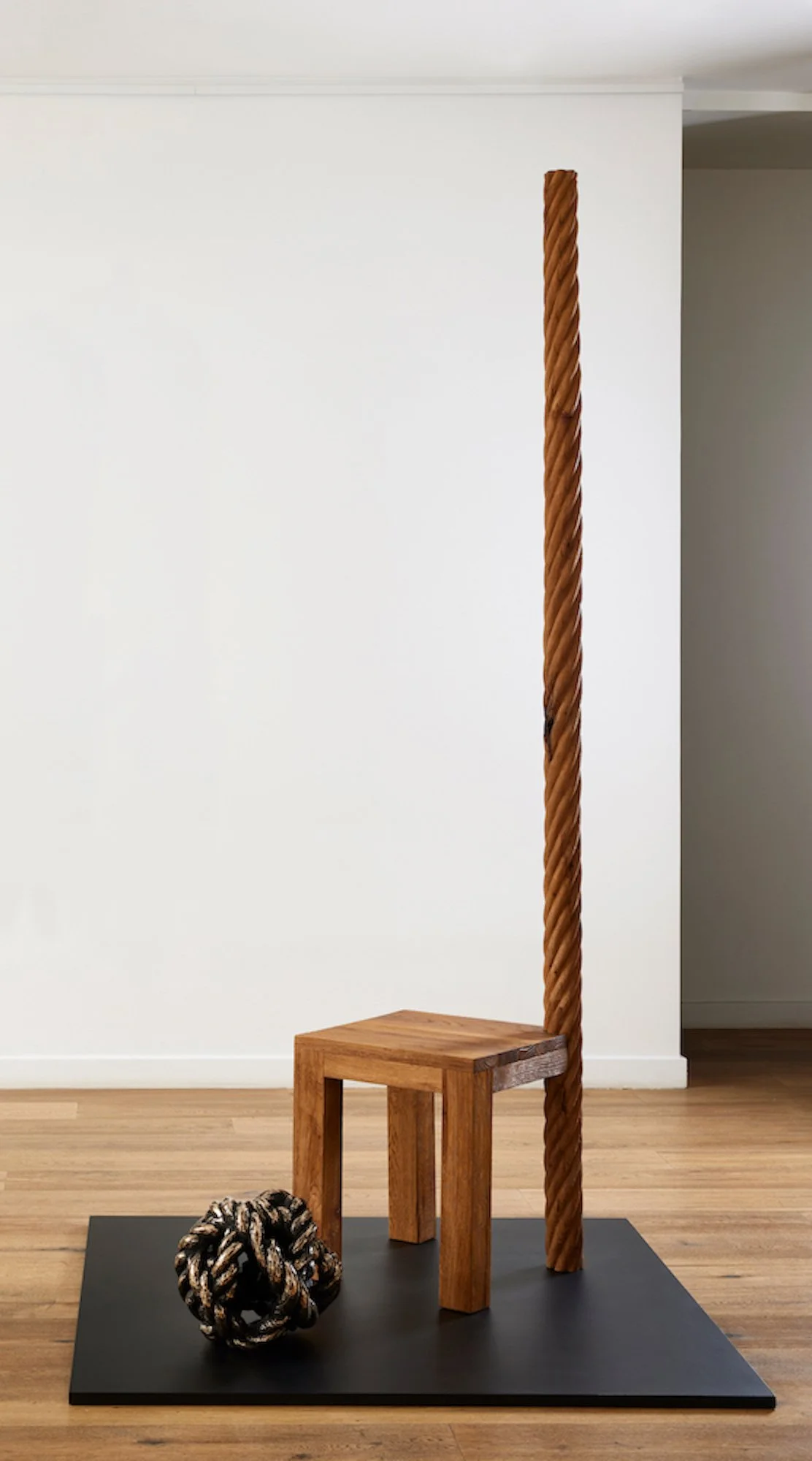
Courtesy of Galerie Negropontes and artist
U: In preparing for what comes next, do you have any special preparation you go through before an exhibition? Did you do anything with this exhibition? If so, what?
M: -“Interiorem pacem” - meaning inner peace - from where all perspectives are open, from where myriad possibilities unfold before me.
Mircea is on view at Galerie Negropontes, Paris during the third and final installment of the series Reflections on Brancusi to mark the 150th anniversary of Constantin Brancusi’s birth, the exhibtion opened on September 11 to December 19, 2026. For more information about this show please visit Galerie Negropontes’s website here.