LANGUAGE AS LIBERATION: Reflections on the American Canon
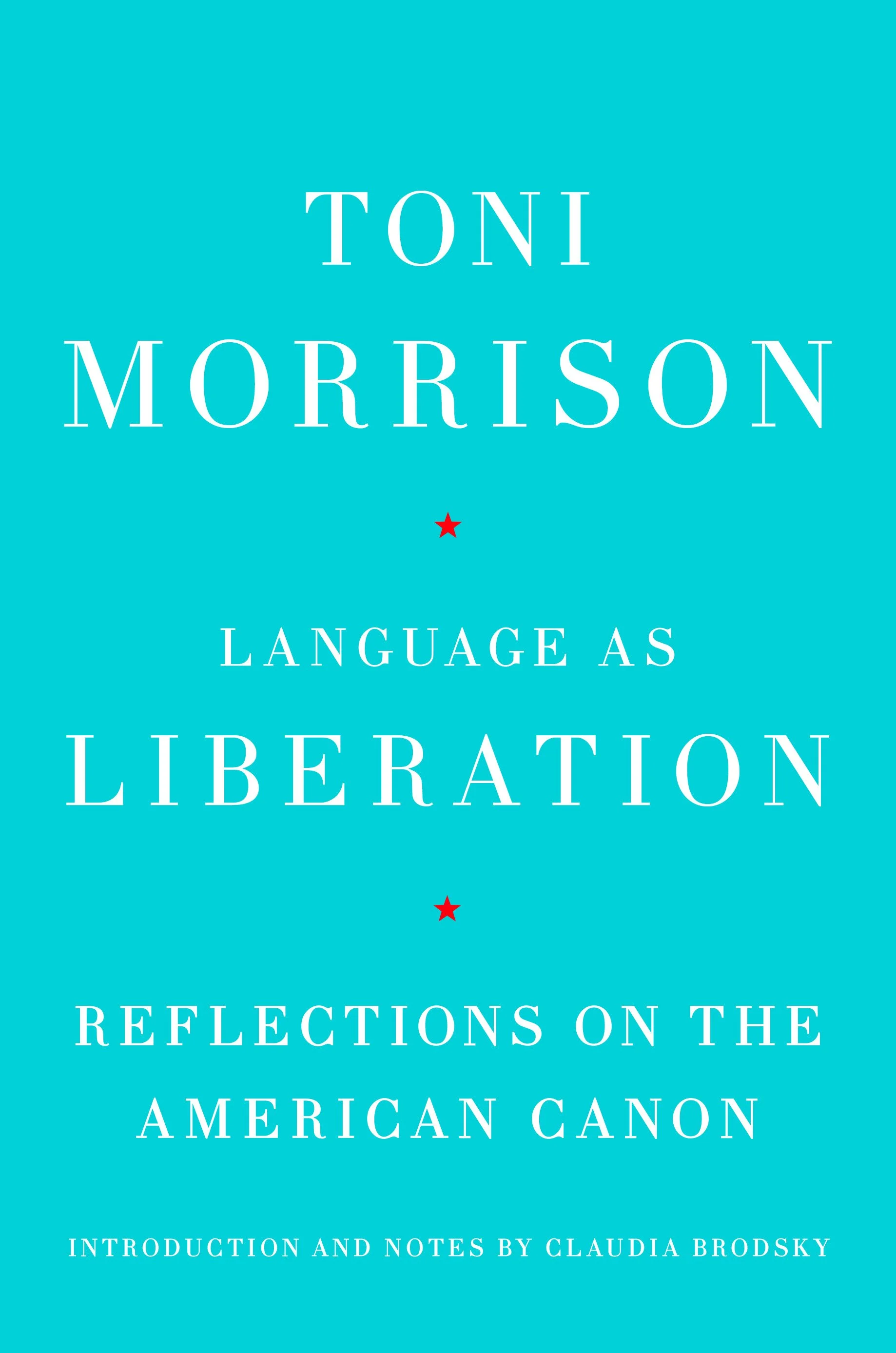
The fiction of Toni Morrison, one of the twentieth century’s most celebrated and controversial authors, has inspired more than a dozen biographies and critical studies. Her likewise formidable and provocative career in book publishing has recently drawn some warranted attention. Morrison’s two decades as an editor at Random House is the subject of Toni at Random, Dana Williams’s 2025 biography. In the ranks of an overwhelmingly white and male literary establishment, Morrison leveraged her stardom to champion Black literature, publishing the likes of renowned poets Gayle Jones and Lucille Clifton, the autobiography of Muhammad Ali, and revolutionary activist-thinkers Angela Davis and Huey P. Newton; persecuted by authorities, generally feared and hated, their voices were heretofore banned from the mainstream cultural discourse. Comparatively little is known about Morrison’s third distinguished career in academia, most notably at Princeton, where she taught in the university’s African American Studies Department, and left behind a legacy as profound as her titanic, two-pronged influence on American literature. Language as Liberation: Reflections on the American Canon (Knopf, February 2026) is a posthumous collection of the late literary giant’s lectures and essays written for “Studies in American Africanism,” a course she taught at Princeton during her 17-year tenure.
Morrison’s son, Ford, contributes a note to the reader on how Language as Liberation “grew from the belief that [his] mother’s teaching materials…deserve to stand with her published work.” Her students would more than likely agree. According to the New York Times, Morrison’s lectures would “cast spells.” Film and TV critic Troy Patterson, a former student of Morrison’s, recalls in a piece for The New Yorker his “indelible” experience in “Studies in American Africanism” during his Sophomore year at Princeton, describing his first encounters with her in class, and the way his fear “caused by Morrison’s daunting, Leonine presence…quickly settled into cheerful enthusiasm.” Patterson disputes the Times’ appraisal of Morrison’s pedagogical gifts as something magical and spellbinding. “There was nothing witchy in her performance—she did not stoop to conjurings,” he writes. “Her way of demystifying things was what fascinated,” and the “firm calm of her velvet voice [inspired] more ease than awe.” One way or another, her lectures did dazzle, and on the strength of her ideas alone, Language as Liberation is a testament to the visionary clarity and surgical precision of Morrison’s prodigious mind.
“Studies in American Africanism was an “examination of ways in which the American literary tradition has responded to an Africanistic presence in the United States,” according to the course description, which appears in the text. With a focus on authors “who have imagined, explored, represented, and employed the narrative, the personae, and the idioms of Africans and their descendants,” Morrison’s course analyzed the literary “strategies” devised to “accommodate Africanism,” the “imaginative uses” for Black people in the literary tradition, and how the “literary departures of certain American writers into what was perceived to be a separate culture” served to define the “American self.” Language as Liberation features discussions on a selection of works by Melville, Poe, Twain, O’Connor, Carson McCullers, William Styron, Gertrude Stein, William Faulkner, Ernest Hemingway, Harriet Beecher Stowe, Willa Cather, and Saul Bellow; a number of them are foundational texts in the American canon of fiction. Morrison’s colleague at Princeton, Claudia Brodsky, notes in her introduction how Blacks were excluded from the canon while white American authors exploited them, with varying intentions and results, in their own contributions to it. In her words, to read Morrison’s “Reflections on the American Canon is to reconceive the establishment of the canon, no less than the nation itself, as founded on the basis of…’race.’”
Professor Morrison begins with a lecture titled “Image of Blacks in Western Art,” immediately restating the course’s primary objectives, calling Studies in American Africanism “an investigation into two principal areas of discursive practice: one area involves the ways in which a non-white, Africanist presence and persona was constructed in the United States, the second…involves the ways in which that fabricated ‘presence’ served the literary imagination in its exploration of American identity.” Later she interrogates the aspirational qualities of American self-hood—the focus on individualism, heroism, and the nebulous ideal of “freedom” enshrined in the The Declaration of Independence, explains how this artificial construct rests upon an inverse fabrication of a lesser other with diametrically opposed qualities. The rugged individualists of the American frontier conceived themselves in opposition to the ostensibly collectively-oriented, conformist plains Indians, with supposedly undifferentiated physical features, and also imagined to lack individual personalities and drives. Africans and their descendants in the U.S. played a similar part in the invention of the idea of American freedom. White Americans, even the working class and poor, knew they were free because they knew that slaves were not. Here Morrison introduces the concept of race as class unifier, calling attention to the ruling class and the strategies it deploys to control and mollify the masses.
She proceeds to examine the way American fiction dramatizes the process wherein self-hood is defined through encounters with an imagined African other. Many of the works she discusses contain classic racial stereotypes while others “explode” them. Mark Twain in Huckleberry Finn underscores the eponymous hero’s bravery and zeal for adventure by contrasting him with Jim, the timid and trembling runaway slave for whose life and freedom the hero risks his own. Similarly, when Hemingway exemplifies the heroism and virility of Harry Morgan, his central character in To Have and Have Not, he pairs him with another stock servile Black sidekick who embodies the obverse traits of cowardice and impotence. By contrast, Harriet Beecher Stowe, for all the racist tropes and reactionary politics her work contains (she advocates a complete separation of the races and passage back to Africa for Blacks to resolve the moral crisis of slavery), is determined to shatter the harmful stereotype of the Black slave without familial ties, obligations and loyalties. In Uncle Tom’s Cabin, her Black slave protagonist is a man much like any other with tender emotions and deep familial bonds, and while he may be inferior to the white Christian in intellectual prowess and character, he is still a human being, and it’s horribly cruel to separate him from his wife and children and reduce them all to property.
Other works reveal authors’ projections of their fears, concerns, internal conflicts, and so forth, onto Black characters. “When problems of fear, influence, loss of status, or power, or freedom surface in the text,” she writes, “a surrogate Africanistic figure is frequently introduced to provide a terrain for this examination, a safe terrain, since focusing on a discredited ‘other’ can protect the narrative voice from a too-explosive self-examination, project into a terrain it considers foreign, alien to its own.” Willa Cather uses a “surrogate self” in Sapphira and the Slave Girl. She invents Nancy the fugitive slave, submerging her in perilous adventures filled with sexual awakening, intrigue, and seduction, all from the safety of the author’s writing desk. Nancy is a surrogate self for her master, Sapphira, too. Sapphira is a “fugitive” in her own right, “committed to escape: from the possibility of developing her own adult personality, her own sensibilities; from her femaleness; from her motherhood; from the community of women; from her body.” The master escapes “the necessity of inhabiting her own body by dwelling on the young and healthy and sexually appetizing Nancy. She has transferred its care into the hands of others. In this way she escapes her illness, her decay, her confinement, her anonymity, and her physical powerlessness.”
The stereotyping of Blacks in literature often served to establish “difference”—an intrinsically American separation and hierarchical ordering of races. This strategy belies a “fear of merging” with a stereotypical other evoking the primitive, savagery, chaos, the absence of restraint. Then there are occasions when “the fear of merging collapses and the protagonist chooses to merge.” The central character of Saul Bellow’s Henderson the Rain King embraces the primitive when he travels to Africa, “furiously chasing something that could be described as ‘free existence.’ Free of the restraint and the burdens that the best of Western culture and materiality have to offer…and claiming no allegiance or dependency on any of the cultural formations that can limit him.” Bellow’s Africa is a combination of Western textbook knowledge and his own romantic distortions. He’d never been to Africa when he wrote the novel. The author isn’t interested in learning about it from Africans, but is “in fact working out Western Knowledge…on them and through them.” Henderson visits Africa to discover himself. With him the self is “visible…only when it merges with the other,” and that merging process is “equated with the discovery of reality.” The stereotyping of Africans in a fictional encounter with an imaginary Africa is sold as a quest for enlightenment and self-actualization.
What stands out, apart from Morrison’s astonishing erudition, is her psychological acuity in decoding the private motivations of the authors she reads. She analyzes literary texts like “Rorschach test answers” and her interpretations are always compelling. While following Morrison’s arguments the question arises of how conscious these authors were about why and to what effect they were availing themselves of artificially constructed “Africanistic” themes and characters in their fiction. But it doesn’t matter; people are only vaguely if at all conscious of why we make certain decisions, and others will often have keener insight into what we do and why.
Notable too is Morrison’s deep admiration for some of these works and their authors despite the moral and aesthetic problems their limited understanding and stereotyping of Blacks engendered in their fiction. It should surprise no serious reader to learn that an author admires her own influences, but it bears mentioning in a cultural climate that sees titles stripped from bookstore shelves and removed from school curricula owing to the offensive character of some or various aspects of an author’s personal life, attitudes or beliefs. It’s hard to imagine Toni Morrison shifting her stance and refusing to teach O’Connor and Faulkner if she were alive today. She would probably advise her students as she always did to read these problematic and brilliant texts with a studied consciousness of the historical conditions under which they were conceived.
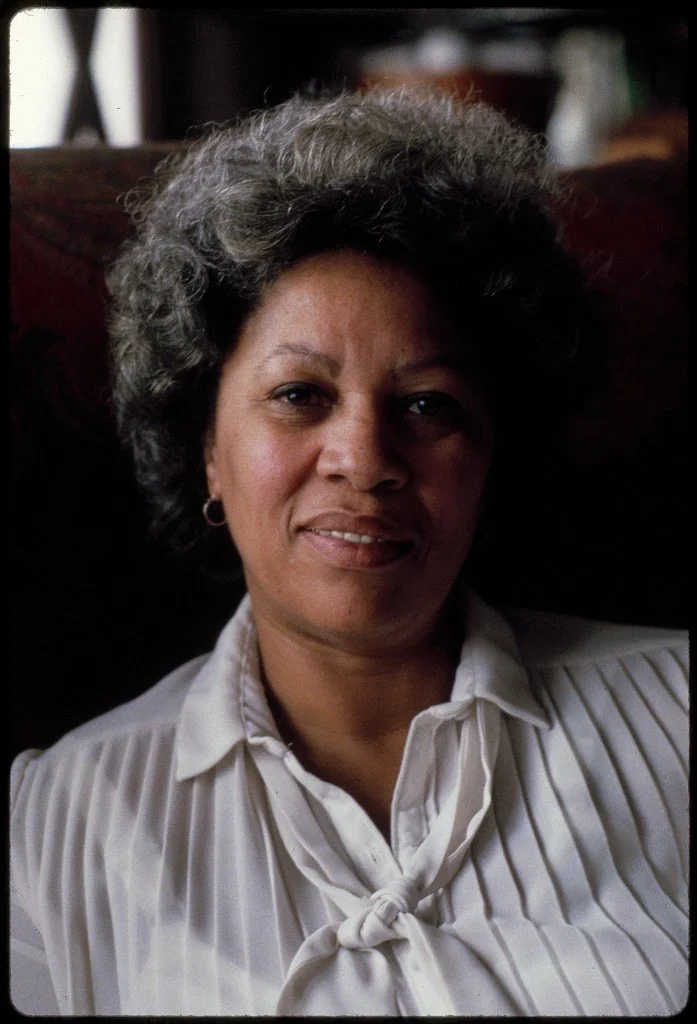
Author Photo: Toni Morrison, Photograph by Bernard Gotfryd. Library of Congress, Washington, D.C.
About the Author:
TONI MORRISON is the author of eleven novels and three essay collections. She received the National Book Critics Circle Award, the Pulitzer Prize, and, in 1993, the Nobel Prize in Literature. She died in 2019.
Language as Liberation: Reflections on the American Canon was released in February of this year by Alfred A. Knopf and is available here.
The magazine highlighted “Language as Liberation,” which can be found here. Isaac Constantine was interviewed by the magazine, which can be found here.