An Orientalist masterpiece by Osman Hamdi Bey up for auction at Bonhams in London

Osman Hamdi Bey (1842-1910), Cami Kapisinda (At the gate of the mosque). Oil on canvas. 208 x 109 cm (81 7/8 x 42 15/16 in). Estimate: £2,000,000 – £3,000,000
London – Osman Hamdi Bey's (1842-1910) major work , Cami Kapisinda (At the Gate of the Mosque) , will be the star lot of Bonhams ' 19th Century and Impressionist Art sale on March 25 at Bonhams in London . Acquired directly from the artist in 1895, this painting is being offered at auction for the first time with an estimate of £2,000,000 to £3,000,000 .
Charles O'Brien, Director of the 19th Century Paintings Department at Bonhams, commented: “ At the Gate of the Mosque is a remarkable example of the work of Osman Hamdi Bey, one of the most prominent figures in the Ottoman cultural milieu at the turn of the 20th century. The painting is being offered at auction for the first time and has an exceptional and unbroken provenance, having been acquired directly from the artist four years after its execution. It is magnificent both in its scale and its attention to detail, and as one of his earliest canvases of such monumental dimensions, it remains a perfect example of the synthesis of a contemporary urban scene with certain architectural features of a 15th-century Ottoman mosque. This greatly enriches our understanding of Orientalist art as championed by an Ottoman artist who had a remarkable ability to make Western observers believe that his scenes reflected the reality of everyday life in his homeland.” " At the Gate of the Mosque represents a major milestone in the work of one of the most fascinating painters of his time—it is certainly an exceptional opportunity for collectors."
Osman Hamdi Bey (1842–1910) received informal training in Paris with Gustave Boulanger, under the influence of the renowned Orientalist painter Jean-Léon Gérôme . Hamdi Bey was one of the first Ottoman artists to bridge the artistic worlds of Turkey and France. His works reflect, in many ways, the Orientalist themes that were so popular in Europe at the time.
Upon his return to Turkey in 1868, Hamdi Bey took a position in the government administration and was sent to Baghdad where he was director of foreign affairs, then returned to Constantinople in 1871, where he continued his career as a painter.
He was appointed director of the newly established Archaeological Museum of Constantinople in 1881, and by securing the publication of the 1884 regulation prohibiting the export of objects discovered during excavations, he gained control over antiquities. This gave him power and influence over foreign archaeologists, while also ensuring a steady supply of artifacts for the museum. Ten years into his tenure, he had achieved his goal: international visibility and recognition of his museum and its status. He thus became a figure of paramount importance and influence among Western archaeologists and the governments conducting archaeological excavations in the country.
At the Gate of the Mosque was to be exhibited for the first time at the Berlin International Exhibition in 1891, alongside two other paintings by him, Turkish Interior and In the Mosque , but was not on display at the opening. On May 24, 1891, Hamdi wrote to Carl Humann: "The large painting is finished and it left last Thursday [May 21] on the Orient Express, as the exhibition committee granted me an extension to complete it."
The painting was created as a pendant to Women in a Türbe (Mausoleum) – the artist having intended to exhibit both paintings at the 1893 World's Columbian Exposition in Chicago, but after an exhibition in Paris, Women in a Türbe (Mausoleum) was purchased by the French state. This acquisition was undoubtedly made in an attempt to curry favor with the artist, who now controlled the licensing of archaeological excavations and the export of artifacts unearthed in Ottoman territory.
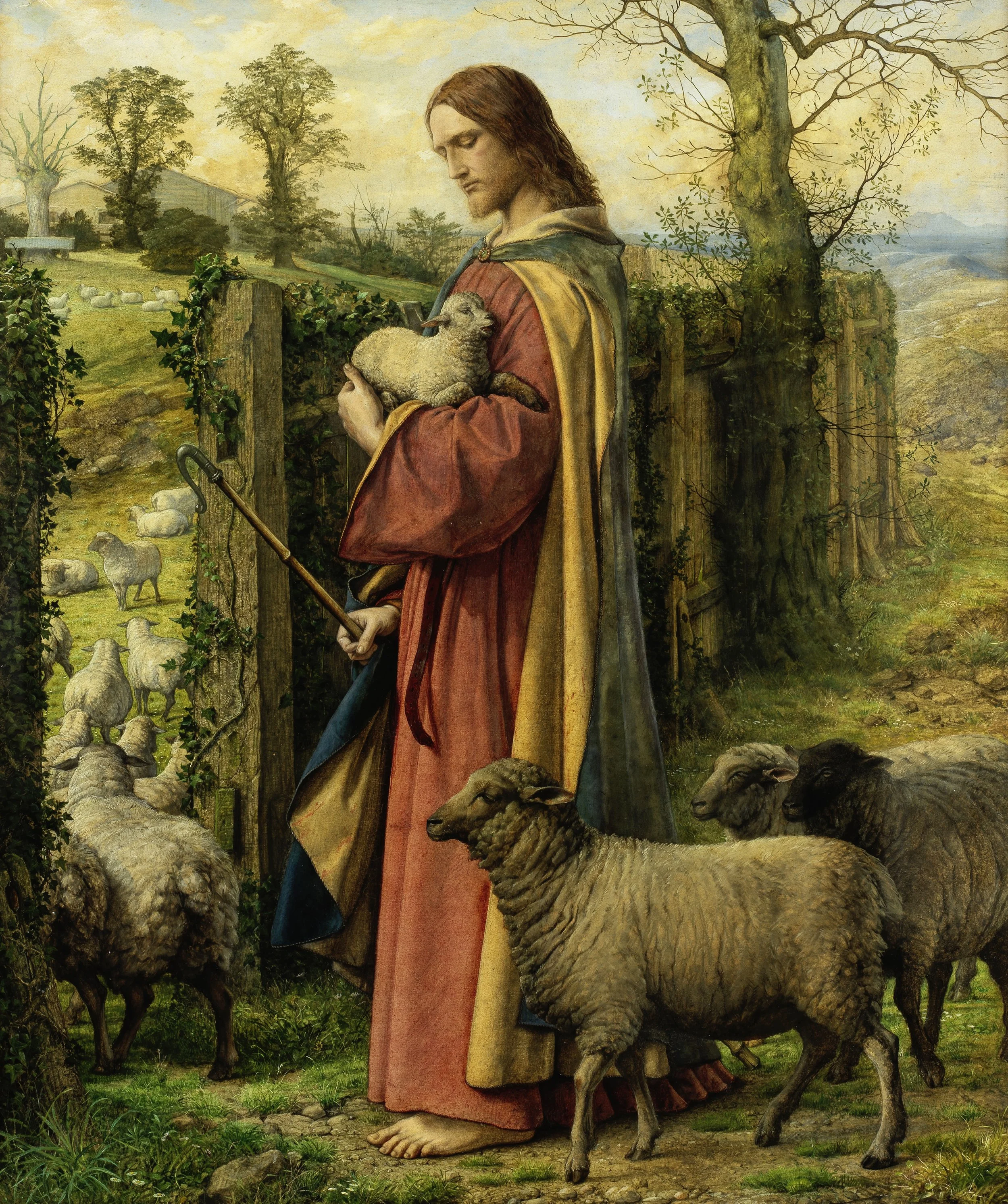
William Dyce, RA, ARSA (British, 1806-1864) The Good Shepherd Estimates 100,000 - 150,000
Sent to America for the Chicago exhibition, At the Gate of the Mosque was purchased by the University of Pennsylvania in 1895. The purpose of this purchase was to ensure the continuation of the work carried out by the University Museum's archaeological expedition at the site of Nippur. This helped to solidify the relationship between the artist and the university, and in 1897 Hermann Hilprecht, the museum's representative in Constantinople, wrote to the university to confirm that Hamdi had donated an important collection of cuneiform tablets to the museum.
The setting of " At the Gate of the Mosque" is identified as the main entrance to the Muradiye Mosque in Bursa. Four other paintings by Hamdi Bey depict the same location. There is no specific narrative or event as described in the artist's Quranic scenes. This work can be interpreted as a transition from his gentle harem scenes to a new version of Orientalism, characterized by a strong awareness of the Ottoman heritage, evident in the architectural and decorative elements, and created for a Western audience.
Although it depicts a real place, At the Gate of the Mosque is a perfect example of the artist's skill in creating an imaginary scene, combining an enlarged doorway and steps in a collage-like fashion, using intense colors and Orientalist tropes. The women wear feraces , cloaks worn outdoors. This typical attire of Muslim women in Ottoman cities contextualizes the scene as contemporary rather than historical. Only one of the books is open, and its page suggests it might be a Quran. The second book, from bottom to top in the rightmost stack, bears the inscription Kamus (Ocean), usually associated with Firuzabadi's famous Arabic dictionary. What is written on the side of the book just above is not a title, but Osman Hamdi, the artist's name, a secret signature in Arabic script. Hamdi often depicted himself in his paintings, as a model rather than a true self-portrait. In a rather exceptional way, this painting features not one, but three faces of the painter, from left to right, represented as a beggar in a suit, as a man in a turban standing and in the foreground on the right, with a turban and a rolled-up sleeve.
In 2019, Bonhams sold Osman Hamdi Bey's Young Woman Reading at auction in London for £6,600,000, a world record price for a work by the artist at auction.
About The Bonhams Network
Bonhams is a global network of auction houses, with the largest number of international salerooms, offering the widest range of collecting categories and selling at all price points. Bonhams is recognised for its bespoke service, and a dedication to local market relationships, enhanced by a global platform. With 14 salerooms, Bonhams presents over 1,000 sales annually, across more than 60 specialist categories, including fine art, collectables, luxury, wine & spirits, and collector cars.
Founded in 1793, Bonhams has representatives in more than 30 countries and operates flagship salerooms in London, New York, Paris, Los Angeles, and Hong Kong. In 2022, Bonhams added four international auction houses to its network: Bukowskis, Stockholm; Bruun Rasmussen, Copenhagen; Cornette de Saint Cyr, Paris and Brussels; and Skinner, Massachusetts. The success of Bonhams’ global strategy is a result of recognising the shift in growing intercontinental buying and increased digital engagement.
In 2023, Bonhams achieved 14% growth with $1.14 billion in turnover. Recent important auctions and landmark single-owner collections, include the white glove sales of Sir Michael Caine: The Personal Collection, Alain Delon: Sixty Years of Passion; Sir Roger Moore: The Personal Collection; Personal Property of Justice Ruth Bader Ginsburg and The Robert & Jean-Pierre Rousset Collection of Asian Art: A Century of Collecting. Other notable single-owner sales included The Estate of Barbara Walters: American Icon; The Alan and Simone Hartman Collection; The Crown Auction: Props and Costumes and The Claude de Marteau Collection.
Top lots for 2023 include 1967 Ferrari 412P Berlinetta, Sold at Quail Lodge, US for US$30,255,000. Tipu Sultan’s Bedchamber Sword (sold in London for £14m – a world record for both an Islamic and an Indian object); Paul Signac (1863-1935), Sisteron, 1902. Sold for US$8,580,000 (estimate US$4-6 million), and Claude Monet (1840-1926), La Seine près de Giverny, 1888. Sold for US$6,352,500 (estimate US$4-6m), both from the Alan and Simone Hartman Collection; A Gilt Copper Alloy figure of Virupaksha, Central Tibet, Densatil Monastery, Early 15th century. Sold for HK$37.9m (£4,060,326) in Hong Kong. Yoshitomo Nara (born 1959) Three Stars. Sold for HK$36,754,000 (£3,930,914), also in Hong Kong.
For more information about these auctions and others featured By Bonhams, please visit their site. Bonhams can also be found on Instagram, Facebook, X, YouTube, and Pinterest.